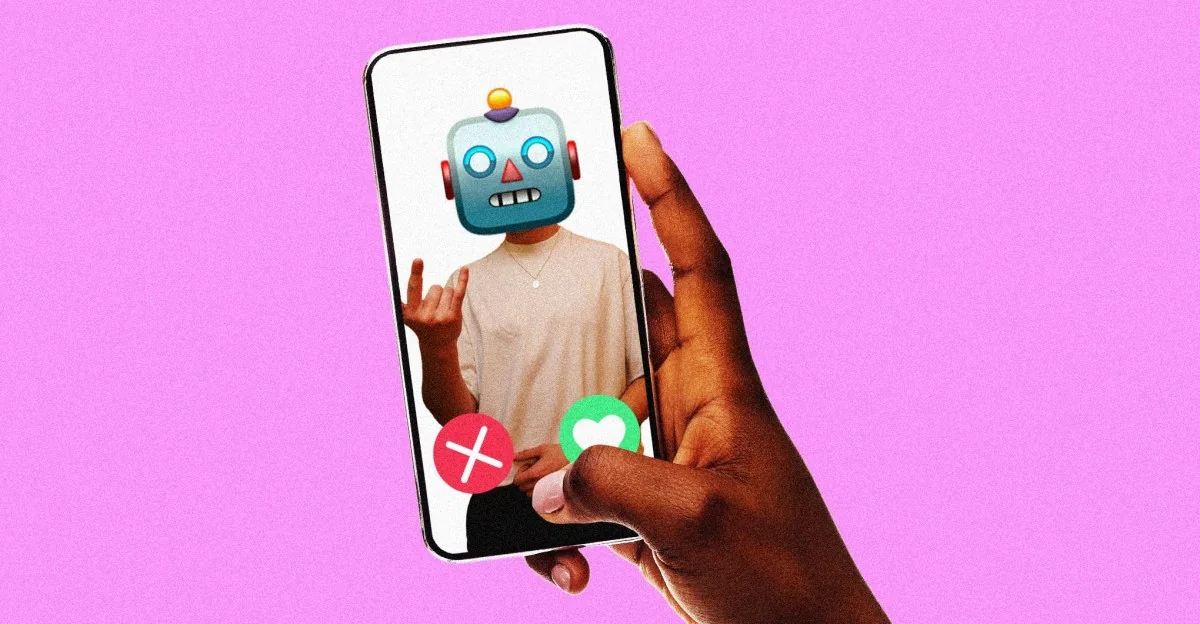
The New Romantic Divide
When Irene moved to San Francisco last year, she started using dating apps to meet new people. After downloading Hinge, the 25-year-old analyst noticed a recurring trend: users explicitly stating their opposition to artificial intelligence in their profiles.
AI is the new dating dealbreaker
Swipe left if you’re not aligned.
AI is the new dating dealbreaker
Swipe left if you’re not aligned.
Some users include prompts like “We’ll get along if” followed by explicit anti-AI statements, signaling that for many, AI has become a political or moral litmus test.
These value statements often appear in profiles of people working in the arts or nursing, highlighting a growing cultural friction between tech-centric workers and those skeptical of the industry's influence.
Existential Anxieties and Career Impact
In San Francisco, the epicenter of the industry, conversations surrounding artificial intelligence now permeate the dating scene. Responses vary from political-style opposition to complex ethical considerations regarding dating those who build these technologies.
Some individuals are wrestling with the ethics of dating someone in the industry, weighing the financial benefits against concerns about the future or the potential for AI to replace human connection.
For researchers in AI safety, the rapid development of the technology creates profound existential anxiety. Some experts consider the possibility of human extinction, which directly impacts their willingness to plan for long-term goals like having children.
“It’s hard to have that planning conversation because I don’t really expect a long-term future.”
These individuals often prefer in-person discussions to explain why they view the future with such uncertainty, as the development of AI alignment remains a critical, unresolved variable.
For now, many are focusing on finding partners with whom they enjoy spending time, regardless of the broader tech landscape.
However, skepticism remains high. Some critics of frontier AI companies view those working in the field as prioritizing paychecks over societal impact, creating a barrier to romantic connection.
Conversely, some industry professionals argue that these feelings are irrelevant to romance, viewing dating as a series of personal compatibility factors rather than a reflection of one's employer.
Despite this, the financial reality of the AI boom is undeniable. High salaries for AI researchers and engineers have made these roles highly sought after in the dating market.
With thousands of new AI jobs added to the Bay Area and upcoming IPOs for major firms, matchmakers report that clients are increasingly specifying “AI engineer” as a preferred qualification.
Automation and Human Connection
AI is also seeping into everyday habits, including how people process emotions and manage their dating lives.
Studies indicate that a significant portion of Americans are turning to AI chatbots for emotional support, sometimes sharing details they would withhold from romantic partners. This raises concerns about the potential for maladaptive behavior in relationships.
Some view chatbots as useful tools for brainstorming or expressing thoughts, while others worry about the long-term psychological implications of replacing human connection with synthetic interactions.
There is also a concern regarding how people treat these models, with some suggesting that poor treatment of AI might reflect a lack of empathy that could eventually manifest in human relationships.
“There are a bunch of people who are rich from AI, and, you know, being wealthy is always a plus.”
Beyond emotional support, some users have begun outsourcing the dating process itself to AI agents.
Some founders are using AI agents to manage swiping, initiate conversations, and book dates, viewing the process as a way to protect their time and focus on higher-leverage activities.
The use of automated scripts to mimic personal communication has become a controversial, yet increasingly common, practice among those looking to optimize their dating efficiency.
Surveys suggest that a growing percentage of singles are using AI tools to enhance their dating experiences, with major apps integrating features to generate responses or facilitate matchmaking.
For those using these tools, the goal is often to bypass the initial digital friction and secure in-person meetings, though the use of AI remains largely undisclosed to the other party.
The Singularity and Future Planning
Existential concerns are also appearing in longform dating profiles, particularly among those in the AI safety community.
Many individuals are now factoring the “singularity”—the point where technology surpasses human control—into their decisions about family planning and long-term commitments.
“Don’t want kids in the pre-singularity future, if there’s a post-singularity future then I might want kids then,” one document states.
Similar to climate anxiety, these concerns reflect a broader debate about the ethics of bringing children into a world facing significant structural changes driven by artificial intelligence.
Some view the potential for future suffering as a reason to avoid parenthood, while others find that the uncertainty of the future makes the present more meaningful.
These existential concerns have contributed to a growing backlash against the tech industry, with protests and rallies targeting major AI companies.
“If there’s a post-singularity future then I might want kids then.”
Analog Resistance
This skepticism has influenced how people evaluate potential matches, leading to a renewed interest in analog, in-person events.
At local matchmaking events, participants often joke about their reliance on human-made presentations, emphasizing a desire to move away from AI-mediated interactions.
Organizers of these events note that many tech workers are seeking community-driven, offline experiences to escape the pressures of the digital landscape.
While anti-tech sentiment is becoming more popular, many people maintain a pragmatic view, recognizing that the industry remains a primary source of economic opportunity.
Ultimately, for many, the immediate need to navigate life and career takes precedence over ideological disagreements regarding the companies they work for.