Introduction
Meet Interface, a new $99 smart ring from AI and hardware startup Natura that’s designed for the era of AI agents. With a press of your finger, you can ask an AI agent to complete a task, capture thoughts, and get things done without reaching for your phone. And while AI is at the heart of Interface, the ring also doubles as a health tracker, as it monitors metrics like heart rate, HRV, sleep, and activity.
The startup was founded by Carlo Edoardo Ferraris, who previously founded tech accessories company Rolling Square. After years of building consumer hardware, he became convinced that rapidly advancing AI needed a new kind of interface that lets people ask for what they want the way they’d ask a person.
The idea behind Interface is to help people look up from their phones while getting everyday tasks done more quickly and naturally. At launch, the ring will connect with a range of AI agents and apps, including Meta’s Muse, Instinct, Grok Bot, Claude, ChatGPT, and more.
Preorders are expected to open next month, with shipping slated for December or January.
Image Credits:Natura
Form Factor and Use Cases
The smart ring was not the company’s first product. Those were HumanPods, a pair of AI-enabled earbuds designed to let users interact with AI agents. But Natura believed it needed a new form factor built for the latest advances in voice technology.
Over time, Natura evolved to an understanding where users want continuous access to their agents. Because a ring is worn constantly and can withstand daily activities like showering and sleeping, the company views it as an ideal continuous form factor.
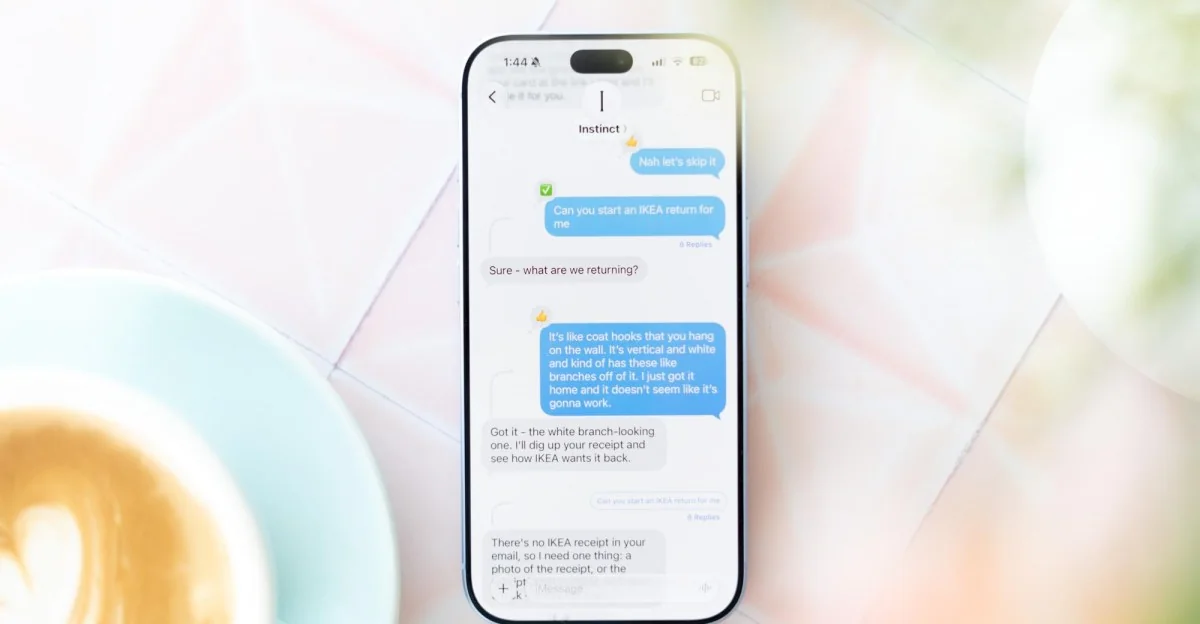
The company highlights numerous potential use cases, ranging from starting workout trackers during runs to checking daily schedules, reordering household items, controlling smart home devices, and recording meetings to generate shared notes.
Responses from agents can be delivered through connected headphones, an iPhone Live Activity, or the NatureOS app.
Users who rely on multiple AI agents and apps can specify which platform handles particular tasks, directing Claude to write code, Instinct to book reservations, or another agent for separate duties.
Image Credits:Natura
Device Control and Future Vision
In addition to managing AI agents, users can control computers and other devices. Leadership anticipates that AI agents will eventually handle most routine computer tasks, replacing screen-based interactions like filling out forms, messaging, and finding files with simple voice requests.
While personal agents are currently adopted primarily by technology-focused users, the company expects broader mainstream adoption within roughly a year.
Pricing and Health Tracking
Although the ring will launch at $99, Natura plans to eventually raise the price. After an initial three- to six-month free period, the company intends to charge a $9 monthly subscription fee.
Natura notes that manufacturing costs are comparable to established products like the Oura Ring and Samsung Galaxy Ring due to shared component usage, but the initial lower price point is intended to reduce entry barriers and drive adoption.
Image Credits:Natura
For health metrics, the ring tracks heart rate, resting heart rate, heart rate variability, sleep stages, daily movement, step count, and skin temperature trends over time.
The hardware provides a battery life ranging from six to 12 days depending on usage, and requires 100 minutes for a full recharge.
While the smart ring market includes health-focused devices from Oura, Ultrahuman, and RingConn, alongside other emerging form factors, Natura positions Interface as a combination of advanced health tracking and continuous AI communication.
The company emphasizes that the hardware integrates high-tier health monitoring and agent communication components while maintaining an extended battery life in a compact form factor.