The Emergence of GTM Engineering
Two years ago, most companies did not have a go-to-market engineer. Now the role is appearing across technology sectors, with practitioners using artificial intelligence and automation to build revenue systems that once required multiple people, tools, and manual processes.
What changed, and what does it mean for the way companies find customers and scale?
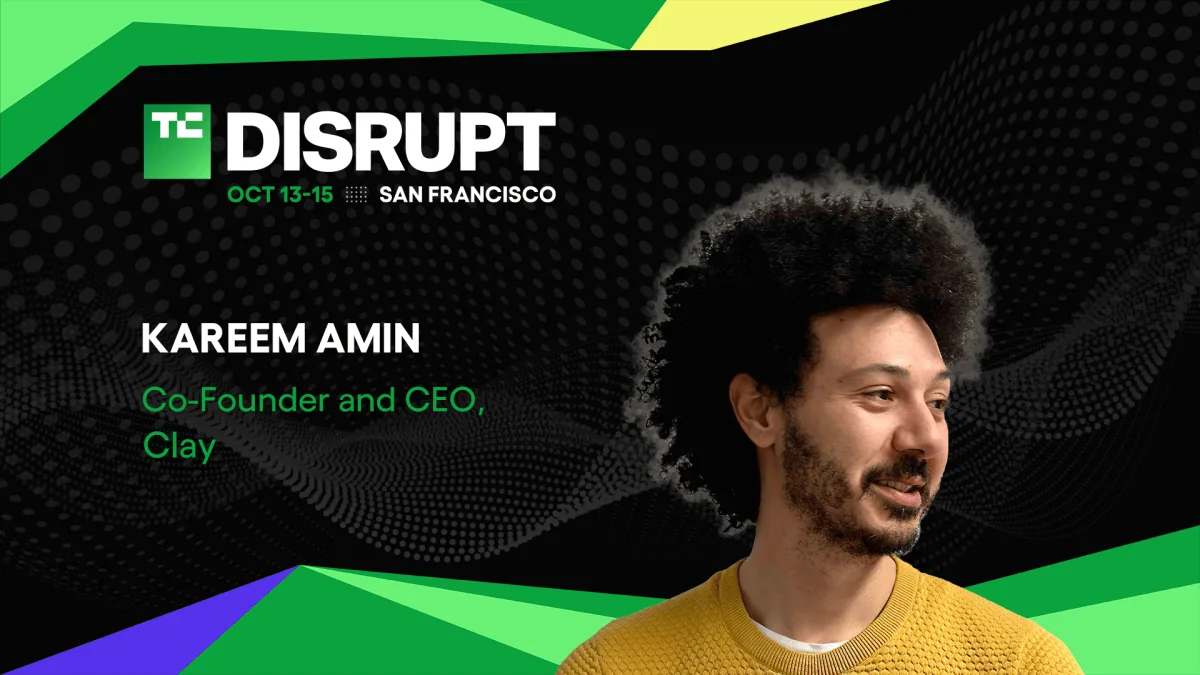
Clay co-founder and CEO Kareem Amin will address how artificial intelligence has transformed the traditional go-to-market stack and helped create a new technical discipline, offering a look at what AI-native go-to-market strategies look like in practice.
Image Credits:TechCrunch
Artificial intelligence is giving go-to-market teams new ways to research prospects, work with data, personalize outreach, and automate workflows that once moved between separate tools and teams. As those capabilities converge, companies are rethinking not only their technology stack, but also who builds and manages the systems behind growth.
If you’re building a company or rethinking how your team approaches sales, marketing, and growth, this is a new role worth understanding. Secure your Disrupt pass and see where GTM engineering fits into the next generation of go-to-market. Get a second pass at a 50% discount, and more savings for groups of four or more.
Daily Operations and Workflows
Traditional go-to-market work can involve hours of researching accounts, cleaning data, qualifying leads, preparing outreach, and moving information between systems. Go-to-market engineering uses artificial intelligence, data pipelines, and automation to turn more of that manual work into repeatable systems.
Clay coined the role in 2023. Its internal guides describe these engineers as practitioners who build automated revenue workflows rather than executing individual tasks by hand. Roughly 100 similar job listings now appear each month, including roles at companies such as Cursor, Lovable, and Webflow.
For founders and leaders deciding where to allocate resources or make their next hire, this shift offers another way to think about growth. Organizations must weigh whether to add headcount to execute existing processes or build systems that allow current teams to operate differently.
At Disrupt, Amin will put the shift into context and explore what AI-native GTM looks like in practice. Get your ticket to Disrupt to understand a role that barely existed a few years ago but could change how your next sales, marketing, or growth team operates.
Infrastructure and Growth
Clay started in Brooklyn in 2017 with the goal of giving more people access to programming capabilities. Its original spreadsheet let users connect information and automate work without writing code. When sales, growth teams, and agencies began using it to find and reach customers, the platform evolved to focus on go-to-market operations.
Today, the company provides infrastructure for go-to-market teams to access data, run agentic workflows, and launch campaigns. Its OpenAI-powered agent, Claygent, automates research and outreach for sales, marketing, and recruiting teams.
That evolution has been accompanied by rapid growth. The company tripled its annual recurring revenue to $100 million within a year and completed a tender offer at a $5 billion valuation, followed by a $115 million Series D funding round at a $7.1 billion valuation.
Clay is also investing directly in the job category by establishing a $1 million scholarship fund to train go-to-market engineers.
For companies trying to determine where AI can make a meaningful difference in revenue operations, add Amin’s session to your Disrupt agenda and see how one company is putting that model into practice.
Leadership Background
Kareem Amin co-founded Clay in 2017 and serves as its chief executive officer. Before that, he was vice president of product at The Wall Street Journal and co-founded collaboration startup Frame, which was acquired by Sailthru in 2012.
Amin started Clay around the idea of putting programming capabilities into more people's hands. Artificial intelligence eventually gave that concept a new application: enabling commercial teams to build systems that automate research, data enrichment, and outreach without relying on traditional engineering resources for every workflow.
Want to understand what a GTM engineer could mean for your own growth strategy? Secure your Disrupt pass and hear directly from one of the founders helping define the category.
Industry Outlook
Go-to-market engineering addresses a fundamental challenge: finding and reaching the right customers without simply adding headcount and software bloat. As artificial intelligence continues to mature, organizations are actively redefining how their sales, marketing, and growth teams operate.
“The GTM Engineer: How AI Created Tech’s Next Big Job Category” is one of 200+ sessions across six industry stages, roundtables, and breakouts at Disrupt, taking place October 13-15 at Moscone West in San Francisco. More than 10,000 founders, investors, operators, and tech leaders are expected, along with 250+ speakers and 300+ exhibiting startups.
In addition, matchmaking, dealmaking, and networking give attendees opportunities to meet potential customers, investors, partners, and other founders confronting many of the same growth challenges.
Secure your pass to TechCrunch Disrupt 2026 and add “The GTM Engineer” to your agenda. Bring a colleague, partner, or peer with a 50% discount, or enjoy additional discounts with groups of four or more.
Image Credits:Eric Slomonson, The Photo Group