Asustor AS6702T v2: 30-second review
Asustor is the storage division of Asus, offering network-attached storage units designed to sit between basic consumer boxes and enterprise servers. The Lockerstor range targets prosumer and small-business environments.
The Lockerstor 2 Gen2+ (model AS6702T v2) refreshes the older 2022 hardware generation. The primary upgrade is networking, moving from dual 2.5GbE ports to dual 5GbE ports, while the remaining hardware largely carries over, retaining the Intel Celeron N5105 processor and 4GB of RAM.
Positioned as a specialized device, the NAS includes four M.2 slots alongside two SATA drive bays, an HDMI output, and two 10Gbps USB ports housed inside an all-metal chassis. Because it utilizes an x86 processor, it supports Docker containers and virtual machines, making it suitable for users prioritizing flexibility and network speed.
Market competition is fierce, with rivals offering newer processors and lower price tags. However, the Asustor model attempts to counter this with superior build quality, extensive storage flexibility, and a longer warranty.
Overall, the AS6702T v2 functions as a capable two-bay NAS tailored for fast networks and NVMe storage pools, though its pricing structure limits its appeal as a pure value proposition.
Asustor AS6702T v2: Price and availability
Pricing for the unit starts around $517 / £486 / €616 depending on the region and retailer, making it a substantial investment for an unpopulated two-bay NAS.
The device is currently available through major online retailers worldwide.
Purchasing options include online vendors such as Amazon and Newegg.
While the manufacturer suggested retail price sits higher, street prices generally hover around $516.99 in the United States.
Pricing varies significantly across international markets, with European and UK customers facing notable conversion inflations.
When compared directly against alternative options on the market, the hardware commands a noticeable premium over competing two-bay enclosures.
Alternative options from competing brands offer lower entry costs, though often with compromises in processor capability or expansion slots.
The primary justification for the cost is high-speed connectivity and storage expansion versatility rather than immediate cost savings.
Review observations suggest the pricing tier feels somewhat elevated relative to the included base memory and processor specifications.
Asustor AS6702T v2: Design
Metal chassis
Screwed trays
Hidden slots
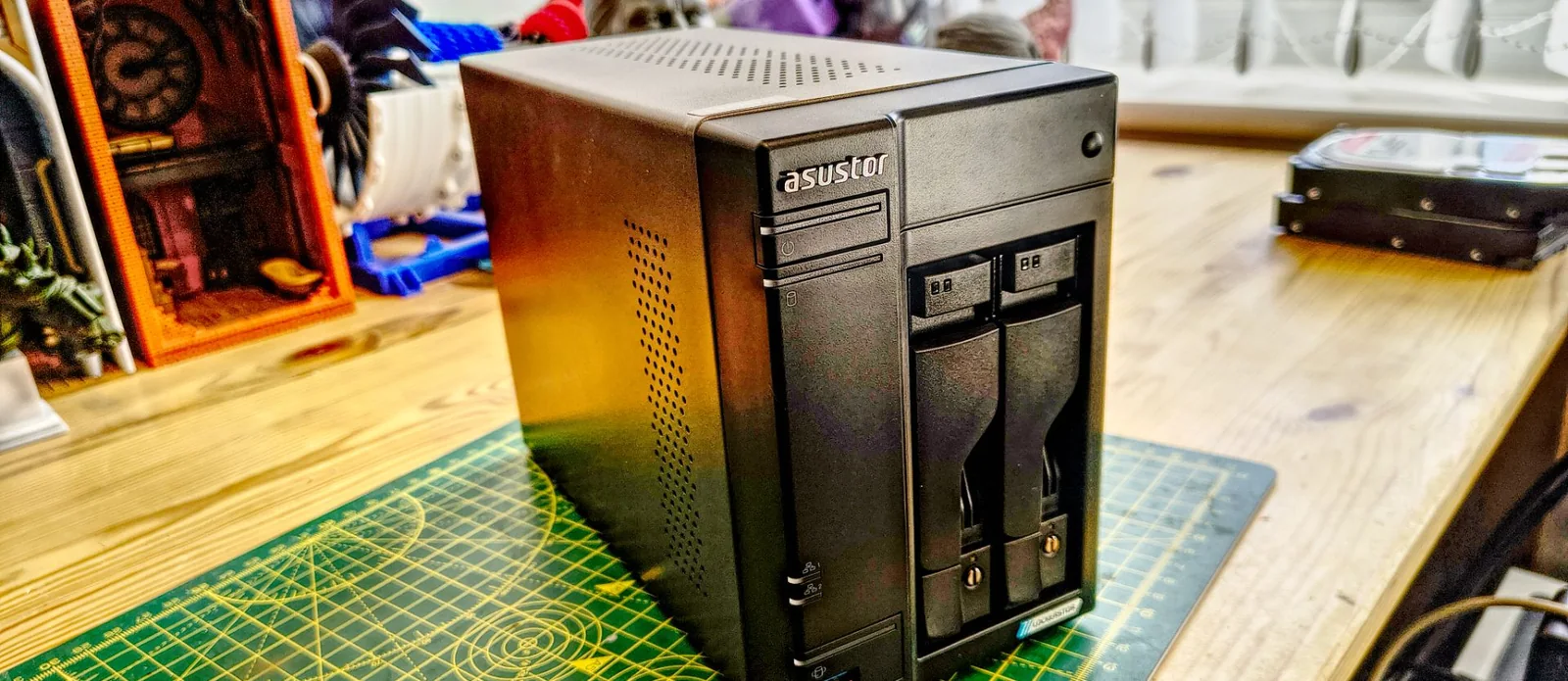
The enclosure utilizes a utilitarian black metal chassis with a plastic faceplate, matching the aesthetic of business-focused storage devices. It measures a compact 163.5mm tall, 108mm wide, and 230mm deep while maintaining a solid weight of 2kg.
Front-accessible drive bays feature secure latches alongside status LEDs and a front-facing USB port. The rear panel houses the dual 5GbE connections, additional USB ports, HDMI video output, and a quiet cooling fan.
Physical installation requires traditional screws to mount 3.5-inch drives into their respective trays, lacking the toolless mechanisms found in many modern enclosures.
The reliance on traditional screw mounting feels antiquated given the premium price point of the hardware.
Toolless installation trays have become an industry standard across most major competing manufacturers.
Internal hardware upgrades require dismantling the case by removing multiple screws. While M.2 solid-state drives install toollessly once the chassis is opened, the factory RAM module resides on the underside of the mainboard, necessitating deeper disassembly.
Competing products often provide external service panels for straightforward memory upgrades without requiring full case disassembly.
The retail package includes the power adapter, ethernet cables, and mounting hardware. A 70mm cooling fan keeps acoustic levels low during idle states, ensuring quiet desktop operation.
Asustor backs the hardware with a reliable three-year manufacturer warranty, matching top competitors in support duration.
Asustor AS6702T v2: Features
Celeron N5105
Four M.2 slots
Dual 5GbE
Under the hood, the device utilizes the quad-core Intel Celeron N5105 processor with integrated UHD Graphics capable of handling hardware-accelerated media decoding and transcoding tasks.
While sufficient for basic tasks, the processor choice feels dated compared to newer, more efficient silicon found in competing contemporary devices.
The processor remains capable of routine file serving, backups, and light containerization, but lacks the raw processing headroom of newer platform architectures.
System memory is constrained by a single pre-installed 4GB DDR4 SODIMM module and an empty secondary slot, reaching a platform ceiling of 16GB total capacity.
The memory controller permits single-channel mixed-capacity upgrades, providing flexibility to expand RAM beyond factory limits, though remaining well below ceilings offered by competitor platforms.
The inclusion of four M.2 NVMe slots serves as a standout physical attribute, allowing diverse configurations for storage pools or caching.
These M.2 slots accept standard 2280 NVMe drives and support advanced RAID configurations (RAID 5, 6, and 10) that cannot be achieved using only the two primary SATA bays.
Each M.2 slot operates at PCIe 3.0 x1 speeds, capping individual drive throughput around 1GB/s, which remains plenty fast enough to saturate network links.
Alternative options on the market occasionally feature faster PCIe lane allocations, allowing higher aggregate solid-state throughput.
Utilizing SSDs as a read/write cache significantly accelerates operations, though pairing the system with an uninterruptible power supply is recommended to protect cached data volumes.
Networking capabilities represent a major highlight, featuring dual RJ45 ports running at 5GbE with backwards compatibility for slower switch speeds and link aggregation support.
Traditional mechanical hard drives cannot fully saturate the high-bandwidth 5GbE connection speeds without utilizing an SSD caching tier.
There is no direct built-in 10GbE upgrade path via expansion cards on this specific two-bay model.
High-speed USB ports allow connection to external multi-bay expansion units, scaling total drive capacity significantly if required.
While expansion enclosures offer massive storage scaling, purchasing dedicated multi-bay NAS hardware is often more cost-effective than adding expansion boxes to a two-bay unit.
Power consumption remains modest during operation and disk hibernation modes, maintaining an efficient operational overhead.
Official storage capacity limits are easily exceeded by modern high-capacity mechanical hard drives as they become available on the market.
Ultimately, the platform provides excellent networking and storage flexibility while remaining constrained by its older processor architecture and limited RAM ceilings.
Asustor AS6702T v2: Software
ADM 5.1
No flexible RAID
TrueNAS and UNRAID possible
The NAS runs Asustor Data Master (ADM) 5.1, introducing modern security features such as post-quantum cryptography support and hybrid TLS encryption.
Initial system setup is straightforward using network discovery tools, though full initialization times vary depending on drive configurations and capacity.
Building large storage volumes and configuring SSD caches can extend setup times considerably, requiring patience during initial deployment.
The ADM interface resembles a simplified Linux desktop environment, offering an application hub with software packages for media streaming, backups, and containerization.
Certain applications lack the depth and refinement found in competing operating systems, with limitations in surveillance management and snapshot flexibility.
ADM 5.1 functions as a competent operating system, though it stops short of being groundbreaking.
File system choices include Ext4 and Btrfs, the latter supporting Write Once, Read Many (WORM) immutable volumes for enhanced ransomware resistance.
The software lacks a flexible proprietary RAID migration tool equivalent to features offered by some competitors, meaning mixed drive sizes can result in wasted storage capacity.
Direct local video output via HDMI is supported through portal applications, providing alternative media consumption methods.
While ADM provides a solid operational foundation for home users and small offices, the software alone is rarely the primary selling point for the hardware.
Asustor AS6702T v2: Performance
5GbE speed
Hard drive limits
NVMe pools
While dual 5GbE ports promise high throughput, mechanical hard drive speeds ultimately constrain real-world transfer rates during standard file operations.
Testing with mechanical drives in a mirrored configuration yields steady read and write metrics restricted primarily by network switch limitations.
System RAM assists with caching operations when dedicated SSD cache pools are absent, maintaining stable data transfer speeds.
Alternative RAID array configurations demonstrate expected throughput variations depending on striping and redundancy settings.
Rebooting the system following configuration changes helps stabilize network performance metrics up to the maximum capacity of connected network infrastructure.
The high-speed 5GbE ports provide limited benefit when utilizing mechanical hard drives alone, especially given the relative scarcity of 5GbE network switches.
Utilizing fast solid-state storage pools allows the unit to approach its high-speed throughput claims, particularly when leveraging link aggregation.
Achieving maximum theoretical network performance requires matching multi-gigabit host hardware infrastructure.
Asustor AS6702T v2: Final verdict
The AS6702T v2 is a capable, well-constructed network storage enclosure that addresses networking speed requirements within a compact two-bay form factor.
However, its hardware configuration feels optimized for a market where high-speed NVMe storage components are significantly cheaper.
Surrounding the headline features are aging components, including the legacy Celeron processor, restricted memory capacity, and irritating physical assembly requirements.
Pricing assumptions place the device at a premium tier against competitors offering comparable or superior build quality.
Competitive models frequently ship with stronger processors, increased baseline RAM, and high-speed ports at lower price points.
Users with multi-gigabit networks requiring NVMe storage pools will find specialized utility here, while general buyers should explore alternative offerings.
Buy it if...
You operate a high-speed multi-gigabit network environment. The dual network ports support link aggregation and channel bonding to maximize throughput when paired with fast storage pools.
You require extensive M.2 NVMe storage flexibility within a compact physical footprint, offering unique configuration options uncommon in standard two-bay enclosures.
Don't buy it if...
You are working within a strict budget. Alternative market options provide newer processors and increased baseline memory for substantially less money while delivering comparable speeds.
You require a future-proof processing platform. The aging processor and limited RAM ceiling struggle with heavy containerization or virtualization workloads compared to modern alternatives.
For alternative storage solutions, explore curated guides covering the best network-attached storage hardware available.



