Introduction to Maestro
Cadence, one of the largest electronic design automation companies, has unveiled Maestro, its new portfolio of domain-specialized AI models tailored for its chip design agents. In initial results compared with general-purpose AI models, Cadence claims up to a 30% improvement in the quality of results and that Maestro effectively uses fewer tokens for the same task, with up to 5x the token efficiency. The first models are scheduled for select early access customers in Q4 2026, and customers may run them on Cadence’s cloud, public clouds, or customer-controlled on-premises environments and post-train them on their own proprietary data, designs, and workflows.
This approach is distinct from competing specialized models like those on hosted infrastructure without using customer data to train the model. Company executives noted that agent costs have steadily increased, making it a natural step to move more of the agents’ iterating into the weights of the models themselves.
Super Agents and Reinforcement Learning
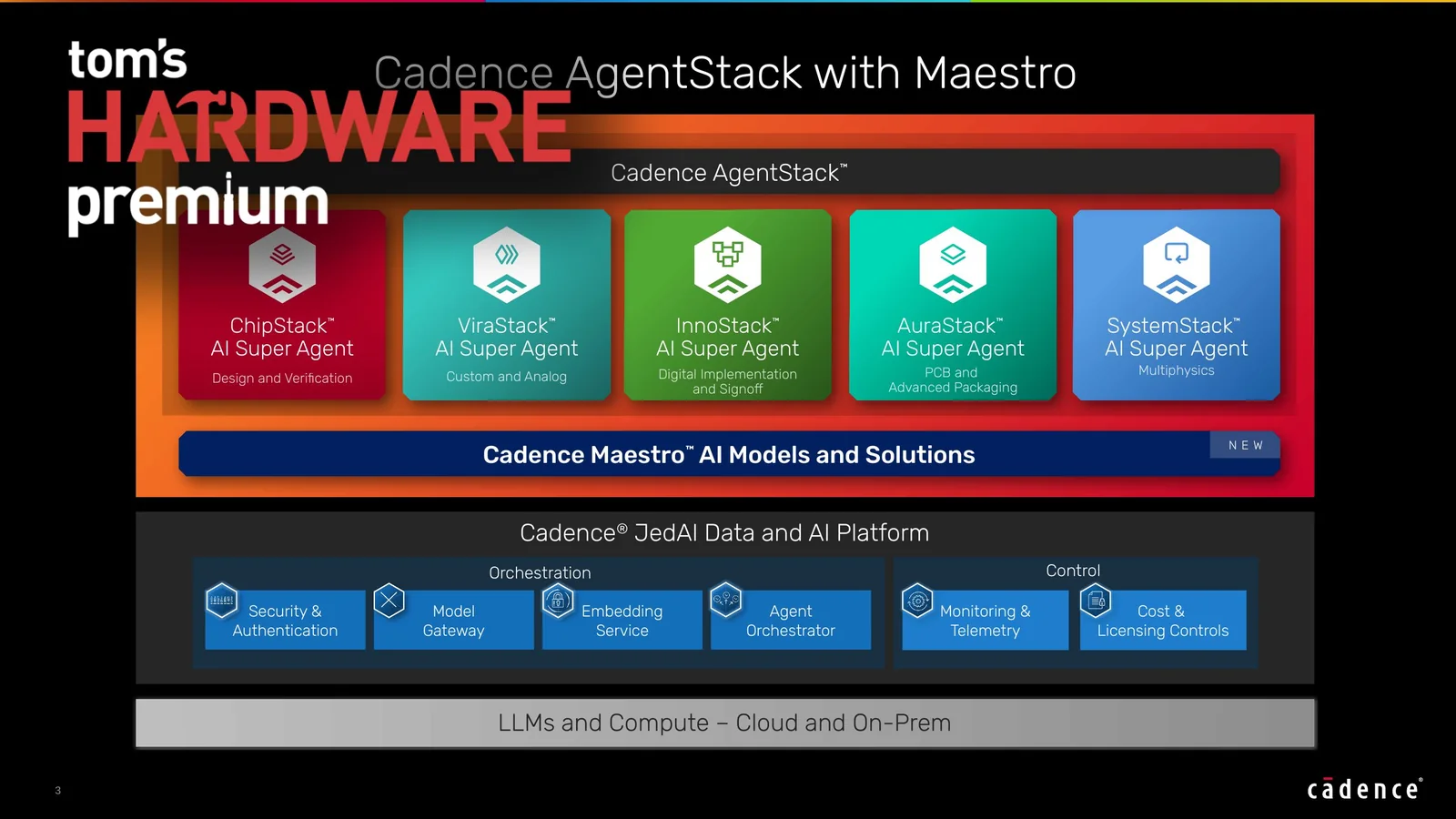
Maestro operates through AI Super Agents which interpret design intent, decompose tasks, and orchestrate the Maestro portfolio with other leading frontier and open-weight models, evaluating trade-offs to guide decisions with domain expertise. It also utilizes reinforcement learning, where deterministic solvers evaluate outputs against engineering objectives, constraints, and ground truth, feeding results back into the models for continuous improvement.
The models include Nvidia’s Nemotron, and customers can execute the customer-data training step themselves with Cadence’s fine-tuning harness on their own hardware and network infrastructure.
Performance Metrics and Efficiency
In chip design, quality of results typically refers to the design’s power, performance, and area. Both the 30% quality improvement and the 5x token efficiency figure are measured against a general-purpose foundation model from which Maestro was initially derived before specialized training.
Cadence attributes the token savings to balancing electronic design automation tool calls with large language model invocations, ensuring the right model is utilized for the right task at the right time.
Runtime remains a critical factor in chip design, where traditional tool calls can take hours or days to return values. Improved efficiency helps manage computing costs, as Maestro use counts toward agent pricing subscription models.
Deployment Options and Security
Flexibility remains central to enterprise deployment, allowing customers to choose among commercial, open-source, and fine-tuned language models across managed and customer-managed deployments. For agent security and sandboxing, Cadence is working with Nvidia on integrations to help protect customer intellectual property.
Customer Adoption
Cadence has experienced steady engagement with its design and verification agents across multiple customer implementations, with several major silicon firms expressing interest in incorporating Maestro into their workflows.
The company’s agentic consolidation strategy incorporates reinforcement learning loops, domain-specific post-training of open-weight models, and model routing to support its suite of super agents.
This rapid pace of progress requires a clear distinction between early access and general availability as platforms and agents continue to evolve through ongoing customer engagements.
Cadence aims to gather more quantifiable benefits and case studies through upcoming quarters, bringing agentic artificial intelligence natively into the electronic design automation vertical.