Fractal arguably kicked off the wood accent PC trend with the North line, and the company says its new Summit case is built for “...expressive, high-performance systems combining distinctive Scandinavian design and advanced cooling potential.” The chassis sports FSC-certified wood (timber verified to come from responsibly managed, socially beneficial, and economically viable forests) for details like the front surround and solid wood feet. There’s no doubt it’s a good-looking case, but if you want to show off the wood, you’ll want to stick to the Chalk White or Black versions, as it blends in with the Blackout SKU we tested.
Design and Aesthetics
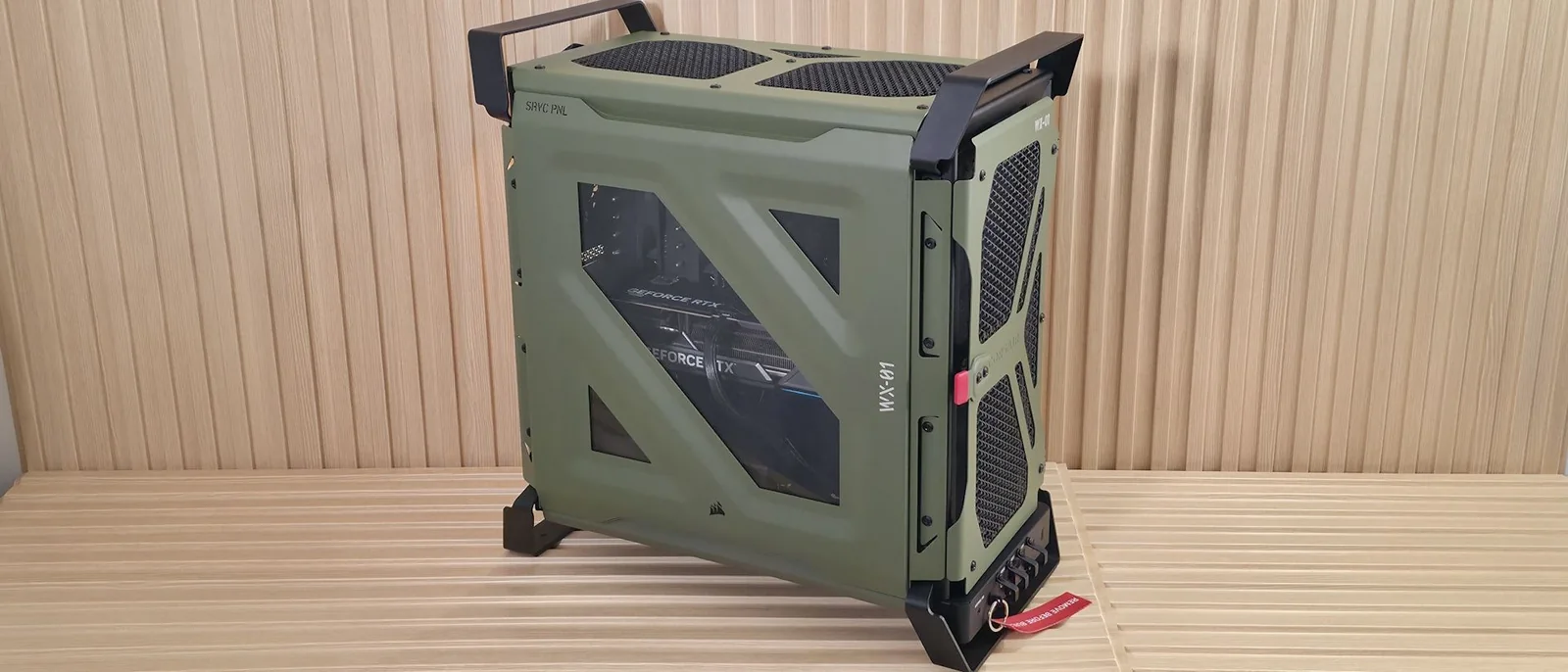
Corsair’s latest case, the Warthog, is a military-inspired chassis that resembles a fuel canister you’d see on military vehicles. Based loosely on the Vengeance C70 case from 2012, the new Warthog evolved into a much better-looking, more functional chassis for today’s hardware in either of the two colorways.
The Warthog does resemble its predecessor, and Corsair borrowed some features from the C70 while updating the design with an even more rugged exterior, significantly more expansion options, and an emphasis on excellent airflow throughout the chassis, and the company largely succeeded.
The Warthog updates include the InfiniRail Fan Mounting System for flexible fan mounting, a pegboard motherboard tray for custom cable management, room for today’s massive video cards, and three mounting locations for 360mm radiators and 13 120mm fans. It even has bump guards on the front I/O for that all-in military aesthetic. The fighter jet-style front IO includes USB ports, one fast USB 3.2 Gen2x2 Type-C port, plus an on/off button for a unique integrated light on the back of the case that illuminates the rear IO area.
If you’re into the military look, the Corsair Warthog priced at $179 and the Warthog RS at $199 with fans absolutely nails it, with plenty of other features that make it a compelling mid-tower chassis. Below are details regarding the exterior and interior features encountered during the build.
Features of the Warthog
External Features
External Features
Externally, the Warthog doesn’t look like many other cases. Sure, it has the general shape of a classic mid-tower, but the front and windowed panel break up the monotony we’re used to, with bars resembling a fuel tank breaking up the window pane and front of the chassis. The front and side panels also use Corsair’s steel 3D-Y perforations for increased airflow, and they look different from most other cases. It also has a military-inspired front I/O, sturdy built-in steel handles, and the familiar army olive drab color alongside a black variant.
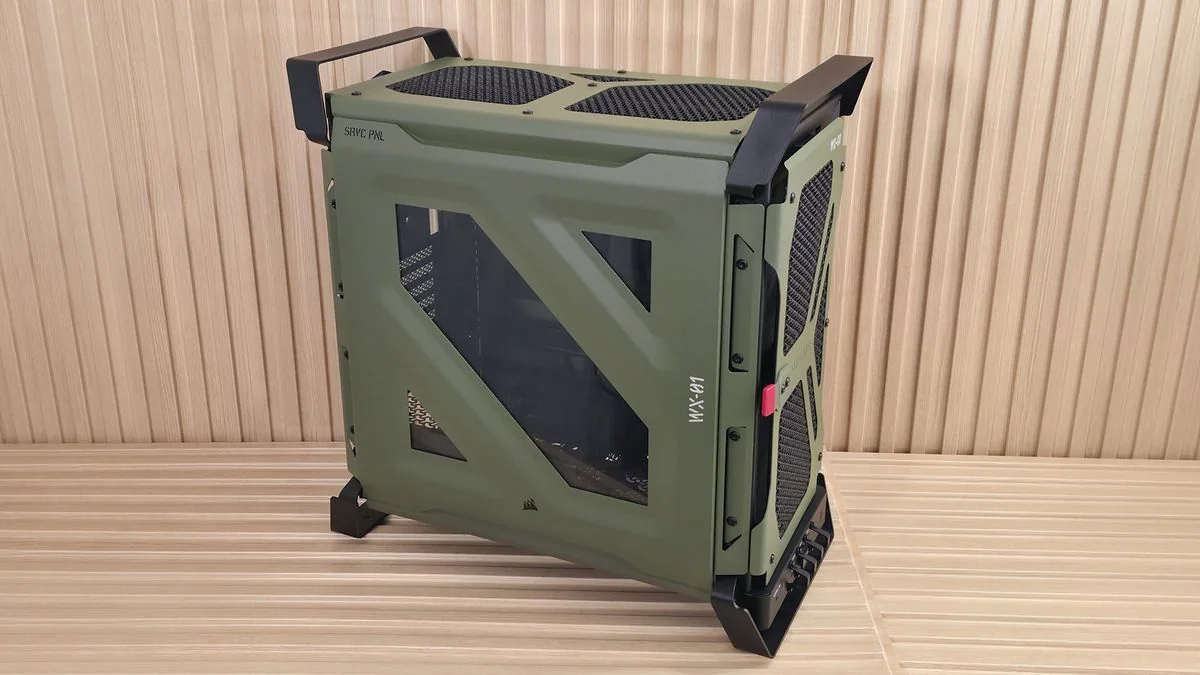
Looking more closely at the front of the case, we get a better view of the door that covers the front panel fans. We get a close-up of the contrasting black 3D-Y perforations, which are said by Corsair to allow 12% better airflow. Next to the red handle, Corsair stamps the model WX-01 in white on a thin crossmember in the upper-right corner, while it is WX-02 for the black SKU. Pull the red tab on the left, and it opens via two hinges on the right, revealing the magnetically attached dust filter.
At the bottom of the front panel is the fighter-jet-inspired I/O panel, complete with bump guards and a flip-up cover over the reset button. Port-wise, it includes a 3.5mm audio jack, a recessed power light, a USB 3.2 Type-C port, a square power button, a flip-up reset button, a light button, and two USB Type-A ports. The tempered-glass side panel features diagonal ribs that reinforce the glass while adding to the rugged look. The other side panel is solid with side venting matching the 3D-Y pattern and an internal magnetic dust filter.
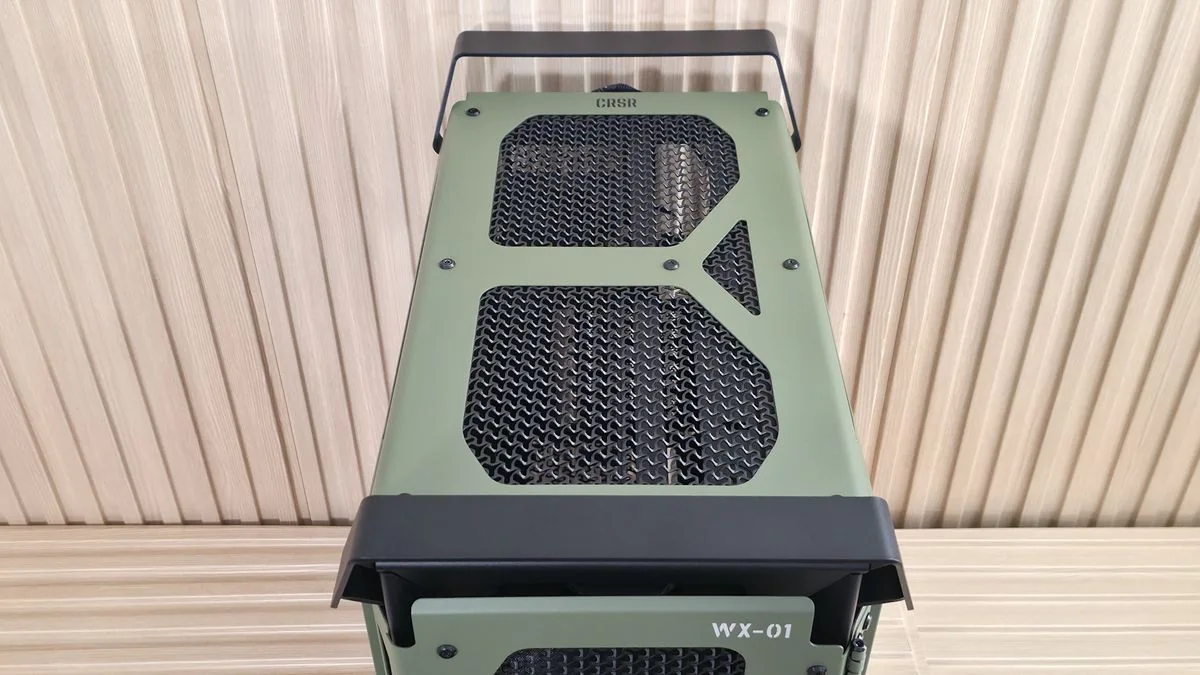
At the top of the case, there are more 3D-Y perforations for airflow. Users can easily remove the top panel for easier access to the Infinirail fan and radiator mounts by loosening the thumbscrews on the back, removing both side panels, and pulling the nylon strap.
Flipping the case around, the power supply sits at the bottom with two captive screws for toolless mounting. Above it, seven vertical expansion slots offer room for large graphics cards and expansion cards. The Warthog also supports vertical GPUs up to three slots wide with an optional riser accessory. A small light is installed above to illuminate the rear I/O area when plugging in cables.
On the bottom of the case, a removable dust filter slides out from the windowed side of the chassis, avoiding the need to move the heavy case to access it.
Internal Features
Internal Layout and Cooling
Inside the case, we see a single-chamber design with visual separation only between the power supply area at the bottom and the rest of the chassis, alongside an adjustable GPU support strut.
The motherboard tray has cutouts for wiring, though space to route larger connectors like the ATX cable is tight, occasionally requiring the frame to be flexed. There are no rubber grommets inside the holes. The pegboard feature allows custom cable management on the back side, and the case fully supports rear-connect motherboards including Asus BTF, Gigabyte Stealth, and MSI Project Zero.
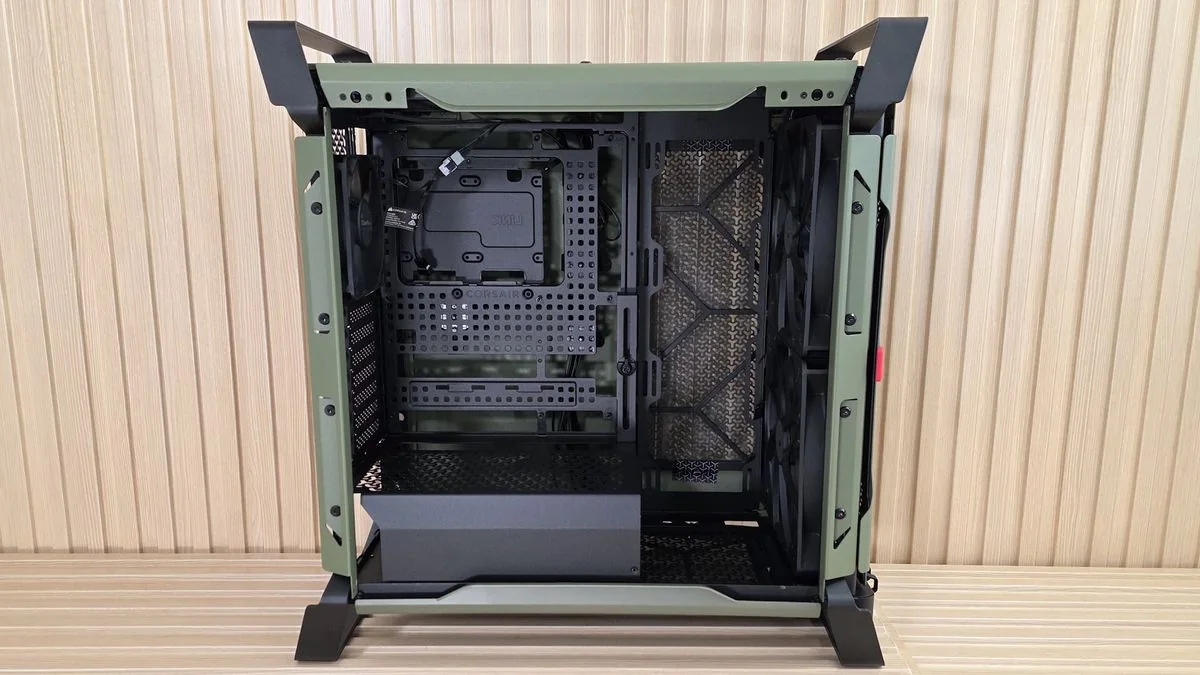
Looking at the front of the case from the inside, the RS version includes pre-installed 200mm RS fans. Corsair states these magnetic half-dome-bearing fans spin up to 1,000 RPM and move up to 135 CFM of air at 36.5 dBA. The front area supports up to three 120mm fans or radiators.
The top ceiling features Corsair’s Infinirail system, which lets users slide and position fans and radiators where needed. While the case fits up to three 120mm radiators at the top, they may protrude and cover the top of the motherboard, making it advisable to mount the motherboard and connect EPS plugs beforehand.
At the bottom rear, the power supply area is vented into the rest of the chassis, drawing filtered, cool air from below to minimize heat radiation.
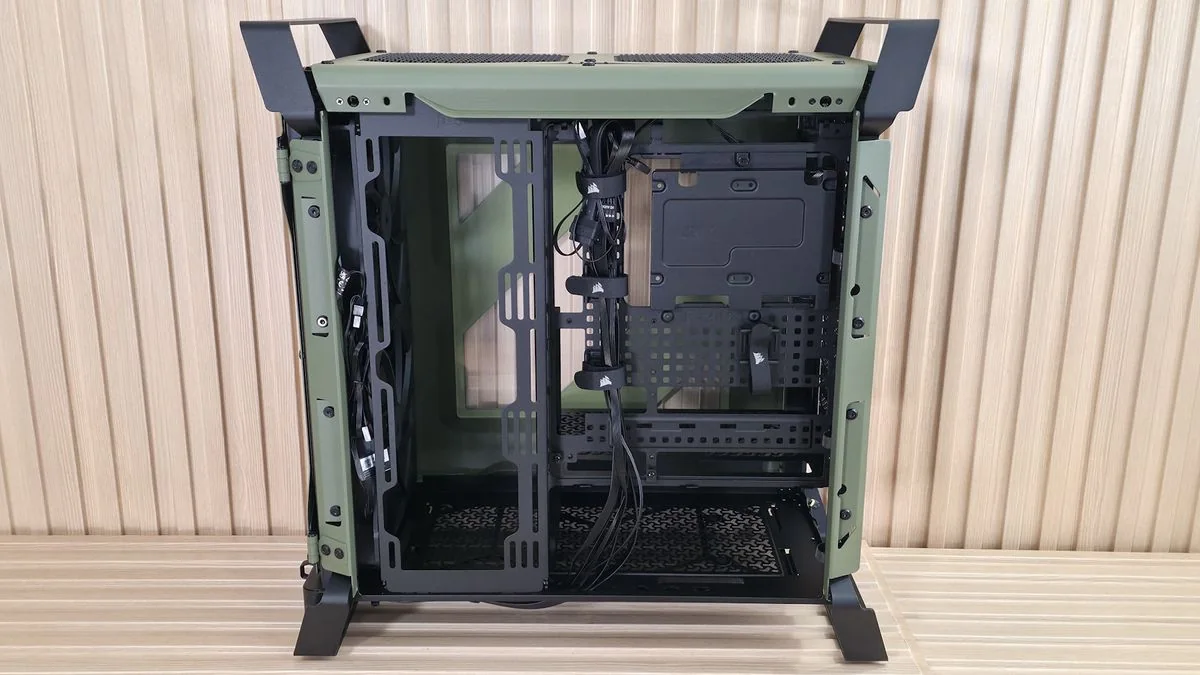
Opening the opposite side panel reveals 50mm of space between the motherboard tray and the outer panel, offering ample room for cable routing. The pegboard motherboard tray utilizes Corsair’s RapidRoute 2.0 cable management system with movable ratcheting strap mounts. Drive mounting uses a combo plate connected via a thumbscrew that supports two 2.5-inch drives and one 3.5-inch drive, though it must be removed to access the back of the motherboard.
Overall, the rugged military-themed case stands out among standard designs, particularly in the olive drab colorway. It offers plenty of internal room for components and multiple radiators, though its polarizing aesthetic means buyers will either embrace the look or pass on it entirely.