Lawsuit Filed in Delaware
Two former Groq engineers are suing Groq’s former board and former CEO Jonathan Ross, alleging the board handed over employees and company technology to Nvidia in a $20 billion deal. The proposed class action, filed in Delaware’s Court of Chancery by Benjamin Serebrin and Joshua Rubin, alleges the deal, with a $17 billion license fee for backers and a separate $3 billion Nvidia stock pool for transferring engineers, kept billions from other shareholders. Meanwhile, Groq is planning to deploy its own technology, now Nvidia’s Groq 3 LPX, according to reports.
Nvidia’s annual report books $14.4 billion of the license as goodwill primarily attributable to the workforce and future development, plus $2.5 billion for the technology itself. The plaintiffs concede that no Delaware decision has directly answered the question raised by the case, which is already under a reported Department of Justice inquiry. Groq told media outlets that the suit is meritless and that its licensing agreement delivered exceptional value for Groq, its investors, and its employees.
LPU Specifications and Hardware
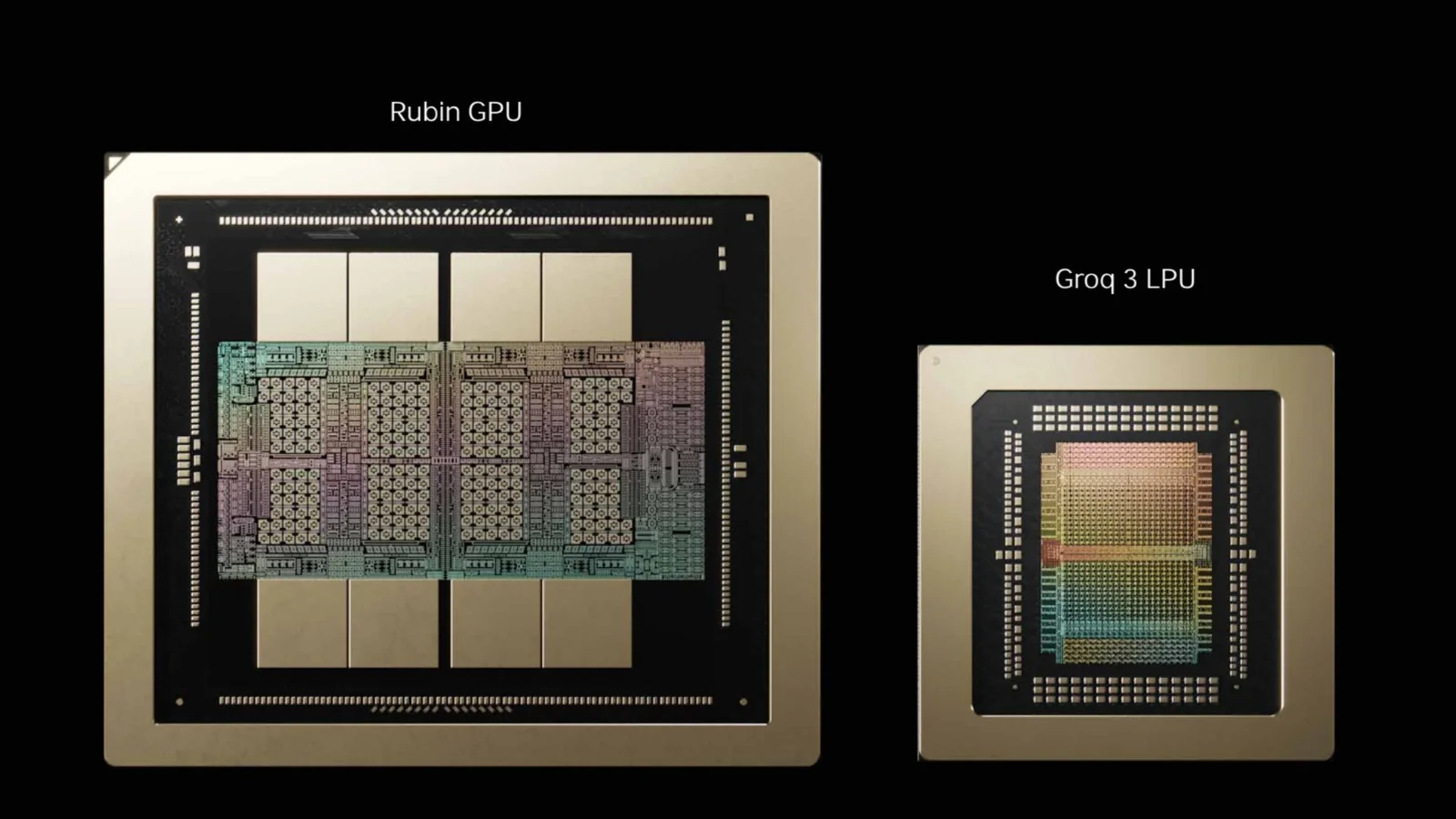
The deal involved both LPU technology and the people who built it, including Ross, a former Google TPU engineer who founded Groq in 2016. The LP30 has 500MB SRAM per die and 150 TB/s bandwidth, uses Samsung’s 4nm process technology, and is rated by Nvidia at up to 1.23 FP8 PFLOPS. A single LPX rack has 256 LPUs with 128GB SRAM, 40 PB/s, and 315 FP8 PFLOPS in aggregate as a decode co-processor for Vera Rubin NVL72.
During an industry event, Igor Arsovski, Groq’s former chief architect and now Nvidia VP of hardware, called the occasion a significant milestone for the integrated team. The rack was already in production at the time, supporting the factual premise of the complaint while leaving legal questions open regarding whether additional compensation is owed.
Nvidia’s financial notes indicate that no customer contracts, existing products, or equity interests were purchased, with $13.0 billion paid at closing and $4 billion payable within one year. The goodwill figure represents about 85% of the $16.9 billion Nvidia booked, showing that Nvidia placed significantly more value on the LPU design team and future development than on the existing design asset alone.
Cloud Pivots and Valuation
Groq stated when the deal was announced that it would continue to operate as an independent company, joining the Nvidia Cloud Partner program. The company reported a valuation following funding rounds and stated it operates multiple data centers while scaling its capacity. Nvidia was slated to participate in financing to support those seeking clusters of accelerated computing.
Groq also noted that it is among the first adopters of Nvidia Groq 3 LPX with Nvidia’s Vera Rubin NVL72, deploying systems with Dell. Those racks utilize the LPU technology Groq licensed to Nvidia. Reports indicate that Groq has shifted its focus heavily toward AI cloud computing.
Allegations of Conflicts
The suit alleges that the Groq board was conflicted, failing to secure optimal terms for every shareholder and denying some of them a vote on the transaction. Specifically, it claims top executives were allowed to take shares at a discount and receive separate payments for moving to Nvidia. According to the complaint, Nvidia hired nearly all of Groq’s engineering staff.
The plaintiffs also argue that because Nvidia did not buy Groq outright, the license payment was taxable as income at Groq, and that subsequent financing valued the remaining entity above the price paid to bought-out shareholders. The suit points to several venture funds on Groq’s board as having engineered the gap.
Sources close to the deal previously indicated that most shareholders would receive per-share payouts tied to the transaction valuation, with the majority of employees joining Nvidia. Vested shares were set to be paid in cash, while unvested shares transition into vesting Nvidia stock.
Regulatory Scrutiny
The Department of Justice has sent Nvidia a formal request for information regarding the transaction structure. Federal regulators have increasingly scrutinized reverse acqui-hires to determine whether they bypass standard merger review processes.
The litigation follows Nvidia’s agreement to acquire Hugging Face, which also involved a purchase price and employee equity splits, though structured as an outright company acquisition rather than a licensing agreement.
As the legal process continues, Nvidia has outlined upcoming deployments with cloud providers and noted further hardware roadmap developments.