Leaderboard Shutdown
The decomp.dev community that tracks and centralizes game decompilation progress is shutting down its public index and leaderboard, claiming in a site update that the acceleration of AI has damaged the decompilation community. The creator points to abuses related to AI usage, such as AI helping forks finish others projects and a general attitude of rushing to complete PC ports, often with little regard to quality. Simply banning AI-assisted projects is a difficult task, as not all of them have the same standards.
The decision was made because AI greatly speeds up decompilation, especially with human guidance, but misuse of the technology has broken the community aspect. AI has made the progress percentages on decomp.dev easier to push up. As a result, the sites index and leaderboard are now causing more harm than good, as the competitive spirit has been corrupted. The scene has become a hollow numbers game where people throw AI usage at things to make numbers go up.
Origins of Decomp.dev
The site was created in 2024 as a way to centralize matching decompilation progress and to grow a community around it. Each project page shows game progress with its history. The goal of matching decompilation is to have hand-written source code that could compile back to the same machine code as the original game. The sites creator is a GitHub maintainer of decomp-toolkit, a GameCube and Wii decompilation toolkit, and objdiff, a local diffing tool for decompilation projects.
Impact of Advanced Models
Matching decompilation used to be a brutally difficult, time-consuming task, taking years for many games. Better tools and community knowledge sped up the progress. AI worked its way in through the years, but results were generally mixed. Things changed with newer models which seemed to know the communitys tools without being told, though the models results still needed a significant amount of human cleanup.
More recent models are much better at handling complex directions and at writing natural code and are exceptionally good permuters. The models can stay on task longer and finish tasks more quickly. However, applying the models without guidance means that the code can compile to the same machine code but wouldnt pass as the original developers work. Humans learning to apply the technology better remains a recurring pattern in this space.
Bad Actors and AI Forks
The open-source projects have been tainted by bad actors who abuse that openness. Some original projects avoid AI for legal or ethical reasons, and AI forks may put little to no effort into contributing back. Because AI has improved, anyone with an AI subscription can now create ports that work at a basic level, using tools written by talented humans. This allows opportunists to race out half-working decompilation ports.
The site was originally built to gamify decompilation, a fun way to stay motivated back when every fraction of a percent took real human effort. While the widening of the community has had positive aspects, it has also brought slop, which is hard to define and even harder to moderate, so an outright ban on AI-assisted projects isnt practical. Judging and policing hundreds of projects is too difficult a task.
Future of Tracked Projects
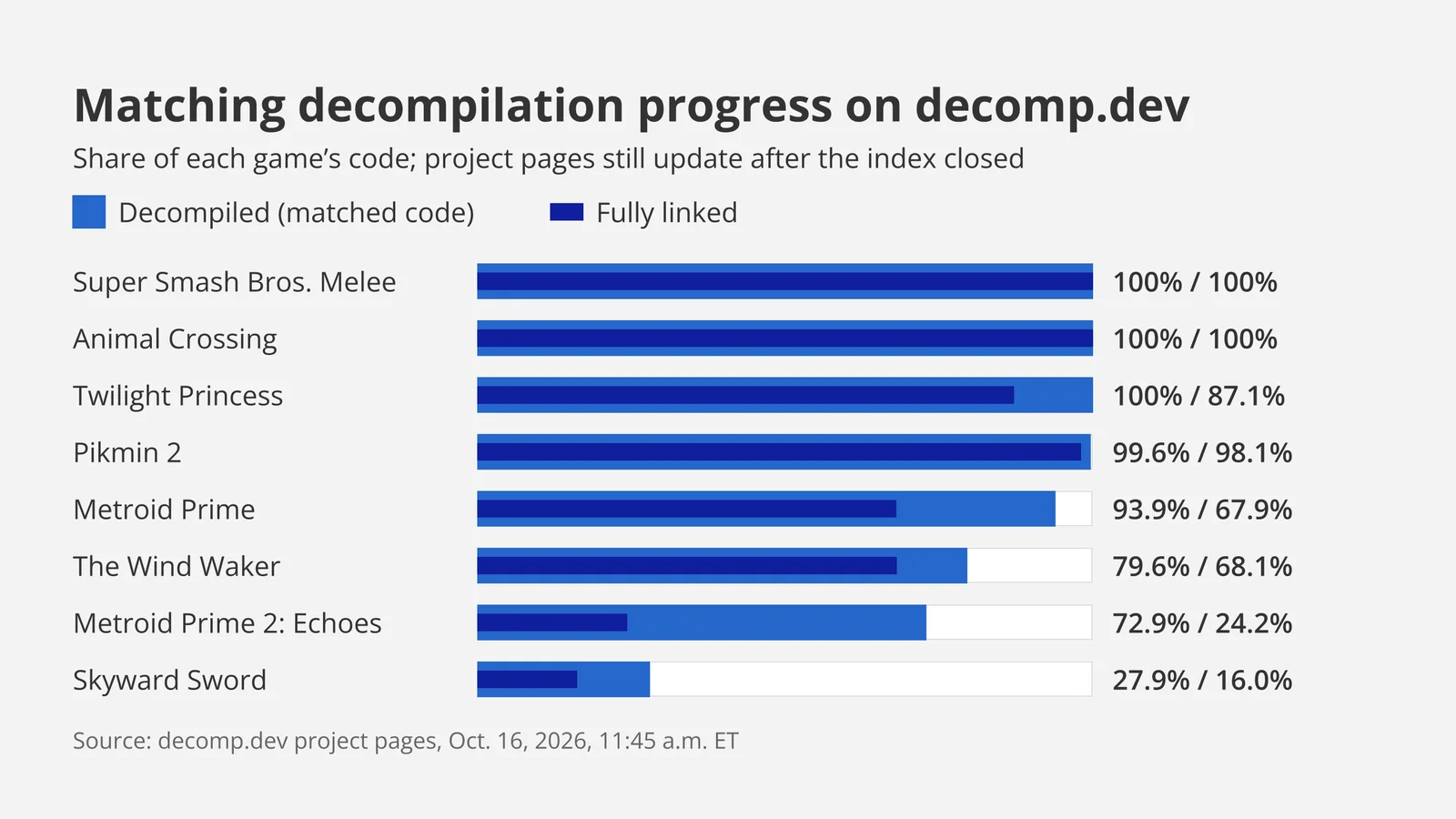
Existing projects, some of which have achieved 100% decompilation progress, such as Super Smash Bros. Melee and Animal Crossing, will keep on reporting, and their pages and history will remain. However, no new projects may join, and nobody may rebuild the site from its code. There is no successor named, and no shutdown date. Decompiling goes on, and AI is making it even faster, but the percentage scoreboard is gone.