The Economics of RAM Repair
A hardware specialist's recent project involving a pair of high-capacity DDR5 sticks worth a purported $16,000 highlights a major shift in component economics. With soaring replacement costs, the traditional chuck-it-and-replace-it attitude toward faulty RAM no longer applies. Spending money on repair labor to save expensive enterprise-grade DDR5 DIMMs has become a sensible financial choice.
The hardware sent in for evaluation consisted of two high-end ECC DDR5 server sticks, one featuring 128GB and the other 256GB of DRAM ICs onboard. Both modules were reported to have physical damage, providing an opportunity to utilize specialized testing equipment including a Unified DDR Flasher Main Board equipped with an RDIMM extension.
Diagnosing and Fixing the First DIMM
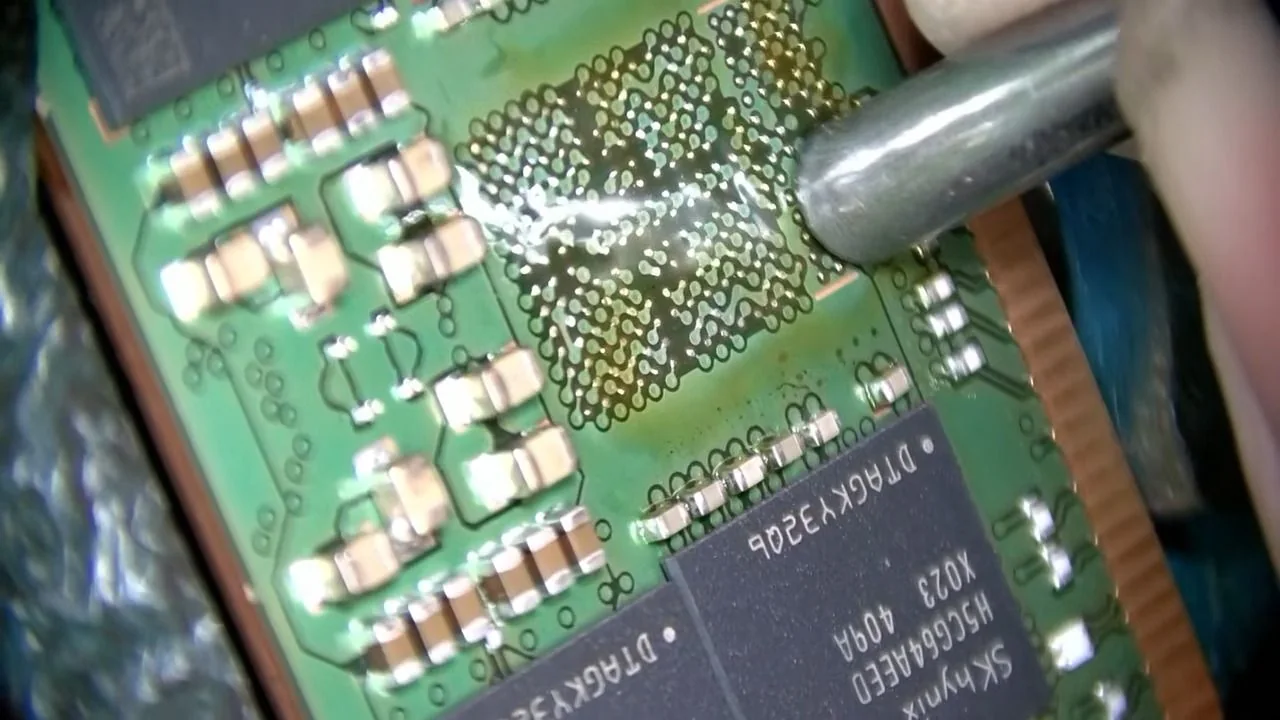
Initial close physical and data-line testing did not reveal definitive failure points on the first module. The technician applied flux and used hot air to reflow the solder across the DIMM, a simpler alternative to a full reballing process where all memory ICs are removed and fitted with new solder balls. This restored the module to working order.
Tackling a Dead Module
The second DIMM presented a more severe challenge, suspected of having a faulty power management integrated circuit. When inserted into a system, the module showed no signs of life and remained cold under thermal camera checks, contrasting sharply with the behavior of the first fix.
Because the second DIMM was completely dead, troubleshooting began on non-DRAM components such as the PMIC and SPD EEPROM. Additional chips were reflowed while the board remained warm, and several questionable ICs underwent complete reballing after closer inspection.
Further investigation using voltage injection and thermal camera monitoring uncovered a short circuit. This defect was resolved by replacing a damaged capacitor and correcting a short on the edge of the printed circuit board. Installing a new PMIC chip successfully completed the repair, allowing the second DDR5 module to power on and train normally.
A Growing Niche for Repair Services
While successfully salvaging expensive components helps reduce electronic waste, the broader takeaway is the emergence of memory module repair as a viable commercial venture. Previously, labor costs often outpaced replacement expenses, but current market valuations mean repair fees represent only a small fraction of purchasing brand-new high-capacity server hardware.