Hisense XR10: Overview
The Hisense XR10 offers powerful projection that can be positioned across various room layouts while remaining easily squared away. That flexibility stems from extensive optical adjustments, including an impressive zoom range and lens shift capabilities, wrapped in an elegant physical design.
The projector is loaded with blazing RGB lasers that provide stunning brightness and color depth, while an adjustable iris helps clamp down black levels for enhanced contrast during dark room viewing. All of this hardware is packed into a stylish, relatively compact chassis that is much easier to transport than many high-end theater alternatives, complete with a high-quality carrying case.
However, this performance commands a steep price. Retailing at a premium, the projector includes decent built-in speakers and VidaaOS, but misses out on advanced gaming features like Variable Refresh Rate (VRR) and 4K/120Hz support that are becoming standard in newer competing models.
Pricing and Market Positioning
Release date: Mid-2026
MSRP: $5,999 / £5,999 / AU$9,999
The Hisense XR10 made its debut at CES and launched with an initial price of $6,999 before settling closer to $5,999 in the US market. While occasional temporary discounts have surfaced, retail pricing remains largely static globally.
The manufacturer includes a premium, highly durable carrying case featuring wheels and an extendable handle, adding tangible convenience for users who transport the unit frequently.
Design, Optics, and Features
The unit features a stylish, compact design paired with a ruggedized carrying case.
It includes highly adjustable and versatile optics.
The built-in VidaaOS platform runs quickly, though app availability can feel somewhat restrictive.
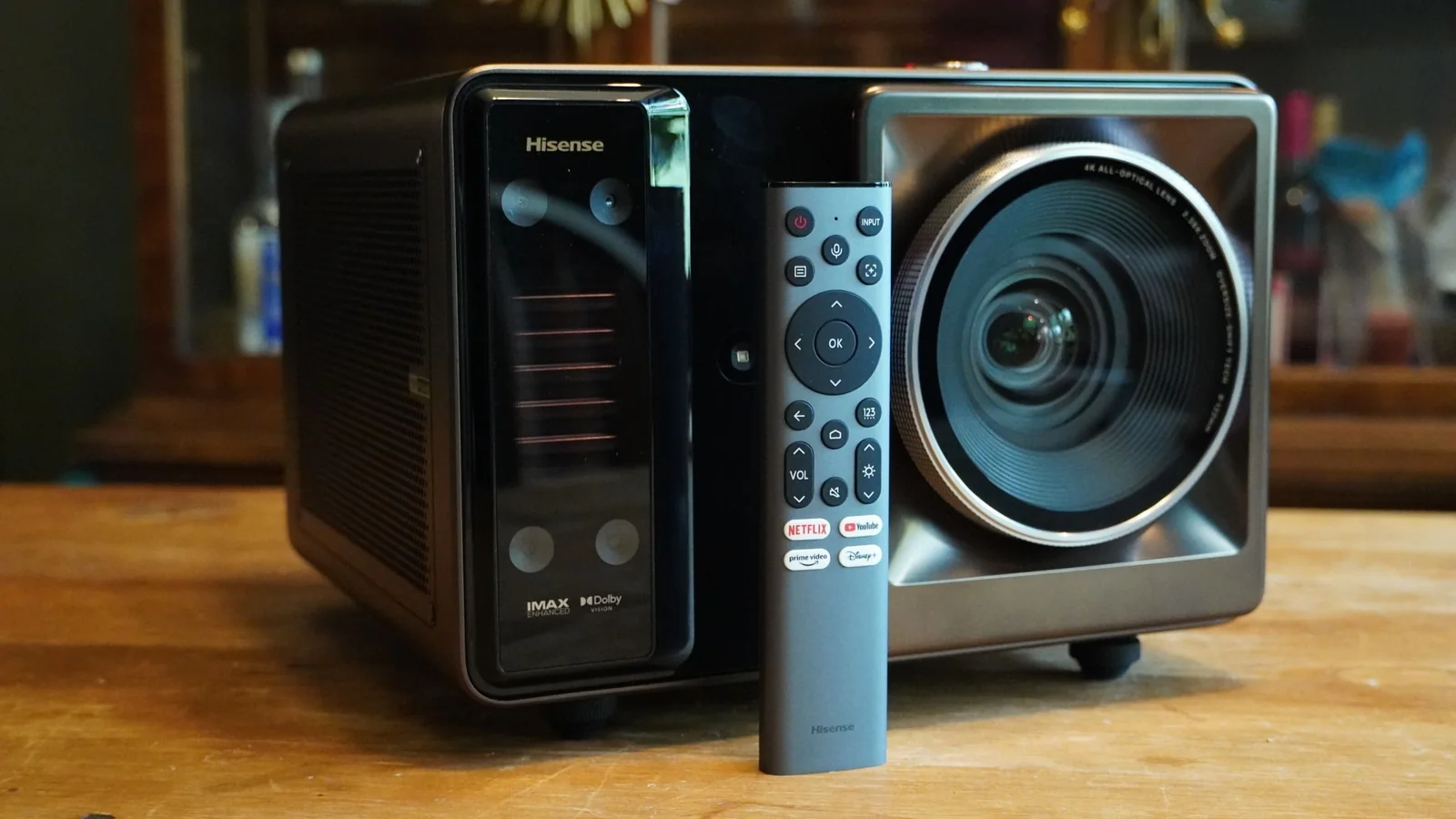
Hisense has crafted a striking aesthetic with the XR10, incorporating a brown metal casing, stylish venting, machined accents, and a knurled lens cover. The top panel houses a volume dial, power button, and an ambient light sensor.
Measuring 11.5 x 10.7 x 8.4 inches and weighing 23.4 pounds, the projector balances a modest footprint with substantial internal hardware.
For alignment, the projector stands on four height-adjustable feet and supports extensive zoom and lens shift capabilities. Its throw ratio ranges from 0.84:1 to 2:1, allowing users to achieve large pictures in tight spaces or shrink the image from a distance without digital cropping.
Additionally, the unit supports 130% vertical lens shift and 46% horizontal lens shift, simplifying placement in challenging room environments.
Automatic picture correction features like screen fitting and obstacle avoidance are built in, though extreme corrections can occasionally overextend the projection size.
Connectivity options are robust, featuring two HDMI 2.1 ports (with eARC support), an HDMI 2.0 port, dual USB 3.0 ports, gigabit Ethernet, and both optical and 3.5mm analog audio outputs.
Wireless networking is powered by Wi-Fi 7, enabling fast connectivity for streaming services through the native operating system.
Software duties are handled by VidaaOS. While it supports major streaming apps and Xbox Cloud Gaming, it lacks some third-party ecosystem options found on platforms like Google TV. Navigation remains swift, aided by a dedicated input button on the included remote.
Cooling fans produce a noticeable whir during operation to manage internal temperatures, though it is easily masked by audio playback.
The included remote provides straightforward directional navigation, direct input selection, autofocus, and shortcut keys for popular streaming platforms alongside a backlit design.
Picture Quality and Performance
The projector delivers brilliantly colorful, stunningly bright images alongside deep black levels.
It demonstrates strong gaming performance capabilities.
Audio output is punchy, though lacking true cinematic scale.
The RGB laser light source produces remarkably vibrant, natural colors that excel during high-contrast animated and cinematic sequences.
Dynamic range performance shines in complex lighting scenarios, rendering subtle color gradients and deep shadow details with high fidelity.
In testing evaluations, maximum brightness output reached over 6,800 lumens in standard calibrated modes, with potential peaks exceeding 7,700 lumens when utilizing enhanced white point settings.
High light output allows the projector to remain usable in rooms with ambient light, reducing the strict need for absolute blackout conditions.
Contrast performance remains potent, supported by an optical iris that lowers black levels significantly during dark cinematic scenes.
Contrast ratios scale dramatically depending on room light control, scaling past 11,000:1 when the optical iris is fully closed down.
Motion interpolation is enabled by default, though disabling it or setting it to film mode avoids unwanted motion artifacts.
Gaming performance is responsive, supporting 4K/60Hz and 1080p/240Hz modes with low input latency. However, the absence of VRR and 4K/120Hz support leaves it trailing newer gaming-focused competitors.
The integrated 2.1-channel speaker system delivers clear audio with respectable volume, though bass response drops off below 70Hz.
Some users sensitive to single-chip DLP projectors may occasionally notice the rainbow effect during high-contrast scenes.
Value and Conclusion
The unit carries a premium market price.
Projection capabilities remain highly capable and flexible.
Priced near $5,999, the XR10 sits above several direct competitors. Its primary justification is its exceptional zoom range and placement flexibility.
While built-in smart TV features and speakers add convenience, they do not entirely offset the steep financial entry barrier.
Ultimately, the XR10 demands a high premium, but remains a powerful option for buyers prioritizing raw projection power and optical adjustability.
Score breakdown
Scored out of 10Price & Release Date
Hisense XR10