Introduction
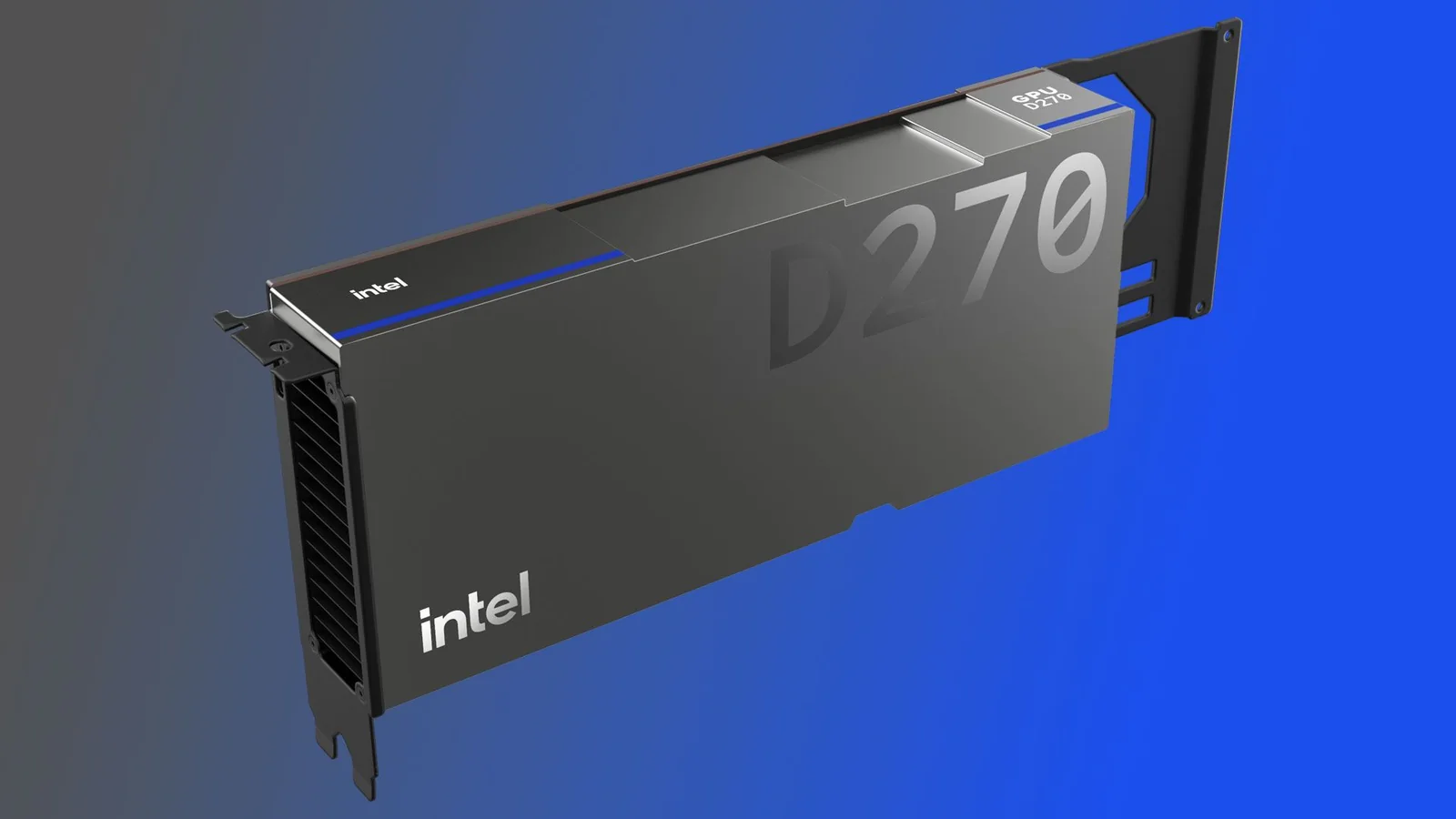
At OCP 2026, Intel has given its Crescent Island chip a proper name: the Intel GPU D-Series. For the first time, the company shared a theoretical peak performance target for the chip of 1.3 PFLOPS of FP8, alongside a final memory bandwidth of 1.5 TB/s for these AI inference accelerators.
Crescent Island is built on Intel's Xe3P graphics and parallel computing architecture, lacking traditional graphics-specific functional units. Intel plans to release GPU D-Series products in an air-cooled PCIe form factor featuring a 350W TDP and up to 480GB of LPDDR5X memory.
Performance and Infrastructure
By comparison, Nvidia's Vera Rubin NVL72 system utilizes 72 Rubin GPUs capable of 17.5 PFLOPS of FP8 throughput each, though those require liquid cooling and kilowatts of power. The GPU D-Series is targeted at an entirely different performance envelope and infrastructure requirement.
Intel GPU D-Series hardware is designed for deployment in traditional air-cooled rack servers scaling up to eight GPUs. In such setups, Intel states the chips can power inference on models exceeding one trillion parameters, supporting large language models, long-context inference, and concurrent services.
Software and Ecosystem
To support distributed inference deployments where multiple GPUs act as a single unit, Intel relies on its common Xe software foundation built for AI across its Xe Cores in iGPUs and discrete graphics products.
For data center integration, Intel is collaborating with a broad ecosystem of OEMs, ODMs, neoclouds, and independent software vendors. Customer sampling of the GPU D-Series is currently underway, though a broad commercial launch timeline has not yet been detailed.
Market Outlook
The release determines whether the GPU D-Series can establish an AI accelerator foothold for Intel, following previous challenges with the Data Center GPU Max family and subsequent architectural pivots.
In a market demanding compute cycles for inference, a workload-specific product packaged in an accessible thermal and electrical envelope may offer the traction Intel needs as AI models and agentic workflows expand.



