Modular Design and Concept
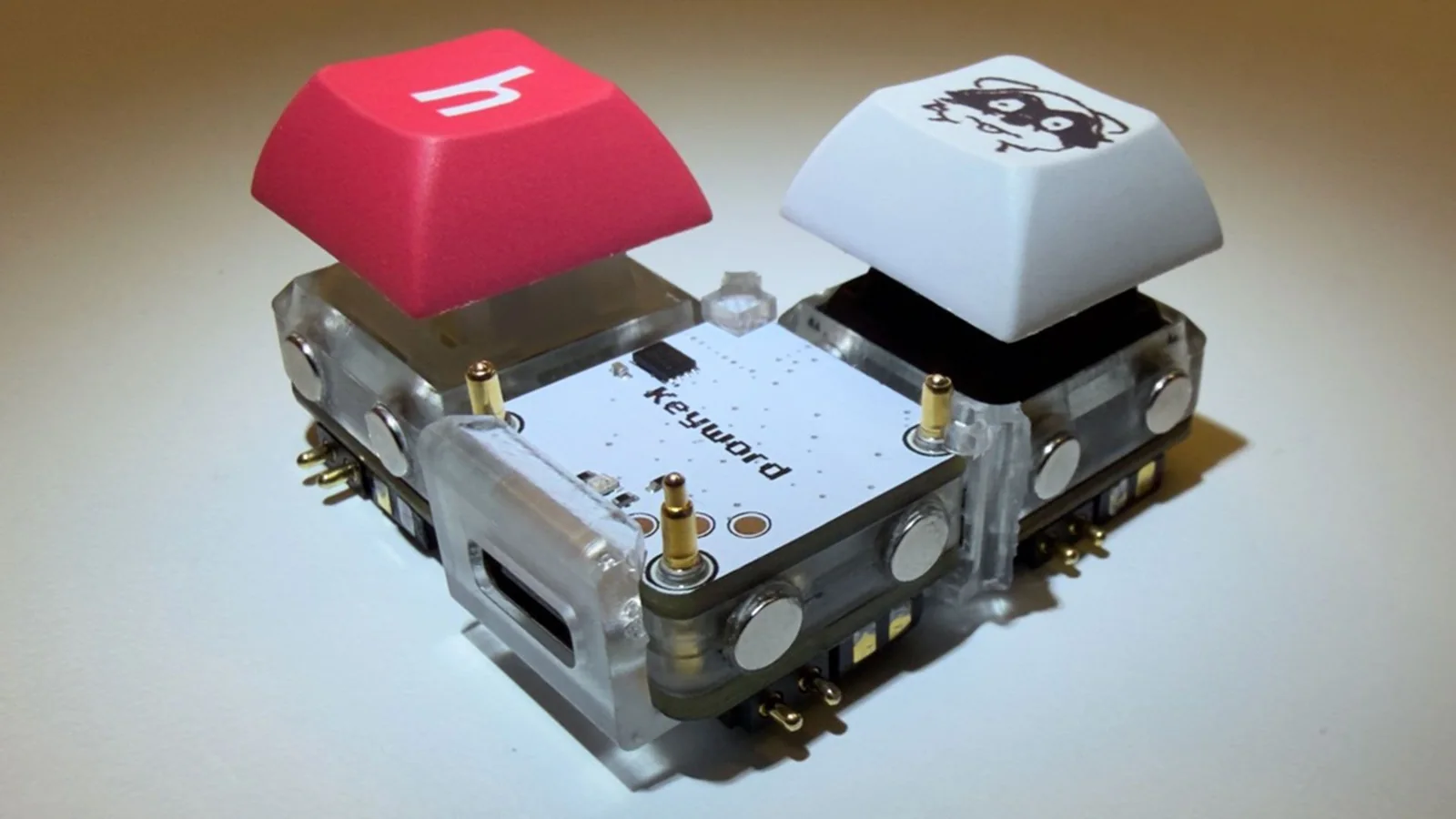
Developer Nathan Alspaugh has published details of his Keybytes project on GitHub. In essence, this is a modular project where a Keyword hub is magnetically connected to Keybit keys, and each key has its own microcontroller. Hence the number of keys and their layout are entirely up to the user, with a modular design akin to building Lego.
The project offers significant flexibility with regard to layout and key selection compared to conventional mechanical keyboards.
Hardware Architecture
It starts with a Keyword, which is the main board that the Keybits connect to. This central component houses a stacked pair of PCBs. The top board packs an Arm Cortex M4-powered microcontroller, Bluetooth antenna, and flash memory. The lower board offers USB-C, charging, and a buck-boost converter.
Adding keys seems straightforward. Every Keybit, one of the modular keys, contains a CH32V003 RISC-V microcontroller. Moreover, it features pogo pins on all four sides of every key for power and I2C communication. The case is magnetic so you can connect it to any aspect of the Keyword and other Keybits. Atop the Keybit, a Cherry MX switch is installed, while users can also utilize alternative mechanical switches supported by the MIT-licensed project plans.
Development Status and Pricing
The project is still in early development, having started recently. Both the Keyword and the Keybit modules are 1U sized measuring 19.05 by 19.05 millimeters.
Alspaugh has shared all the design assets, files, and documentation under a permissive MIT license for builders wanting to assemble their own hardware.
However, assembling a full-sized layout can become costly. Getting PCBs manufactured, sourcing components, and 3D printing custom parts presents a considerable task for larger builds. Alspaugh noted that pricing out a full-sized keyboard with two keywords and roughly 110 keybits approached around $900 assembled.
While the Keyword features a status light, current Keybit modules lack integrated illumination, leaving room for future hardware iterations and expansions.
Future iterations could potentially introduce customizable RGB lighting or specialized input modules.