Overview
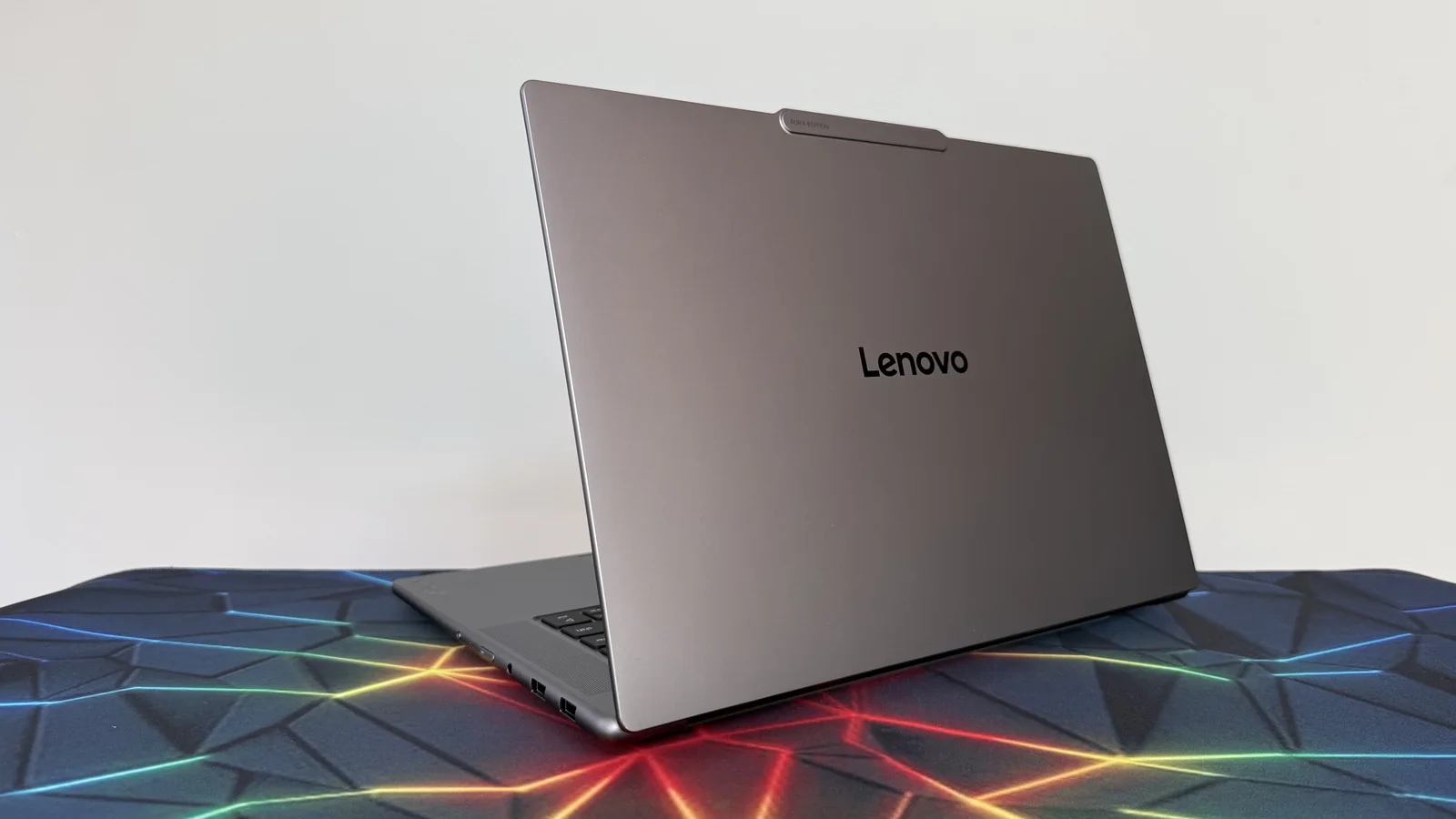
The Lenovo Yoga Pro 7i Aura Edition Gen 11 stands out as one of the more substantial clamshell laptops in Lenovo's Yoga series, commanding a starting price of $2,600. This cost reflects its high-performance Intel silicon and Nvidia RTX GPU, complemented by a 2.5K OLED screen.
Weighing 3.7 pounds, this 15-inch laptop has considerable heft, which might make it less ideal for daily portability. However, its chassis is noted for being solid and sturdy, exhibiting minimal flex around the top cover or hinge. Core features like the keyboard and touchpad are well-executed, and the extensive port selection adds significant convenience.
Positioned as a versatile tool for aspiring creatives, the Yoga Pro 7i offers robust processing power and up to 15 hours of battery life in a compact 15-inch form factor. The review raises the question of whether this 'jack of all trades' justifies its price point, which can approach $3,000.
Configurations and Pricing
The Yoga Pro 7i is available in two primary configurations, offering flexibility in processing power. The processor and GPU are bundled together, simplifying choice but limiting individual component customization.
The higher-end configuration, reviewed by the source, features an Intel Core Ultra 9 386H processor, an Nvidia RTX 5060 graphics chip, 32GB of LPDDR5 memory, and a 1TB SSD. Its 15-inch OLED touchscreen boasts a 2.5K (2,560x1,600-pixel) resolution, with this model priced at $2,900 on the Lenovo store.
A more affordable base configuration is available for $2,600 directly from Lenovo. This variant, sometimes found for under $2,000 at retailers like Best Buy during promotions, includes the same RAM and storage but is equipped with an Intel Core Ultra 7 356H processor and an Nvidia RTX 5050 GPU.
Lenovo also offers various software bundles, including Windows 11 Pro and Microsoft 365 services, which can increase the final price by several hundred dollars.
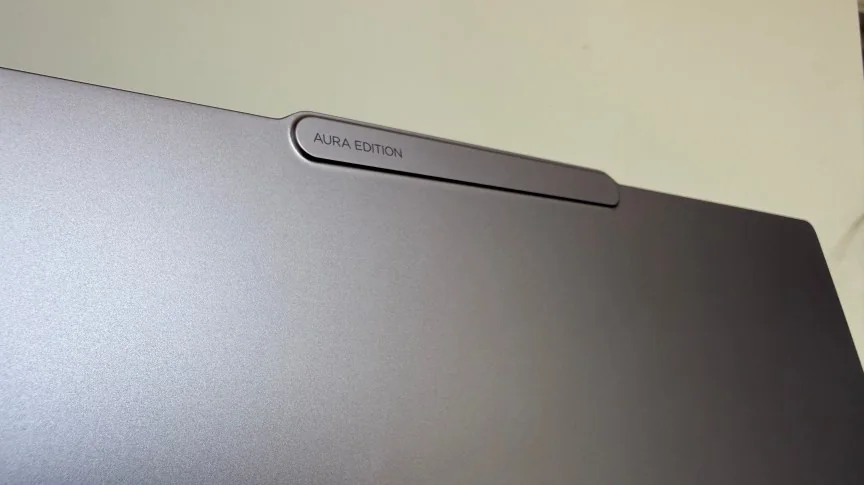
The 'Aura Edition' designation is purely marketing jargon, indicating the use of Intel silicon and having no direct impact on the laptop's price or performance.
Solid Performance, Graphics Card a Key Advantage
Designed with creatives in mind, the Yoga Pro 7i combines high-end Intel silicon with a discrete Nvidia 50-series GPU, providing substantial processing power. This premium product is expected to handle resource-intensive applications like Blender effectively and can also run older AAA games.
While it delivers respectable benchmark scores against other non-gaming laptops with Intel Panther Lake and Arrow Lake architectures, the Yoga Pro 7i's performance in single- and multi-core tests is significantly outmatched by dedicated gaming laptops such as the Alienware 18 Area-51 and Razer Blade 18. However, these gaming machines are considerably more expensive and less portable.
The source review notes that Apple's M5 chip generally outperforms the Yoga Pro 7i's processor in Geekbench 6 and Cinebench 2024 single-core tests. Nevertheless, the Intel Core Ultra 9 386H configuration of the Yoga Pro 7i demonstrated superior results in multi-core tests.
For gaming, users should not expect more than 60 frames per second (fps) on contemporary titles. While it can handle slightly older games, running Guardians of the Galaxy at nearly 160fps on high settings, it is primarily optimized as a creative workstation.
The Yoga Pro 7i particularly excels in GPU performance, as evidenced by the 3DMark Steel Nomad benchmark test. Its Nvidia RTX 5060 graphics card positions it significantly ahead of other creative laptops like the Dell XPS 16 and M5 MacBook Air. It even competes favorably with some budget gaming laptops in demanding graphical tests, surpassing models like the Acer Predator Helios Neo 16 and MSI Cyborg 15 in the 3DMark Fire Strike Ultra benchmark.
Although 15 hours of battery life is not considered exceptional by current standards, the Yoga Pro 7i outperforms most clamshells with similar CPU and GPU combinations. For instance, Dell's XPS 16 achieves only 14 hours, and the more expensive Yoga Pro 9i 16 manages just 11 hours. This extended battery life is a valuable asset for the Yoga Pro 7i.
Bulky Yet Sturdy Design with Mixed Display Quality
The Yoga Pro 7i is a substantial device, weighing 3.7 pounds, which places it in the same weight class as some 16-inch models. While not the heaviest laptop available, its density makes it noticeably cumbersome for prolonged carrying.
Despite its bulk, the laptop's build quality is commendable. The top cover resists warping or bending even under significant pressure, and the hinge exhibits minimal flex, contributing to a satisfactorily sturdy clamshell design.
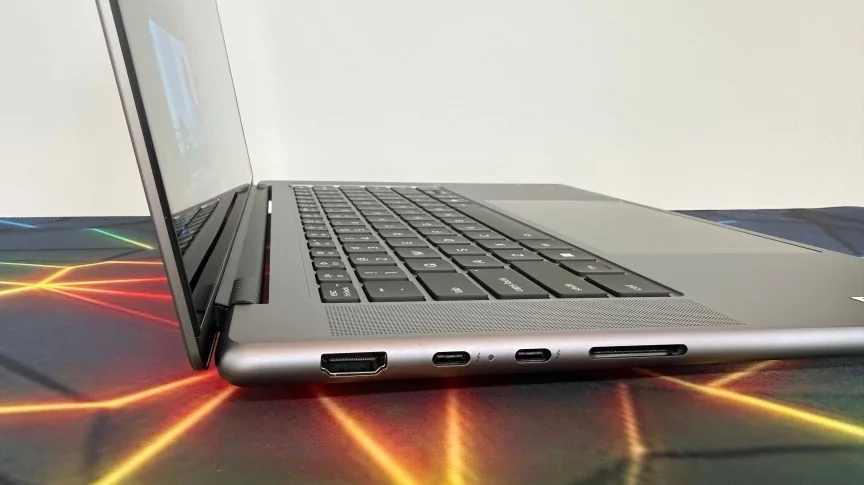
Connectivity is a strong point, with the larger chassis accommodating a generous array of ports. These include two Thunderbolt 4 USB-C ports, two USB-A ports, an HDMI 2.1 port, an audio combo jack, and an SD card reader, which should meet most users' needs without requiring additional adapters.
The 2.5K OLED screen is considered somewhat underwhelming for a laptop in this price range, especially given that less expensive Yoga models offer higher-resolution panels. While the display provides solid color contrast and vibrant picture quality at maximum brightness, the source reviewer felt this was a compromise that might not suit its target creative audience.
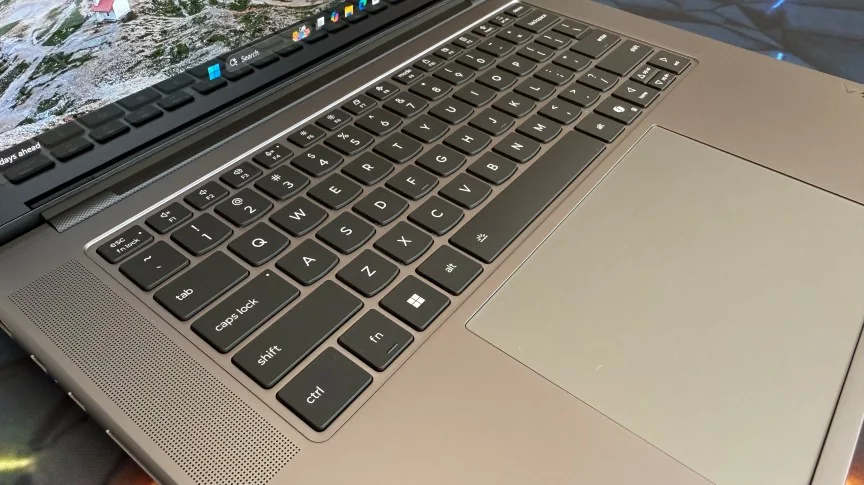
Other design elements are well-executed, particularly the keyboard, which features firm keycaps that respond well to focused pressure. The inclusion of a backlight is also a welcome feature for working in low-light conditions.
The mechanical touchpad, while large and easy to navigate, is not without its flaws. It exhibits excessive resistance towards the top of its surface area and lacks dedicated mouse buttons, which can make clicking in certain areas slightly inconvenient. Such minor design compromises are more commonly expected in budget laptops and could be significant for a device nearing $3,000.
Is the Lenovo Yoga Pro 7i Aura Edition Gen 11 Worth Buying?
A laptop with a starting price of $2,600 warrants close examination. The Yoga Pro 7i justifies its cost with solid specifications, including high-performance Intel silicon, an Nvidia graphics card, 32GB of RAM, and a 1TB SSD, all of which are premium components.
This workhorse laptop delivers strong single- and multi-core processor performance and can handle some demanding games. While it may not outperform its more expensive sibling, the Yoga Pro 9i 16, the Yoga Pro 7i offers a tangible advantage with a few extra hours of battery life, which is a practical benefit for daily use.
Compared to the Dell XPS 16, which starts at a similar price, the Yoga Pro 7i generally surpasses it in performance across most metrics, thanks to its superior Intel and Nvidia graphics combination. Despite being somewhat less aesthetically striking and a bit unwieldy for a 15-inch model, the Yoga Pro 7i presents a compelling option in the current market, especially considering the rising costs of technology.