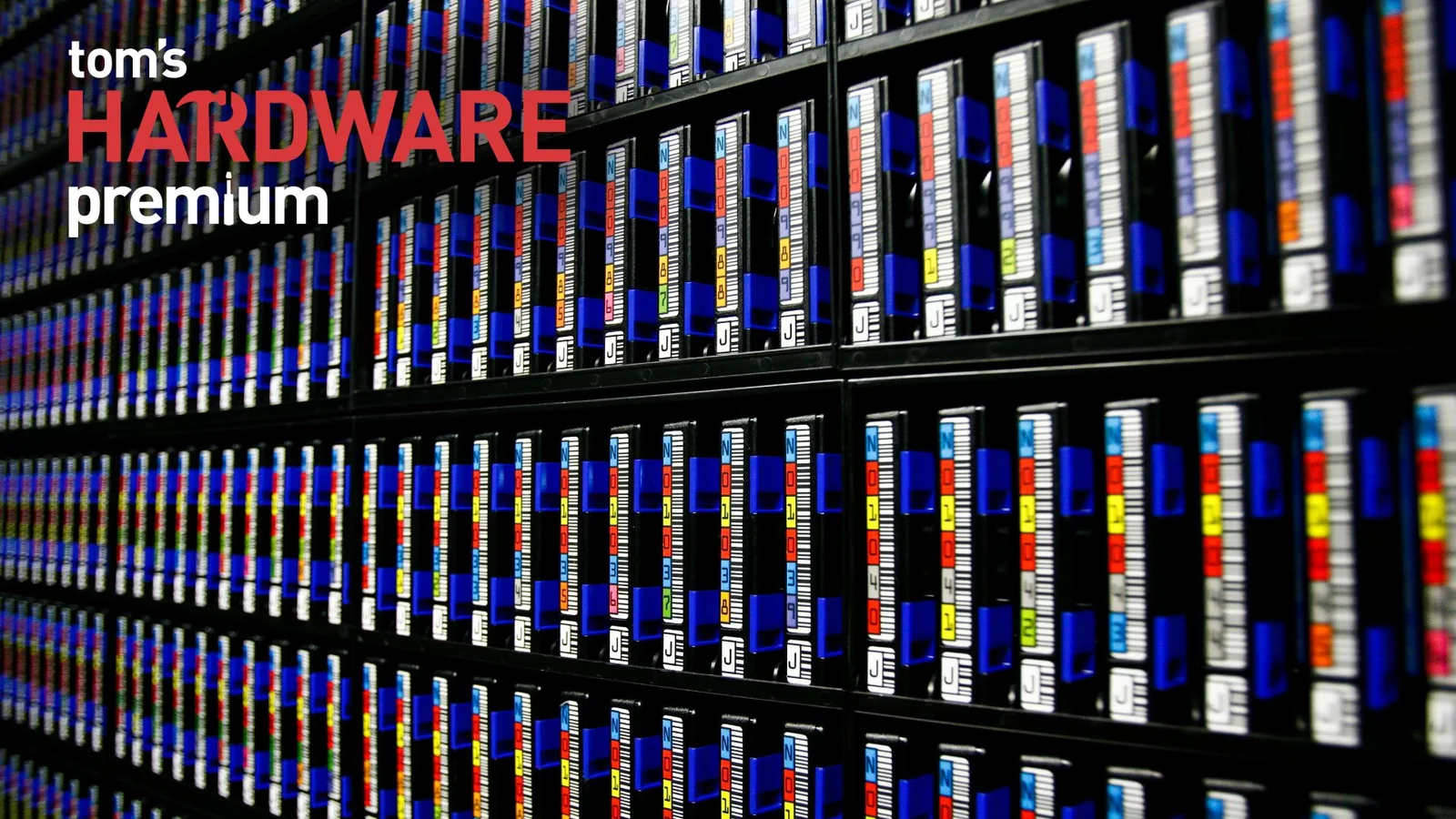
In a world where high-capacity SSDs and hard disk drives compete for market dominance, magnetic tape storage may seem archaic. However, the 25-year-old Linear Tape-Open format continues to evolve at a remarkable pace.
The current LTO-10 generation stores up to 40TB of uncompressed data per cartridge, while HPE, IBM, and Quantum — the companies behind the LTO Program — now envision LTO-14 cartridges with up to 365TB of native capacity. But capacity is not the only advantage of LTO. In fact, the consortium has deliberately slowed its capacity roadmap in a bid to prioritize reliability, cost per terabyte, and manageable backup and recovery times over the previous goal of doubling capacity with every generation.
LTO began in 2000 with the LTO-1 format, which stored just 100GB of data natively and transferred it at 20 MB/s. Since then, capacity increased to 200GB with LTO-2, 400GB with LTO-3, 800GB with LTO-4, 1.5TB with LTO-5, 2.5TB with LTO-6, 6TB with LTO-7, 12TB with LTO-8, and 18TB with LTO-9.
The original LTO-10 media introduced in 2025 increased native capacity to 30TB, whereas an extended-length LTO-10 cartridge announced later increased it further to 40TB.
LTO cartridge capacity has increased by a factor of 400 in about 25 years without changing the form-factor itself. For comparison, the capacity of 3.5-inch hard drives increased by roughly 585 times over the same period, from around 75GB in 2000 to as much as 44 TB today, so tape has evolved at a slower pace. However, LTO has evolved without dramatic changes in internal complexity.
Scaling Vectors and Density Improvements
The 40TB LTO-10 cartridge is noteworthy because its additional capacity is enabled by higher recording density and longer tape. The LTO-10 format uses 15,104 data tracks, up 68.5% from 8,960 tracks with LTO-9, and combines them with higher linear density. To make this possible, LTO-10 uses a redesigned high-bandwidth servo mechanism that enables the head to follow increasingly narrow tracks accurately.
Both 30TB and 40TB LTO-10 media use a strontium-doped barium ferrite recording layer, but the 40TB version uses a new Aramid base film that is thinner and smoother, enabling manufacturers to pack more tape into the same cartridge. According to MagStor, the thinner substrate increases tape length from approximately 1,035 meters with the 30TB cartridge to around 1,335 meters with the 40TB version. Meanwhile, the 40TB cartridge works with the same LTO-10 drives as the existing 30TB media.
Therefore, modern LTO has at least two major scaling vectors: recording more bits on a given area of tape, and putting more tape into a cartridge. With LTO-10, the consortium had to drop backwards compatibility.
There appears to be plenty of room left on the tape front. Back in 2020, IBM and Fujifilm demonstrated a strontium ferrite tape technology with an areal density of 317 Gb/in², which could theoretically enable a cartridge capable of storing 580TB. The prototype used tracks only 56.2nm wide and a 29nm TMR read sensor, proving magnetic tape could reach capacities vastly beyond commercially available LTO products.
Modifying the Long-Term Capacity Roadmap
Ironically, despite considerable technological headroom, the LTO Program has recently made its roadmap considerably less aggressive.
When HPE, IBM, and Quantum extended the roadmap through LTO-14 in 2022, they expected capacity to roughly double every generation, targeting up to 576TB native for LTO-14. But that changed in November 2025, when the three companies introduced a revised roadmap targeting 70TB native for LTO-11, 120TB for LTO-12, 210TB for LTO-13, and 365TB for LTO-14.
While the new roadmap is somewhat less impressive, developers claim the revised targets are intended to prioritize reliability, affordability, efficiency, and cost per terabyte. Lowering maximum cartridge capacities should help reduce the amount of time required to store and recover data.
AI has turned archives into strategic assets, according to Stephen Bacon, Vice President of Data Protection Solutions Product Management at HPE. The new 40 TB LTO-10 cartridge helps enterprise-class organizations consolidate petabytes efficiently and strengthen cyber resiliency.
Bandwidth is becoming one of tape's more obvious limitations. LTO-8 offered 360 MB/s of native bandwidth, LTO-9 increased this to 400 MB/s, and LTO-10 remains at 400 MB/s, although hardware compression can boost effective throughput to as much as 1,200 MB/s.
As a result, while maximum native cartridge capacity increased from 12TB with LTO-8 to 40TB with LTO-10, native transfer performance improved by only around 11%. At 400 MB/s, writing 40TB sequentially takes roughly 28 hours without overheads.
Impact of Dropping Backwards Compatibility
One notable aspect of LTO-10 is that it breaks a long-standing tradition of backward compatibility. Up until LTO-7, new drives could read cartridges from two generations earlier and write media from one generation earlier. Because LTO-10 redesigns its head, its backwards compatibility disappears completely: an LTO-10 drive reads and writes only LTO-10 media.
This creates challenges for operators maintaining archives for decades. Once they adopt LTO-10, they must either migrate archives to the new format or keep older drives in their fleet.
Surging Demand Driven by AI Data Growth
The AI boom could strengthen demand for tape. AI infrastructure produces enormous datasets, but not every training dataset, checkpoint, model, log, or generated asset needs to remain indefinitely on expensive SSDs or HDDs.
LTO capacity shipments reached 160.3 exabytes in 2025. However, shipments in the first quarter of 2026 jumped 57% year-over-year, according to figures reported by the LTO consortium, driven by AI-related data growth, traditional archival demand, and cyber-resilient backups.
Hugues Meyrath, CEO of Quantum, noted that tape is increasingly viewed as a strategic component of modern data infrastructure, delivering predictable economics and resilient long-term data retention at scale.
Tape provides vast capacities at a low cost per terabyte, while cartridges consume virtually no power while sitting offline. Physically removing a cartridge from a drive provides a genuine air gap against network-based attacks.
Meanwhile, tape's disadvantages remain fundamental: tape is sequential and cannot provide random-access performance comparable to HDDs or SSDs.
Conclusion and Future Outlook
25 years after LTO-1 offered 100GB per cartridge, LTO-10 can store as much as 40TB, with roadmaps pointing toward 365TB in future generations. Laboratory demonstrations indicate that magnetic tape holds considerable scaling potential beyond today's commercial products.
For a storage technology whose demise has been predicted repeatedly, LTO continues to evolve at a predictable pace, with growing adoption and robust relevance in modern enterprise environments.