Microsoft and Nvidia Unveil RTX Spark and Surface Laptop Ultra
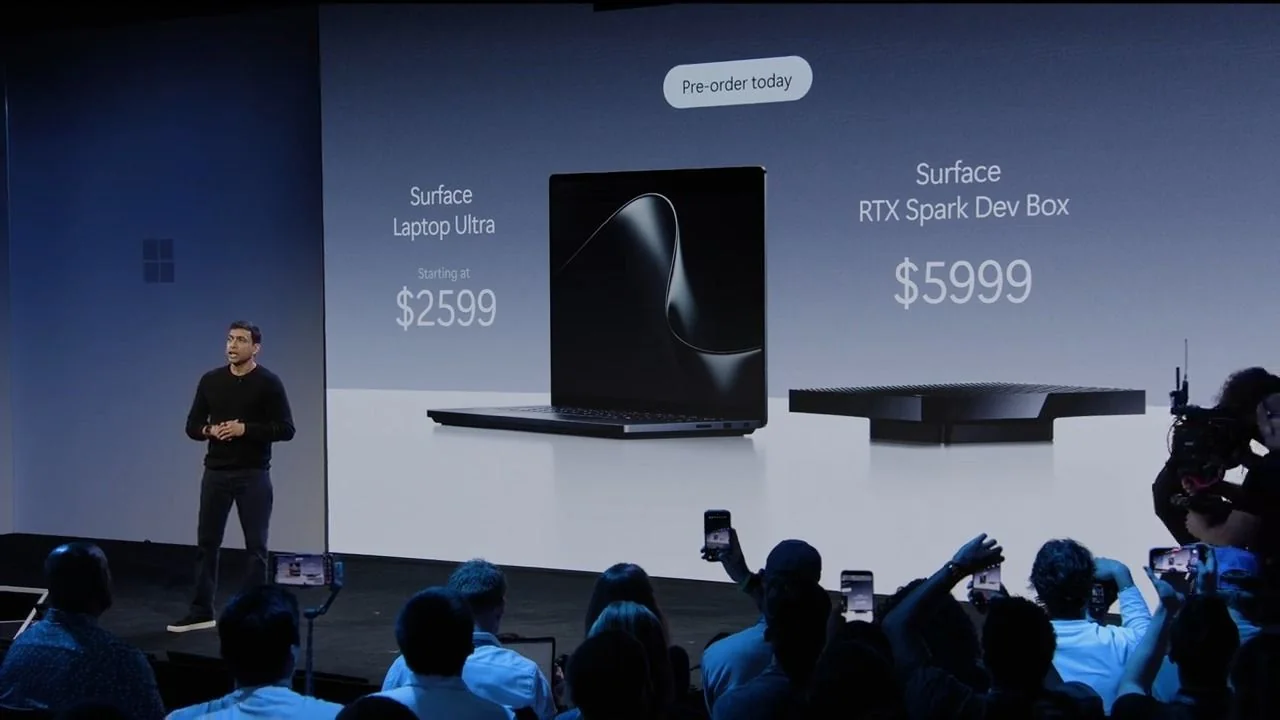
At an event in San Francisco, Microsoft and Nvidia teamed up to show off the RTX Spark chip, along with the Surface Laptop Ultra and new features in Windows 11 that use the new system-on-a-chip's capabilities. The device, along with the Surface RTX Spark Dev Box and the broader Spark ecosystem is available for pre-order today, with devices shipping on October 16. Microsoft CEO Satya Nadella, Nvidia CEO Jensen Huang, and Windows and Devices head Pavan Davuluri took turns on stage. Huang stated, "We've reinvented the personal computer completely."
Microsoft CEO Satya Nadella described the event as building a "frontier ecosystem," anchored in Agent 365, Microsoft IQ, and Copilot. Pavan Davuluri, head of Windows and Devices, highlighted Windows 11 as the most secure platform for AI agents, emphasizing containment features.
Pricing and Availability
The Surface Laptop Ultra will start at $2,599, with the Surface RTX Spark Dev Box beginning at $5,999. Both devices are available for pre-order and are scheduled to ship on October 16. Other PCs from manufacturers like Asus, Dell, Lenovo, HP, and MSI will also ship on the same date.
Davuluri demonstrated the Surface Laptop Ultra running GitHub Copilot and playing Gears of War: E-Day at 60 frames per second. He stated that hundreds of AAA and indie titles would be available on day one, with Call of Duty slated to arrive on RTX Spark in 2027.
Weighing 4.5 pounds, the system is claimed to offer the brightest peak HDR on a laptop. It also incorporates a magnetic USB-C charger, dubbed "magnetic connect," which functions similarly to Apple's MagSafe or older Surface Connect ports but uses a standardized USB-C interface.
A video demonstration showcased the system's capability to handle complex workloads across Blender, Photoshop, ComfyUI, and Unreal Engine, utilizing both local and cloud models to reduce task completion times from days to hours.
Performance Benchmarks
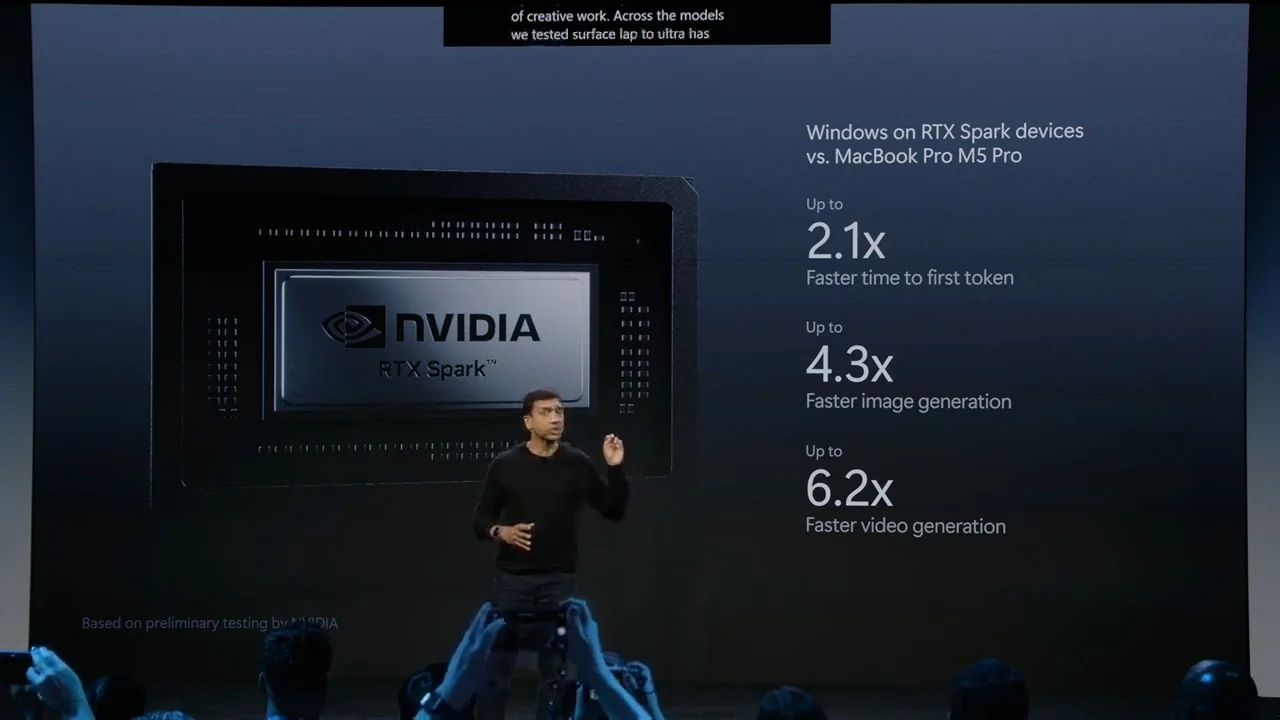
Microsoft compared the RTX Spark's performance to the M5 Pro chip in a MacBook Pro, claiming it is up to 2.1 times faster for first token generation, 4.3 times faster for image generation, and 6.2 times faster for video generation.
Windows 11 will introduce new quick actions in the Taskbar's Search menu, enabling users to modify settings, take screenshots, or arrange windows using natural language. The Taskbar can also launch Copilot directly if a request warrants it, allowing seamless transitions from Search to Copilot.
Davuluri also detailed the integration of local models from various vendors, including Hermes, OpenClaw, and Perplexity, demonstrating Perplexity Computer. Meta's Muse is also slated to arrive on Windows, alongside a streamlined setup process for Windows AI agents.
Additionally, Davuluri announced DGX Spark and Station for Windows, described as a "supercomputer" designed to bring advanced computing capabilities to desktops. Desktops from HP and Dell featuring these systems are expected later this year, marking their expansion beyond Linux exclusivity.
Copilot's Local Capabilities
Microsoft's Jacob Andreou elaborated on the new Copilot, which now gains access to local files and models, enabling it to perform actions on behalf of the user. While still utilizing cloud models, Copilot will transition to local models for tasks requiring enhanced privacy.
Andreou provided an example where Copilot used a blend of local and cloud models to manage tax data, searching for documents, renaming them, and zipping them into a folder. Copilot also drafted an email to an accountant for approval, with these features expected in the coming months.
Microsoft Execution Containers
Davuluri delved into the technical aspects of AI agents, specifically Microsoft Execution Containers, which are nearing general availability. These OS-integrated sandboxes are designed to control data sharing with agents.
Windows will enforce agent attribution for actions performed. Enterprise IT departments will have tools to establish agentic rules across their device fleets. Microsoft's Divya Venkataramu demonstrated this by showing her access to documents, even when agents lacked similar permissions.
Davuluri also discussed hybrid intelligence, which combines local and cloud-based agents to optimize token usage. Microsoft's HydraFusion, a system for balancing these agents, will be integrated into GitHub Copilot, the CLI, and VS Code on Windows by October 15, utilizing new models such as MAI Code 1.1 Flash and Nvidia's Nemotron. He noted that DeepSeek V4 Flash, with advanced quantization, can operate locally at 1.6 bits using 60GB of memory.
Windows ML will function as the runtime for deploying models across GPUs, NPUs, and CPUs. Llama.cpp will also be integrated into Windows ML, offering developers opportunities to experiment with new models from launch.
Kayla Cinnamon of Microsoft demonstrated hybrid intelligence on a Surface RTX Dev Box, showing GitHub Copilot detecting unused code, packages, and feature flags for code cleanup. An Efficiency mode allows Copilot to automatically select models based on task complexity; a more intricate prompt utilized advanced language models, with local sub-agents handling other aspects.