Soft Optical Fiber Sensing
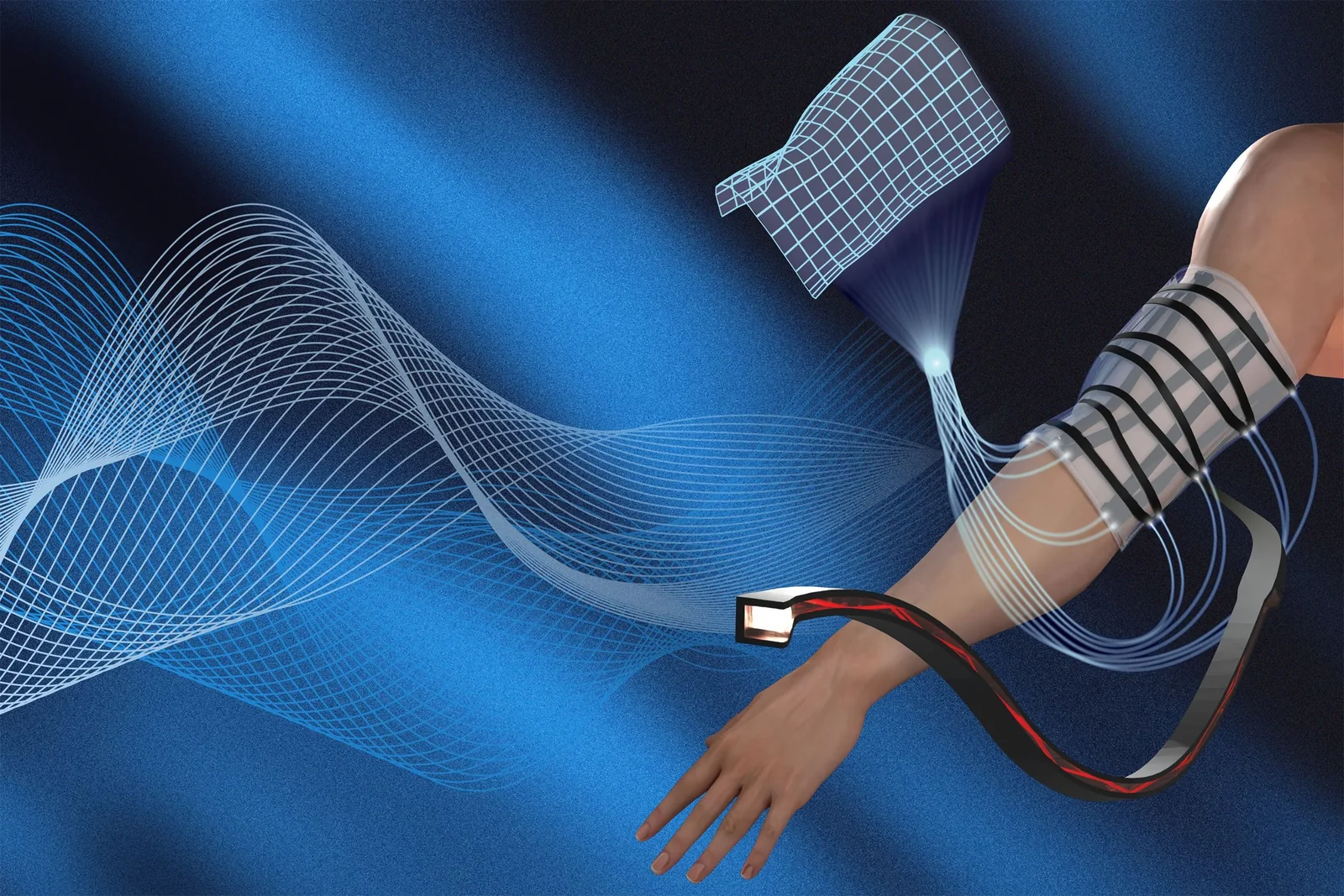
MIT engineers have built a soft, wearable shape-sensing sheet with self-tracking movement that could be useful for controlling games, virtual reality, and physical therapy applications. The technology, which leverages optical fibers to track the sheet’s own 3D shape, keeps its error below half a centimeter in lab tests. Qifan Yu, an MIT mechanical engineering graduate student on the team, put rigid-sensor designs at around 1 to 2 cm and called the result on par with existing technologies. The sheet also still works even when damaged, though the fibers remain thicker than ideal for standard garments.
The development builds on research published in Advanced Intelligent Systems detailing waveguides that respond to bi-directional bending. The array is laid out to discern complex shapes efficiently. Combined fiber responses mean fewer sensing elements are required, which also improves damage resilience. Additionally, the fibers respond to pressure, allowing them to sense external forces such as a press on the forearm.
Traditional optical fibers use a transparent glass core inside a light-trapping cladding, where bending reduces the light reaching the far end. MIT modified this approach by using a flexible rubber core paired with black-dyed cladding. By intentionally roughening one side, bending the fiber in different directions produces measurable variations in light loss, enabling directional sensing.
Design and Reconstruction
The system embeds multiple fibers into a silicone sheet, featuring an LED at one end and a light sensor at the other. While the sensing surface is fully soft, the sheet itself does not stretch. An external circuit board handles data collection, using an algorithm to translate readings into a full 3D shape. The setup includes 14 waveguides measuring 160 mm long arranged in two layers of seven within a 16 x 16 x 0.5 cm silicone sheet. Analog-to-digital converters feed microcontrollers over I2C, and shape reconstruction runs in MATLAB approximately three times per second.
To determine the optimal layout, the team simulated sheets with various waveguide arrangements, comparing estimated 3D shapes against known models. Researchers discovered that angling the waveguides improved accuracy more effectively than simply adding more fibers.
Resilience tests involving cut or disconnected fibers demonstrated that the remaining active fibers could still successfully reconstruct the overall shape. Simulations showed that error remained under 0.3 cm with up to three of the 14 waveguides disabled, rising to about 1 cm when five or more were cut.
Testing and Future Applications
A physical prototype was evaluated by laying the sheet over three 3D-printed molds. Measurement accuracy was determined using the root-mean-square distance between the real and reconstructed surfaces, yielding results of 0.37, 0.28, and 0.45 cm. Separate force-sensing capabilities operate independently from the shape-tracking mode. Wearable testing on human limbs required a simpler scaling method for wrist and elbow angles to account for joint stretching.
According to co-author and MIT assistant professor Kaitlyn Becker, the soft sensing surface is safer for human interaction. The team hopes the technology can assist physical therapists in tracking patient progress. Other potential applications include motion-mimicking virtual reality interfaces and the teleoperation of soft robots.
Future work will focus on scaling down the fiber thickness from the current 1 mm down to tens of micrometers to enable practical smart garments. Researchers also aim to develop faster solvers, incorporate more waveguide layers, and experiment with stretchable electronics.