Building an AC-Powered Cooling Loop
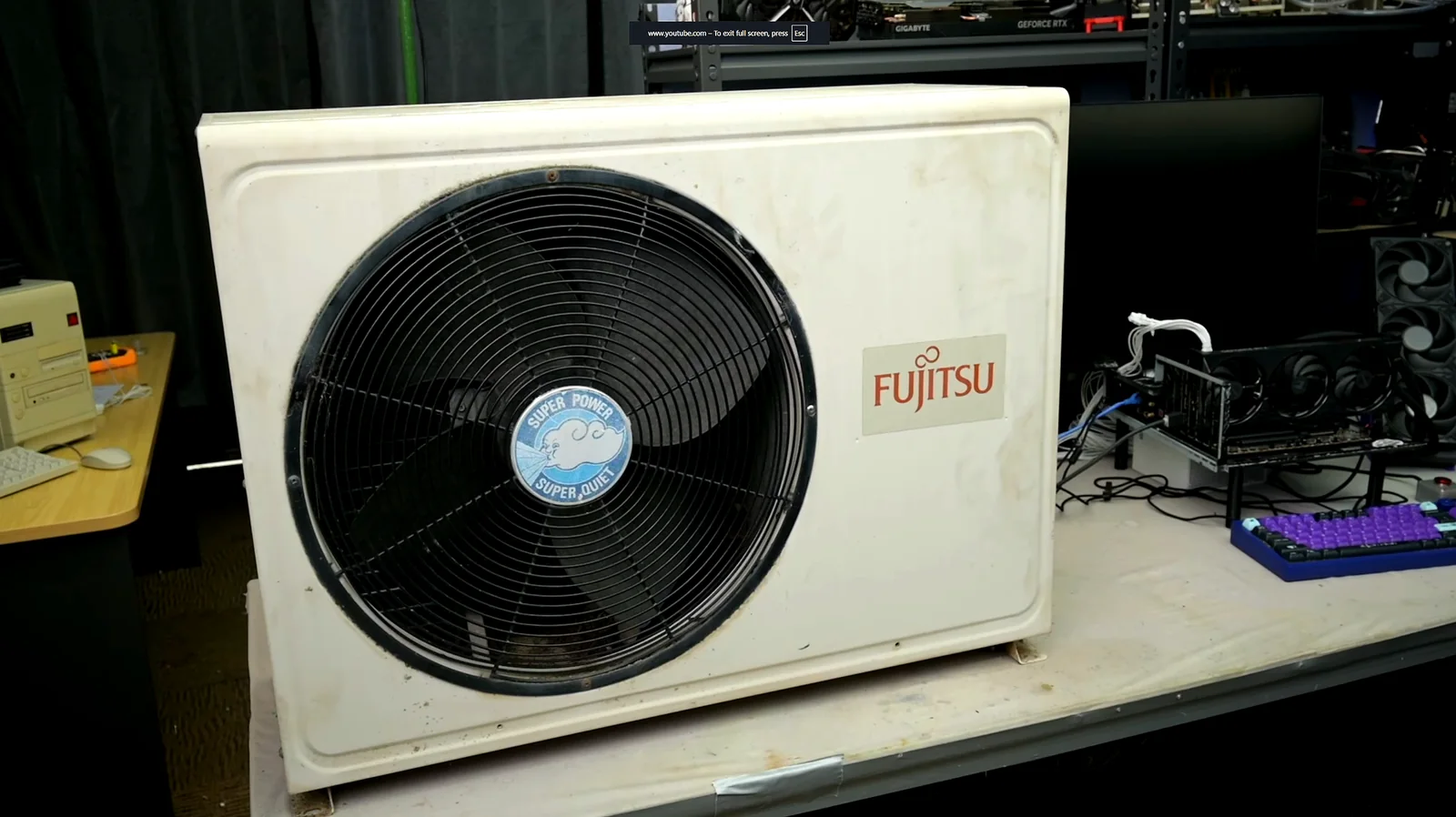
An Australian hardware modder has pushed custom liquid cooling to extremes by repurposing an old 4-kW outdoor radiator and fan unit from a split air-conditioning setup. Stripped of its original gas components and fitted with casters and a standard reservoir, the salvaged hardware was integrated into a custom water-cooling loop.
The builder removed unnecessary internal components to isolate the radiator, fan, and pump assembly, creating a mobile external cooling tower designed to handle massive thermal loads.
On the PC side, modifications included converting standard plumbing fittings into a Y-joint configuration and designing custom 3D-printed mounting brackets to secure the water blocks onto various processors.
Benchmark Results and Thermal Performance
When tested with an Nvidia GeForce RTX 5060, which normally runs at a modest 52ºC under its standard cooler, the massive four-kilowatt cooling capacity dropped temperatures down to just 33ºC, representing a 16ºC improvement.
Capitalizing on the substantial thermal headroom, the modder pushed the GPU boost clock from 2902 MHz to 3300 MHz. Despite the 14% increase in clock speed, average frame rates saw only a 3% uplift, demonstrating the efficiency limits of modern GPU architectures.
A more demanding test involved the power-hungry Nvidia GeForce RTX 3080. Under the AC radiator loop, the card's temperature plummeted from 65ºC down to just 28ºC, bringing it close to ambient room temperature.
Handling Combined CPU and GPU Loads
The final test subjected the cooling rig to a combined workload by pairing the loop with the notoriously power-dense and high-heat Intel Core i9 14900K processor alongside the graphics card.
The setup successfully lowered the Intel processor's temperatures by 18ºC down to 76ºC. Meanwhile, the graphics card's thermal sensors registered virtually no change under the dual load, indicating that the improvised radiator possessed cooling headroom to spare.