Modding Community Bypasses Limits
Over recent weeks, the release of DLSS 5 Neural Rendering in NBA 2K27 was followed by its porting to older GPU generations, alongside the unlocking of DLSS Multi Frame Generation for older graphics cards. Modders Dashdogy and Uncle Burrito explain how the community has been breaking down Nvidia software-based locks on hardware previously restricted from running these features.
During the release of the RTX 5000 series graphics cards, physics and mathematics student Dashdogy watched a Digital Foundry interview discussing Multi Frame Generation locked to Blackwell GPUs. While the idea of MFG running on older RTX 4000 series hardware was floated, the feature was never officially released for Ada Lovelace hardware, prompting the student to investigate.
A few weeks later during mid-semester break, Dashdogy decided to look into whether implementing the feature on older hardware was possible.
Utilizing an AWS instance and spending a week of late nights, he unlocked true MFG on Ada Lovelace hardware, a feat previously believed to be impossible due to incompatible instructions that caused black screens for earlier modders. Extensive testing shows Multi Frame Generation has unofficially arrived for non-Blackwell hardware.
Dashdogy is not the only modder unlocking features for older-gen GPUs. When the DLSS 5 Neural Rendering DLL first emerged online, RTX Remix modder Uncle Burrito examined the package. Despite high computational requirements mentioned in initial reveals, Uncle Burrito targeted the DLL directly.
Reverse-engineering the software with the assistance of AI tools showed that most code was compatible with Ada, suggesting Ada support was left behind as unfinished work rather than a hard technical limit.
Less than a day after an early access version of NBA 2K27 released the DLL, Uncle Burrito ported the technology to Ada hardware. Nvidia subsequently clarified that Neural Rendering would indeed receive support on RTX 4000 series GPUs, reinforcing the theory that implementation on Ada was merely incomplete in initial shipping versions.
These foundational mods now serve as baselines for community integrations of Neural Rendering and MFG, enabling ports all the way back to the 2018 Turing architecture and, in DLSS 5's case, AMD hardware via simple click-and-install tools.
Unlocking MFG (Dashdogy)
Dashdogy's modding background includes creating Stellaris compatibility scripts, but porting DLSS MFG to Ada devices presented a significant challenge due to architectural instruction set differences between Blackwell and Ada. Running Blackwell instructions directly on Ada previously generated frames while returning a GPU error and a black screen.
Nvidia implementations of DLSS rely on Streamline as a universal translation package alongside the Neural Graphics Framework (NGX), proprietary software powering AI features like Super Resolution and Frame Generation.
Targeting Streamline and NGX directly, Dashdogy spoofed memory calls defining how many frames the GPU could generate. This allowed an Ada GPU to process higher frame generation multipliers, bypassing the black frame issue.
Initial releases of the Cyberpunk 2077 mod revealed a sluggish response when using higher than 2X MFG, suspected to stem from Hardware Flip Metering, a feature cited by Nvidia as a barrier for older hardware.
Using a cloud instance with an RTX 6000 Pro Blackwell GPU, Dashdogy conducted kernel dumps and used AI tools to compare the Blackwell kernel against native RTX 4000 series integration.
For 6X frame generation, the GPU renders two real frames and places five generated frames between them, a precise integration necessary to prevent disjointed frame pacing.
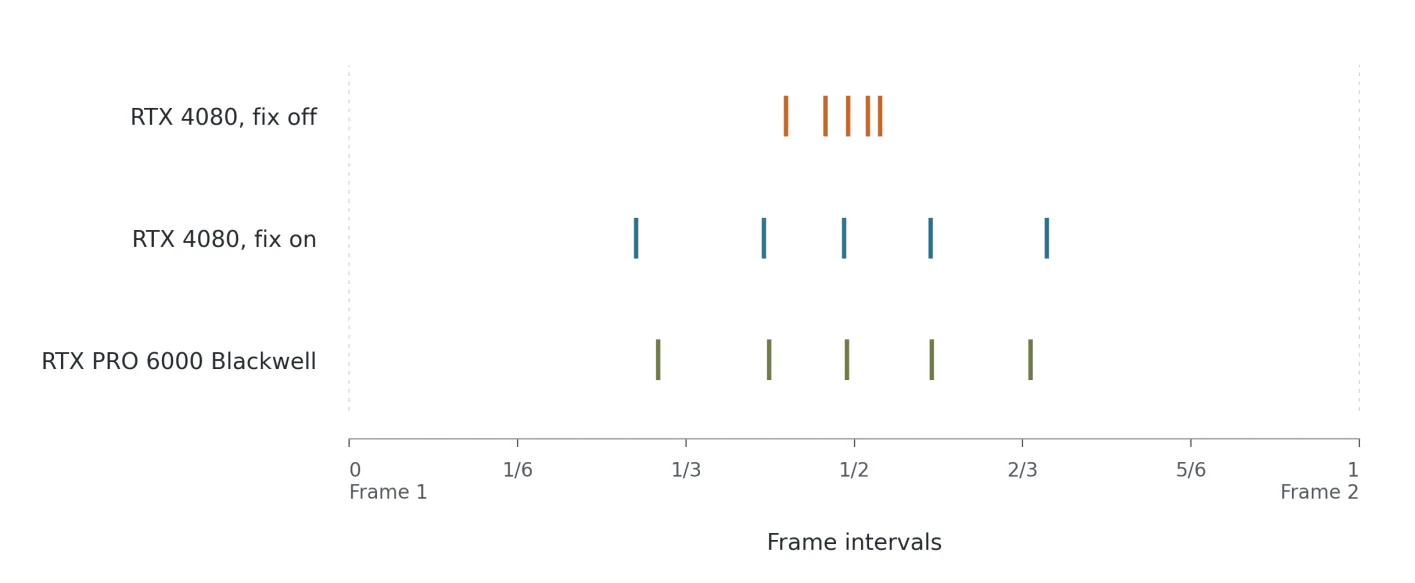
Measurements showed that unpatched 40-series GPUs forced all five generated frames into the same interval used by 2X frame generation, rather than spacing them evenly.
This midpoint scaling limitation caused poor responsiveness. Fixing the kernel motion processing instructions allowed generated frames to spread out evenly, matching Blackwell behavior.
The mod operates wherever standard frame generation is implemented, utilizing backported architecture-specific optimizations from the 50-series to improve overall latency.
The frame pacing fix now operates as a loadable ASI file controlling up to 6X frame generation, with subsequent forks integrating the logic into ReShade.
Unlocking DLSS 5 NR (Uncle Burrito)
Graphics enthusiast Uncle Burrito, known for implementing Path Tracing into Need For Speed Underground 2 using RTX Remix, tracked the emergence of the nvngx_dlssnr.dll file.
While written for Blackwell, the Ada architecture shares FP8 instruction support used by DLSS 5 Neural Rendering to load model weights.
Although the model weights require code execution via CUDA binaries, architecture differences meant certain instructions failed to run on RTX 4000 series hardware.
Out of 15 CUDA binaries within the DLL, four failed to run on Ada, requiring replacement binary patches.
Using Ghidra and Claude Code to recompile binaries initially resulted in a black screen due to an incorrect CUDA SDK version selection, despite displaying the neural rendering debug banner.
Uncle Burrito emphasized the importance of understanding underlying code mechanics when working with AI coding tools to avoid operational pitfalls.
After recompiling with the correct CUDA SDK, Ada performance matched expectations given its native FP8 support and hardware limits.
Because modern games rely on standardized motion vectors and depth buffers, the patched DLL functions as a drop-in replacement.
Subsequent development by RenoDX expanded support to Ampere and Turing architectures by translating models for FP16 instructions.
Unblocking Software Lockouts
Dashdogy and Uncle Burrito's mods unlock features that would otherwise remain restricted or delayed on older hardware, though performance overhead increases on older architectures.
Modders note that hardware segmentation serves both as a sales strategy for new GPU generations and a practical timeline for optimization.
Given rising consumer graphics hardware costs, community modifications provide users an avenue to extend the lifespan of existing hardware.
The irony remains that unlocking these features on older hardware relied on advanced AI models, utilizing the same technology ecosystem driving modern GPU sales to bypass manufacturer restrictions.



