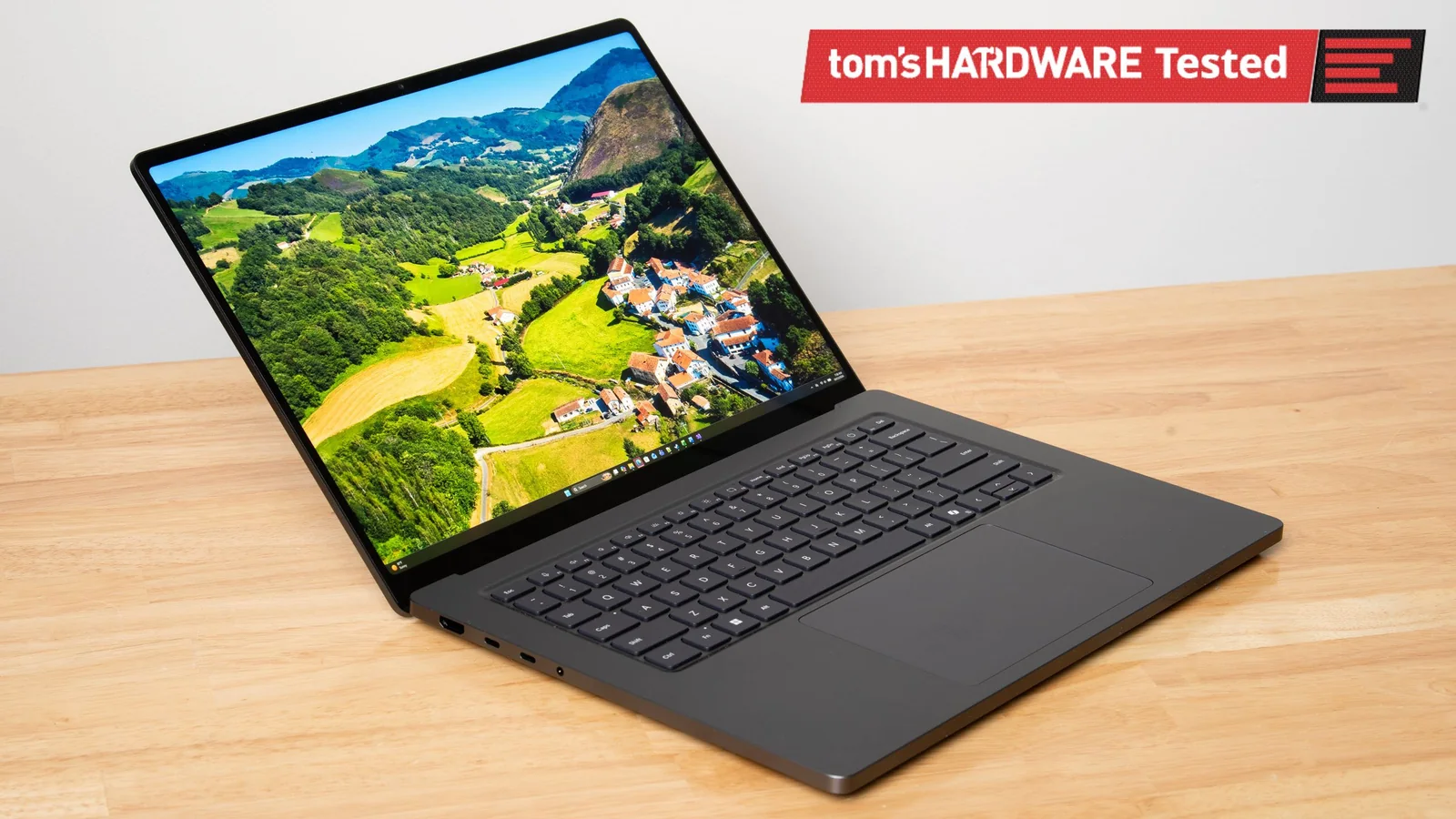
Introduction to RTX Spark
Nvidia CEO Jensen Huang announced the RTX Spark platform with the grand ambition to reinvent the PC. By pairing the GB10 Superchip with a version of Windows on Arm tailored for the secure and contained execution of local AI agents, Nvidia and its hardware partners are paving the way to a future where the PC acts as an active, autonomous companion for work and creation.
The hardware foundation for that vision is now in place. Detailed evaluations of the RTX Spark platform paired with Microsoft’s top-end Surface Laptop Ultra configuration put these claims to the test.
This system features the full RTX Spark Superchip equipped with 20 CPU cores and 6144 CUDA cores, alongside 128GB of LPDDR5X-9400 RAM, providing substantial compute headroom for on-device workloads.
Initial evaluations focus on broad platform capabilities and competitive performance comparisons rather than final battery longevity or display characteristics, which will be covered in upcoming individual hardware reviews.
While battery life remains a primary concern for mobile users evaluating new silicon platforms, comprehensive power metrics require dedicated testing across multiple chassis designs.
For initial comparative testing, the Microsoft Surface Laptop Ultra with RTX Spark was evaluated against a 14-inch MacBook Pro featuring Apple's M5 Max SoC with a 40-core GPU, an 18-core CPU, and 128GB of LPDDR5X RAM, as well as an AMD Ryzen AI Halo system running fresh data stacks.
Local AI performance
Evaluating local AI execution requires looking beyond basic metrics. Past testing typically isolated prompt processing and token generation phases, assuming systems fast at both delivered the optimal experience.
However, agentic workflows demand a broader view of total task completion time across multiple inference turns. To capture this end-to-end duration, analysts developed the AgentPerf-local benchmark to replay inference traces across complex agentic tasks, where faster completion times directly translate to higher user productivity.
Consequently, performance is measured via time-to-completion values similar to traditional content creation and CPU benchmarks, replacing raw time-to-first-token and tokens-per-second statistics.
As local AI benchmarking continues to evolve, standard testing methodologies adapt to better reflect real-world multi-turn assistant behavior.
Testing utilized two compatible models: the dense Qwen 3.8-27B model, known for high local intelligence, and the Qwen 3.6 35B A3B mixture-of-experts model. Each test system compiled llama.cpp from source to leverage hardware-specific CUDA, Metal, or ROCm acceleration.
Using Unsloth’s Q4_K_M quantization, the Qwen 3.8 27B model ran with DFlash2 speculative decoding on the RTX Spark and MacBook Pro platforms, and built-in MTP on the Ryzen AI Halo configuration.
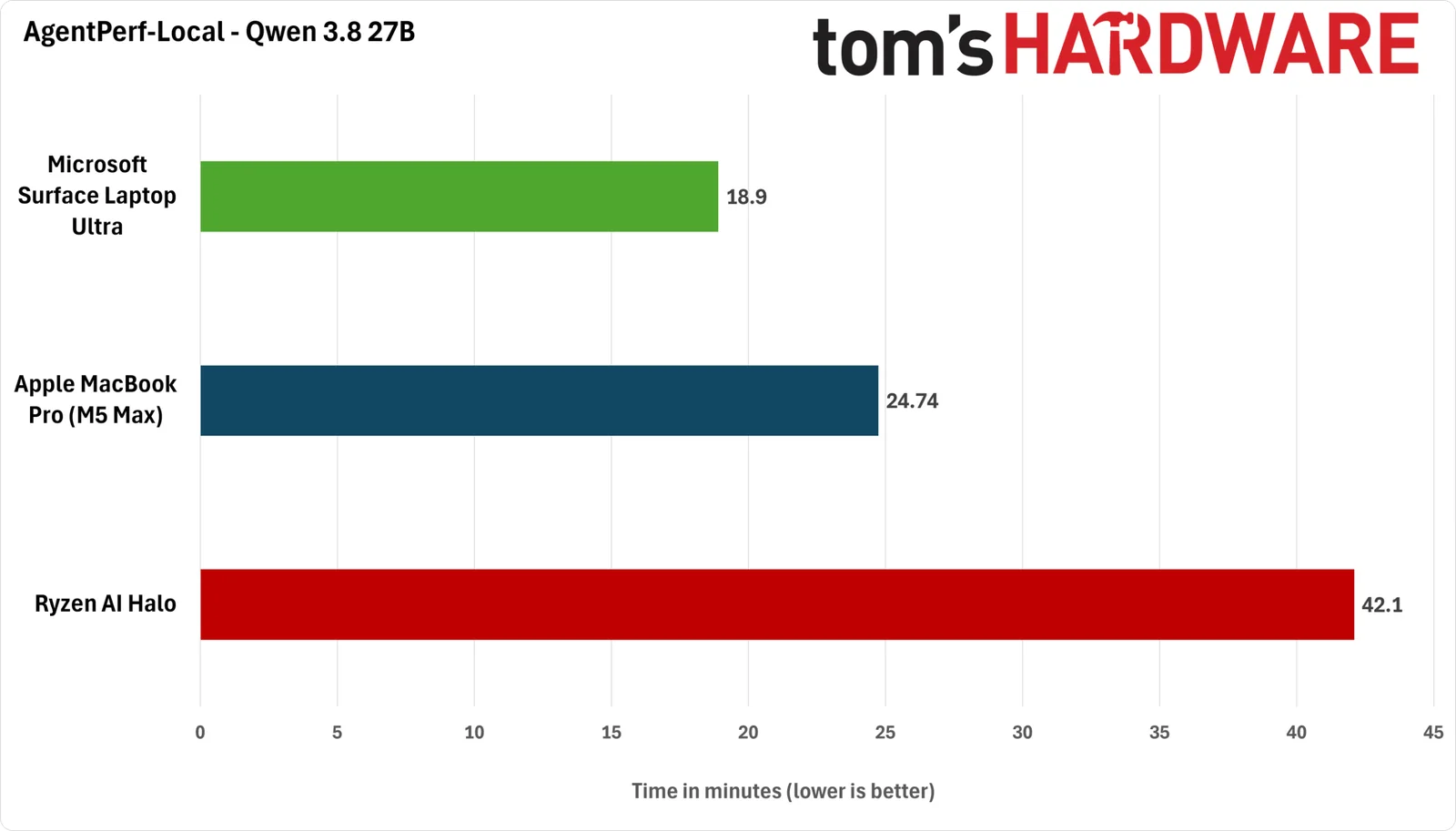
Memory bandwidth is not the sole constraint for local AI execution. Despite theoretical memory bandwidth advantages, the M5 Max MacBook Pro took approximately 25% longer to complete the AgentPerf benchmark with Qwen 3.8 27B than the RTX Spark-powered Surface Laptop Ultra.
While software maturity plays a role, the Surface Laptop Ultra benefits from a larger 15-inch chassis design and a 140W power adapter compared to the 14-inch MacBook Pro's 96W charger.
Even when compared against larger 16-inch Mac configurations with identical 140W power supplies, the RTX Spark platform demonstrates leading execution speed for this specific agentic task.
Older computing platforms like AMD's Ryzen AI Max+ 395 required roughly double the time to finish the same agentic tests with Qwen 3.8 27B, clocking in at approximately 40 minutes.
The mini desktop form factor of the Ryzen AI Halo could not overcome the inherent performance gap observed during these heavy inference workloads.
Testing the lighter-weight Qwen 3.6 35B A3B model with quantization and MTP enabled yielded further efficiency insights.
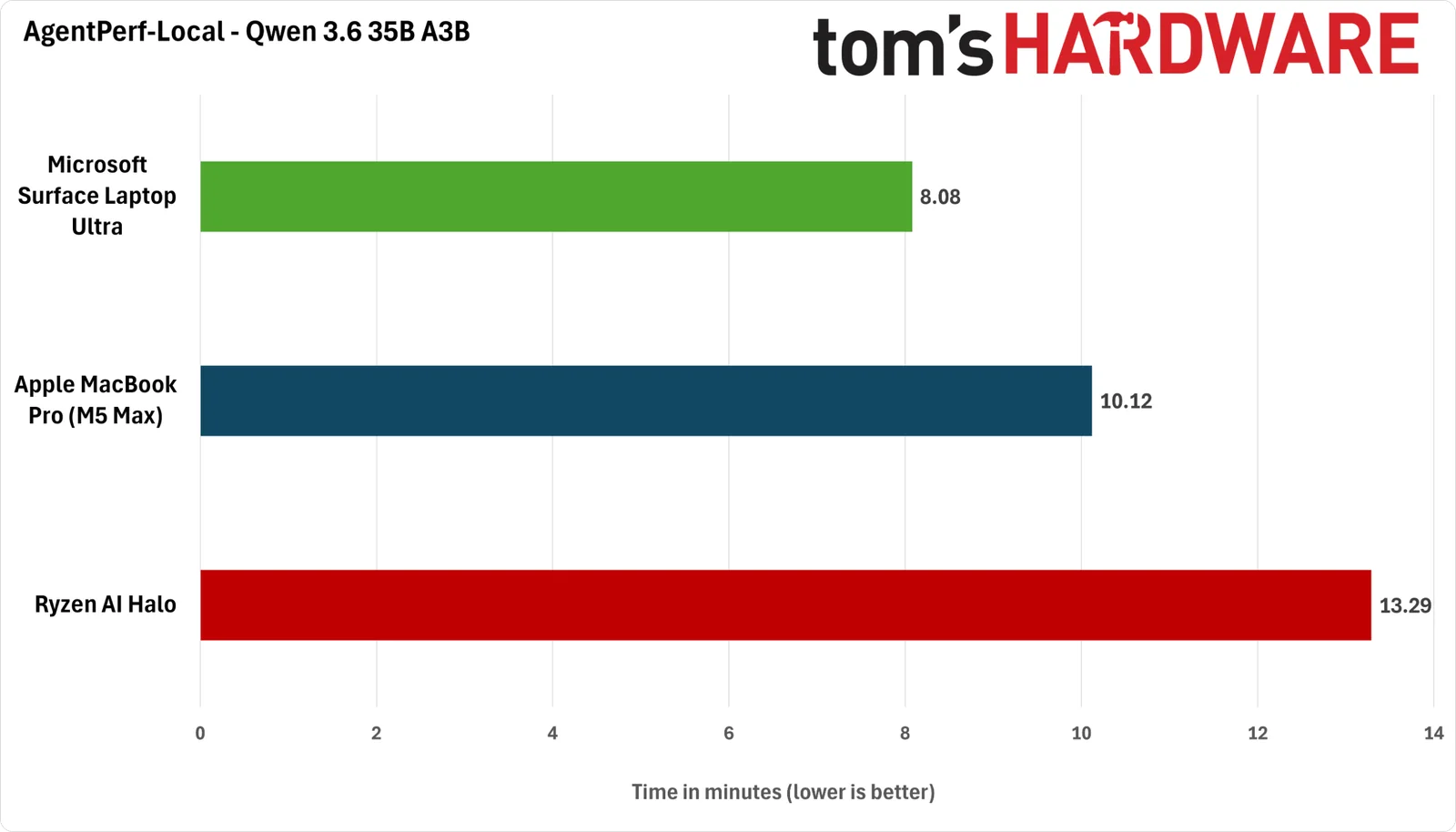
The Surface Laptop Ultra completed the lighter model test in eight minutes, outpacing the 14-inch MacBook Pro's ten-minute finish by 25 percent. While the Ryzen AI Halo finished in a more manageable 13 minutes, it highlighted the compromise in model intelligence required to achieve acceptable speeds on that hardware.
Although lower upfront system costs are attractive, higher performance hardware capable of delivering intelligent tokens more rapidly allows for greater productivity and value generation over time.
Gaming performance: first impressions
Despite Nvidia's emphasis on the 6144-CUDA-core GPU, the RTX Spark platform encounters significant hurdles in gaming. Most modern titles lack native Arm compilation, and the architecture's maximum shared memory bandwidth of 300 GB/s falls short of dedicated graphics hardware.
Because the entire GB10 SoC contends for a limited pool of memory bandwidth, graphics workloads—which are inherently memory-bound—face bottlenecks when feeding the streaming multiprocessors.
Testing with CPU-heavy titles like Gears of War: E-Day reveals that the baseline performance of the Grace CPU cores and the overhead introduced by the Prism x86 emulator negatively impact frame rates.
GPU utilization hovered around 85% on average at near-1080p resolutions with high presets and frame generation enabled, alongside occasional stability hiccups during map transitions.
Due to heavy CPU dependence, demanding titles highlight the necessity of native Arm builds for optimal execution efficiency.
Titles less reliant on the CPU still encounter architectural bandwidth limitations when scaling up graphical presets.
Achieving stable frame rates at the Surface Laptop Ultra's native resolution required dialing down settings, utilizing DLSS Performance upscaling in windowed mode, and employing frame generation to approach the display's 120Hz refresh rate.
Even with optimizations, input latency remained higher than standard desktop gaming rigs, and enabling ray tracing severely impacted frame rates and latency.
Gaming is clearly a secondary focus for the RTX Spark platform. Navigating limited memory bandwidth and emulation overhead requires careful tuning of settings, resolution, and upscaling to maintain acceptable smoothness.
DLSS Frame Generation proved essential for maintaining fluid motion and managing developer-intended latency profiles in supported titles.
Despite Nvidia Reflex integrations, the Grace CPU architecture yields higher input latencies compared to traditional high-end x86 gaming desktops.
Users demanding minimal input latency and maximum frame rates in cutting-edge games will still be better served by a traditional laptop featuring a dedicated RTX graphics processor.
Bottom line
Nvidia's RTX Spark represents a bold attempt to reshape personal computing for future agentic AI workflows, introducing significant silicon integration to the mobile PC market.
Performance evaluations demonstrate that despite modest CPU metrics and shared memory constraints on paper, the Blackwell GPU on the GB10 chip delivers sufficient AI horsepower to outpace top-tier competing SoCs.
Whether opting for dense models focused on intelligence or faster mixture-of-experts architectures, the platform consistently delivers strong processing speeds for local assistants.
However, the platform's inaugural iteration falls short of a complete sweep across all consumer use cases.
It cannot fully replace a dedicated gaming notebook, as gaming performance often fails to meet high-end expectations.
The combination of Prism x86 emulation overhead and moderate CPU speeds creates bottlenecks for unoptimized software titles.
Even in titles with lighter CPU dependency, shared memory bandwidth constraints limit maximum graphical settings.
Additionally, complete operating system software support for secure, manageable local agents within Windows remains a work in progress.
Considering it is a first-generation product combining complex IP from multiple engineering teams, the overall maturity and polish of the RTX Spark ecosystem remain impressive.
Real-world daily use as a primary Windows machine reveals minimal friction for standard productivity workflows, marking a solid milestone for on-device AI integration.
The primary barrier to adoption is cost, with launch configurations commanding steep pricing for modest storage capacities.
Users unconcerned with cloud data privacy can often access faster, larger models via cloud APIs on traditional hardware for significantly less investment.
For enthusiasts prioritizing privacy, offline availability, and local hardware control, the RTX Spark successfully merges high memory capacity and compute density with Windows compatibility.
Broader market success will depend on overcoming economic hurdles such as component price fluctuations and software ecosystem maturity over subsequent hardware generations.
Ultimately, the RTX Spark targets dedicated believers willing to invest heavily in the future of local AI infrastructure today, while mainstream users may prefer to wait for fuller software optimization.



