The Warranty Nightmare
When a PC gamer's GPU with a 12VHPWR or 12V-2x6 power connector melts, it's often in a computer they built by hand, and they typically only have one chance at recourse — hoping their GPU is under warranty and making a claim.
But it ends up that when someone else built your PC, it could open up a can of worms that has two companies pointing the blame at each other while a customer sits with a burned-up RTX 5090, power supply, and power cords.
That's what happened to one system owner, whose father purchased a Digital Storm Corsa system delivered in May of 2025. The system was packed up and stored until it was unboxed later, featuring an AMD Ryzen 9 9950X, 2TB Crucial T700 Pro SSD, 64GB of Kingston Fury RGB RAM, and an Nvidia GeForce RTX 5090 from PNY, costing $5,245.00 before tax.
The computer was put into regular use months later, and problems started just two weeks into operation.
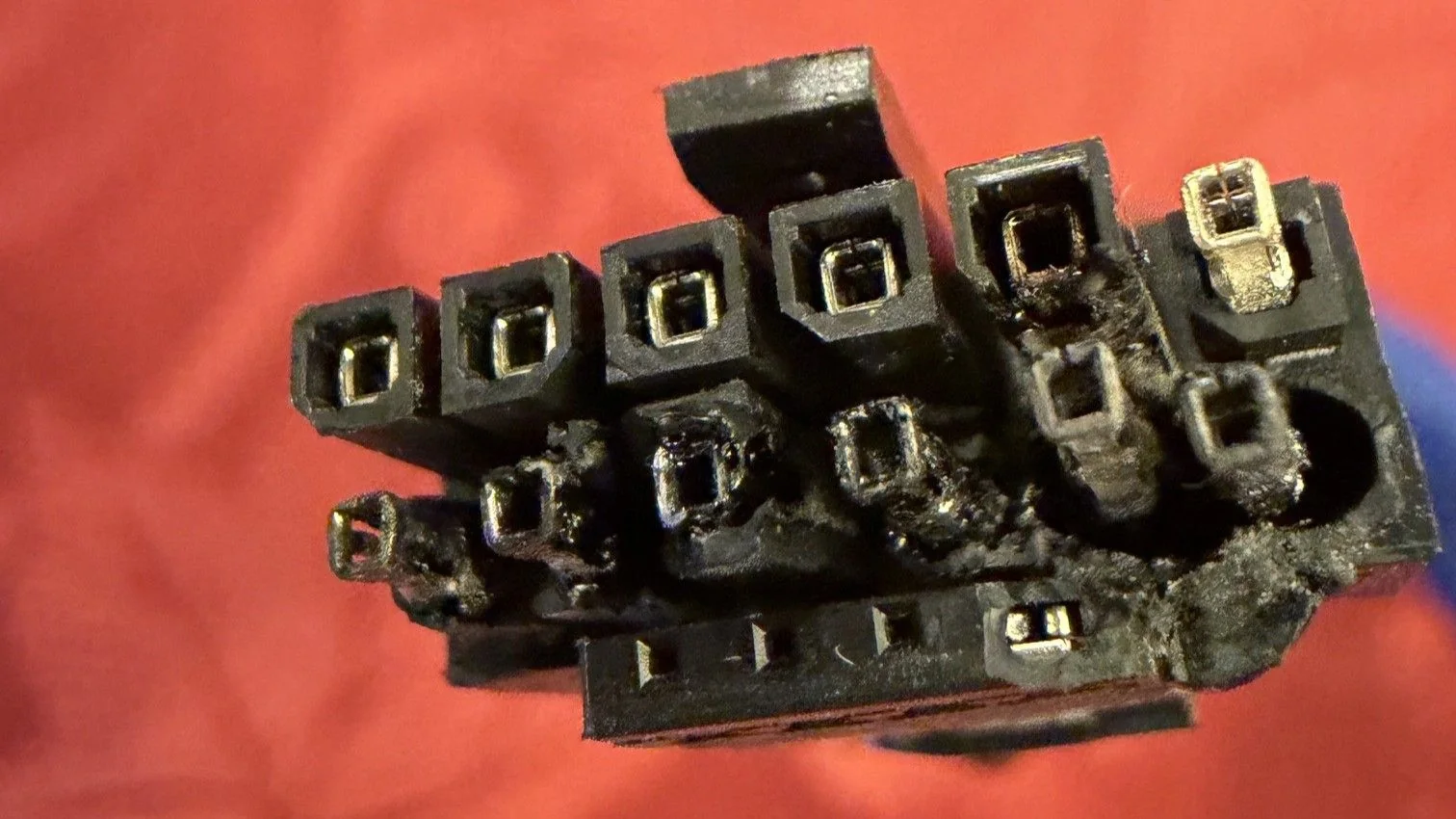
The user noticed a strange burning smell near the machine, followed by monitor flickering. After diagnosing potential hardware issues, an inspection of the internal wiring revealed severely melted and burned cables.
The power cable was fused directly into the connector, and while the user managed to separate the pieces, parts of the connectors remained permanently stuck together.
The damage extended beyond the GPU to the power supply, a 1,000-watt semi-modular model from Digital Storm with an 80-Plus Gold rating, equipped with custom blue-sleeved cables. The cable header fused completely into the power supply unit, leaving bare wires exposed at both ends.
The owner verified that all internal cabling was properly seated before bringing the system online.
Pictures of the damage
Photographic evidence showed severe thermal damage across both ends of the power cable, along with burns along the length of the wire itself and visible deformation near the GPU interface.
Navigating Manufacturer Support
The owner faced a complex path for recourse between Digital Storm, the system integrator, and PNY, the manufacturer of the graphics card.
Digital Storm offers a one-year warranty on hardware parts and three years on labor, meaning the parts warranty had already expired by the time the fault manifested. However, individual components carry manufacturer warranties, such as PNY's three-year coverage for GeForce RTX gaming GPUs.
An initial support ticket opened with Digital Storm was closed after customer service noted that the parts warranty had expired and advised attempting an RMA directly with PNY.
When the owner contacted PNY for an RMA, the process hit a roadblock regarding the use of custom cables provided by the system builder.
A PNY support representative clarified that the company's warranty covers only PNY-approved power cables or adapters included in the retail box. Using third-party power cables, adapters, or custom PSU wiring that results in melting, burning, or deformation voids warranty eligibility for the hardware.
The company stated it cannot process an RMA when damage is attributed to unsupported or third-party cabling solutions.
Further inquiries into whether PNY publishes approved cable compatibility lists or extends coverage to third-party system builder bundles yielded limited exceptions.
While systems purchased from authorized builders are generally covered, their custom cabling configurations may not inherit direct component-level approval.
The frustrated consumer ultimately filed a safety report with the Consumer Product Safety Commission database.
In a statement, PNY emphasized that it stands behind its graphics cards, including those sold through authorized partners, and noted it would review the case directly with the customer.
Digital Storm did not respond to requests for comment regarding the incident.
Out-of-pocket repair options were unavailable through the manufacturer, echoing similar disputes across the hardware community involving third-party or bundled power supplies.
Digital Storm's warranty policy states it will help replace defective parts post-expiration if manufacturer coverage remains active, though no supporting records were provided to confirm assistance in this case.
Industry-Wide Connector Concerns
The affected owner expressed a preference for a direct component refund rather than a replacement due to ongoing safety concerns regarding high-end graphics hardware.
The user pointed to widespread reports of high-power connector melting issues affecting modern flagship graphics cards.
While connector failures have been documented across multiple brands on both RTX 4090 and RTX 5090 hardware, the issue ties back to the standardized 12VHPWR and 12V-2x6 interfaces overseen by the Peripheral Component Interconnect Special Interest Group (PCI-SIG).
PCI-SIG previously issued member notices emphasizing rigorous safety testing to mitigate risks associated with high-current power delivery.
System builders often source components from various top-tier manufacturers like ASUS, PNY, and MSI interchangeably, meaning replacement parts do not always guarantee a different hardware ecosystem.
Vendor warranty policies regarding third-party cables remain varied and often ambiguous across the industry. Brands like MSI explicitly state that unauthorized parts or software can void warranties, while others maintain vague language concerning bundled accessories.
Purchasing prebuilt systems well in advance of actual use risks letting the standard warranty clock run out before deployment, leaving buyers with limited leverage.
Lessons for Prebuilt and Custom Builders
When building a PC independently, the responsibility for cable selection rests entirely on the builder, whereas prebuilt systems shift that accountability to the assembler.
Reviewing individual component warranties can be tedious, but understanding a system integrator's overarching support terms provides clarity on long-term coverage limitations.
Buyers seeking maximum accountability can opt for unified hardware ecosystems where a single manufacturer produces both the graphics card and power supply.
Purchasing expensive hardware gifts close to their deployment date—or securing extended coverage plans—helps ensure proper warranty utilization if early failures occur.
Verifying all internal connections, power headers, and component seating upon delivery remains a prudent preventive measure for any prebuilt system.
Best Practices for Custom Rigs
Custom builders aiming for maximum warranty security often rely exclusively on the dedicated power adapters bundled directly inside high-end GPU packaging, such as multi-adapter 16-pin to PCIe configurations.
However, doing so can bypass native power supply cables designed to simplify modern cable management.
As flagship GPUs continue to scale in power and cost, calls are growing for hardware manufacturers to standardize complete 16-pin ATX cabling solutions directly in the box across all vendor partnerships.
Customization remains a core appeal of PC building, but strict vendor liability boundaries mean enthusiasts must navigate potential hardware incompatibilities carefully.