Low-Loss Silicon Photonics
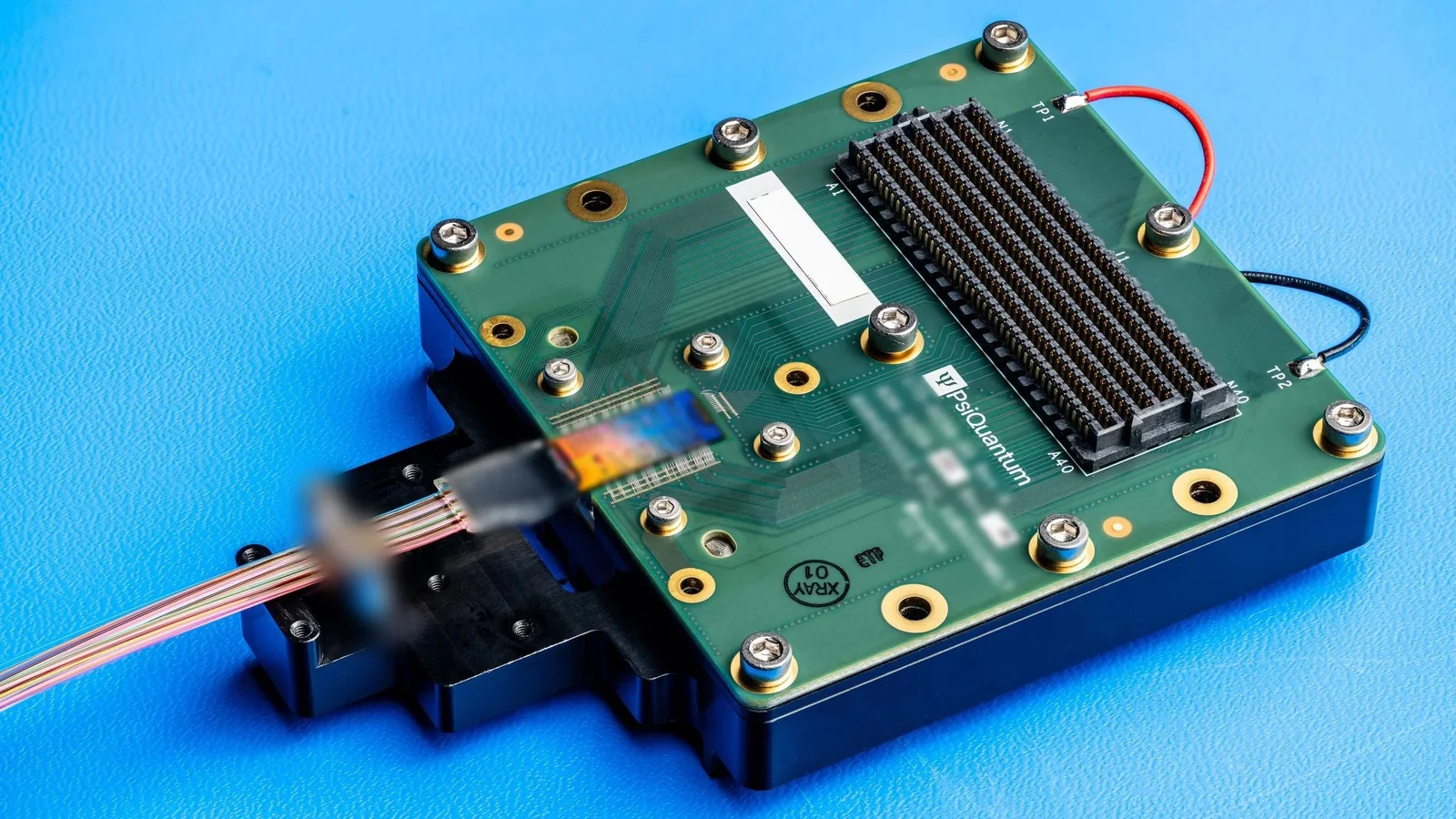
Quantum computing company PsiQuantum has announced the development of an optical switch built from its low-loss silicon photonics platform for use in artificial intelligence data centers. Optical switches traditionally suffer from light loss, where the amount of light fading across the switch is measured in decibels. While standard data center optics can tolerate a 3 dB loss, representing half the light, PsiQuantum's new switch debuted with a laboratory demo losing only 1.2 dB, or roughly a quarter of the signal, without requiring an amplifier. The initial prototype features an 8x8 configuration with eight inputs and outputs, placing it behind commercial alternatives with 32 to 300 ports, though larger hardware is currently in development.
The optical circuit switch routes light directly from fiber to fiber without conversion to electrical signals. Conventional data center switches perform this conversion at every hop, consuming power and introducing latency. An optical circuit switch maintains a fixed light path until a reassignment is triggered, with performance largely determined by insertion loss. PsiQuantum's design etches circuits onto a silicon chip containing no moving parts, avoiding the tiny microelectromechanical mirrors utilized by competitors like Google and Lumentum, allowing it to function alongside standard packet switches.
Eliminating signal conversions becomes increasingly critical as AI computing clusters expand, since moving data between graphics processing units represents a significant network bottleneck. Optical interconnects offer higher bandwidth than copper wiring, which faces strict distance limitations, though industry-wide laser shortages remain a challenge. Improving communication bandwidth and reach allows separate server racks containing GPUs to communicate efficiently and operate as a unified system.
Competitive Landscape
Comparable switches developed by Salience Labs and iPronics incorporate built-in amplification and maintain insertion loss ratings under 2 dB, representing less than 37 percent light loss. Google's mirror-based Palomar switch also achieves sub-2 dB loss across 136 ports. While Salience and Lumentum offer products with 32 and 300 ports respectively, PsiQuantum's eight-port prototype trails in port density.
PsiQuantum's 8x8 architecture ensures that every input connects to every output in a strictly non-blocking design where establishing new connections does not disrupt existing ones. Laboratory measurements recorded a typical 1.2 dB insertion loss, 40 dB of crosstalk corresponding to about 0.01 percent light leakage to adjacent ports, and a reconfiguration time under 3 milliseconds. These metrics surpass initial engineering targets. The loss figures account for fiber-to-fiber transitions, including coupling light onto and off the silicon chip, but exclude external connector losses.
Minimizing optical component loss is vital because quantum computing architectures tolerate minimal signal degradation. Published research indicates that PsiQuantum's silicon nitride waveguides achieve loss rates as low as 0.5 dB per meter, while splitters and crossings achieve 0.5 and 1.2 millidecibels respectively, keeping individual component loss to a fraction of a percent.
The company reports that chip-to-fiber coupling achieves approximately 60 millidecibels of loss, representing about 1.4 percent light loss under optimal laboratory conditions without an attached fiber array. These measurements establish a baseline rather than worst-case projections for a 64-port switch, as routing light across additional internal components increases cumulative loss.
Integration and Standards
Acceptable loss thresholds depend on transceiver optics deployed at link terminations. Optics manufacturers indicate that optical circuit switches can introduce up to 3 dB of additional insertion loss while remaining compatible with standard transceivers. Lumentum notes that 3 dB loss supports off-the-shelf FR4, DR4, and DR8 optical modules used to interconnect GPU servers across distances ranging from 500 meters to 2 kilometers. PsiQuantum's prototype targets the O-band wavelength range utilized by these plug-in modules, adhering to internal requirements specifying insertion loss below 2 to 3 dB.
The 8x8 prototype targets conventional data center workloads and satisfies Nvidia's proposal requirements by remaining well below the 3 dB loss ceiling. Although the current port count serves a demonstrative role, PsiQuantum has taped out a 64x64 variant, initiated a 72x72 design, and continues developing larger form factors. The company plans to maintain low loss characteristics as scale increases.
Switching speed remains secondary to insertion loss for current optical circuit switch deployments. Google utilizes thousands of switches to resize tensor processing unit pods or bypass failed hardware using millisecond-scale microelectromechanical systems switches. PsiQuantum's sub-3 millisecond reconfiguration time falls within this operational class, although competing amplified chip switches achieve sub-300 microsecond speeds to assist with mid-workload network adjustments.
Opportunities remain to enhance switching speeds using barium titanate, a material already deployed in PsiQuantum's 64-port quantum system switches to manipulate light at gigahertz frequencies. Barium titanate exhibits a strong refractive response under voltage, maintaining short switching elements and low losses at speeds significantly faster than the current demonstration vehicle. While initial commercial products rely on thermally switched silicon nitride platforms, barium titanate provides a pathway for advanced future iterations.
Deploying commercial switches for conventional applications helps de-risk the manufacturing, packaging, and supply chain infrastructure required for quantum computing hardware. Artificial intelligence and quantum systems share complementary technologies, presenting an opportunity to commercialize underlying research. Leadership additions and federal funding awards aim to accelerate the application of this silicon photonics platform across next-generation computing infrastructure.
Company executives emphasize the advantage of monolithic chip architectures over moving-part designs. Nvidia maintains a financial stake through its venture arm and collaborates with PsiQuantum on graphics and quantum processing unit integration alongside silicon photonics research. Nvidia also holds investments in competing optical switch developers.
Market research indicates that while optical circuit switches currently rewire artificial intelligence clusters primarily inside hyperscale environments like Google, broader industry adoption remains in early proof-of-concept stages. Market forecasts project expanded demand through the end of the decade, creating commercial opportunities for GPU network integration. PsiQuantum has distributed evaluation samples and testing kits to select computing vendors and hyperscalers.
Commercial product announcements are anticipated in the coming months alongside updates regarding larger hardware configurations. While competitors have demonstrated 64-port and larger roadmap designs, verified performance at scale will determine the commercial viability of larger monolithic optical circuit switches.