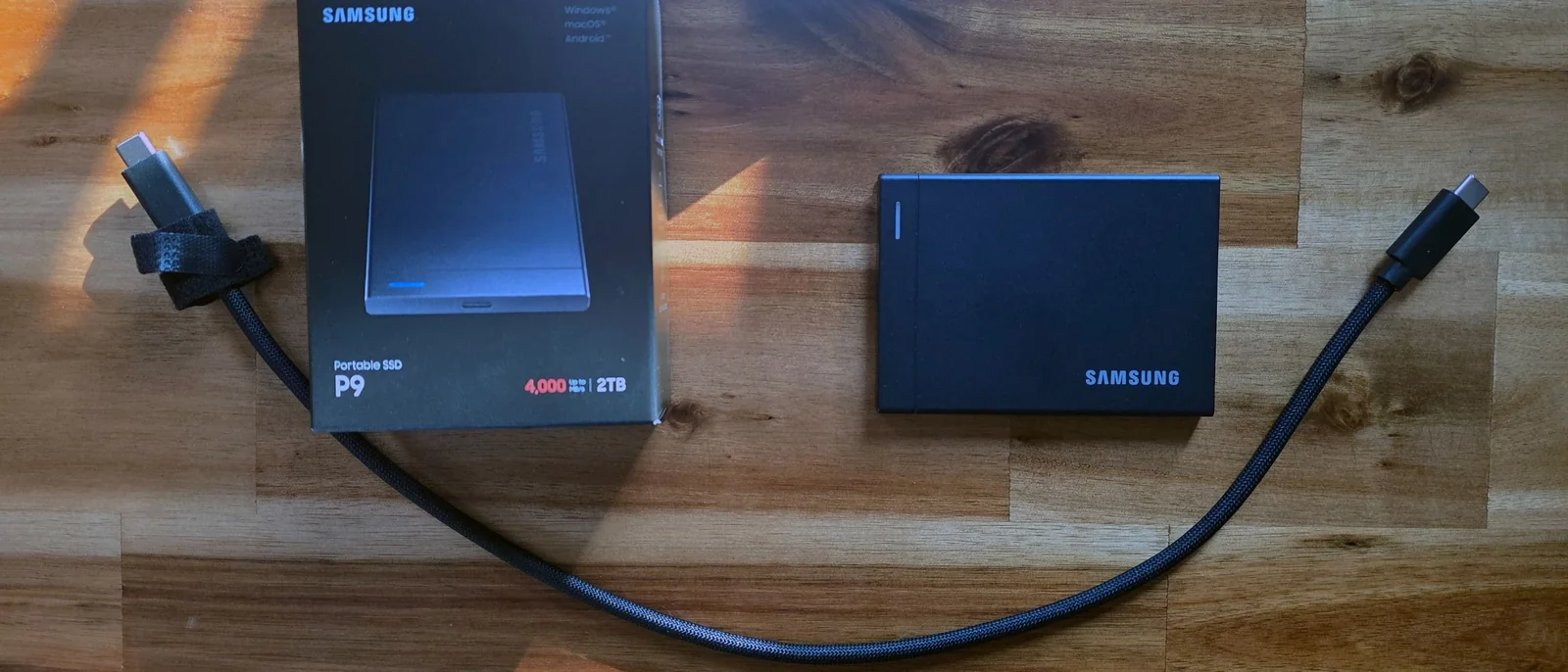
It’s a tough time to launch an external SSD, with demand for flash and RAM at all-time highs thanks to AI hyperscaler demand. But content creators, videographers, and media collectors need more, faster, and roomier options, so Samsung has launched its first USB4 external drive, the Portable SSD P9.
Performance and Pricing Overview
It’s offered in 1, 2, 4, and 8TB capacities, with rated sequential read speeds up to 4,000 MB/s and write speeds up to 3,800 MB/s, packed into a slim 0.3-inch solid shell. It also includes one of the nicest-feeling sleeved cables I’ve come across, measuring a generous 16 inches. The Samsung P9 is a premium, pocket-friendly portable drive that’s speedy enough to potentially knock rival models out of their top USB4 drive spots.
It’s also quite expensive, starting at $339 for the 1TB model, $649 for the 2TB version tested here, and commanding $2,879 for the 8TB model. While these prices might seem extreme compared to older budget entries, Samsung’s pricing aligns reasonably well with current USB4-based competition amid widespread component scarcity.
Design and Build Quality
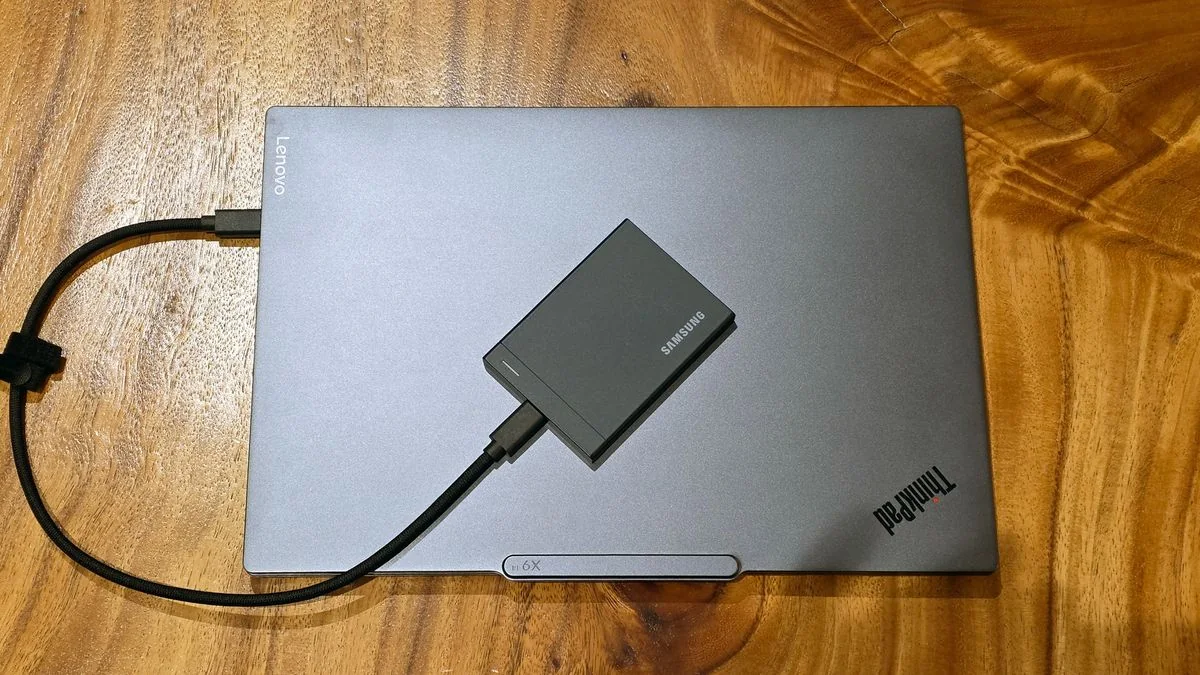
At 3.5 x 2.6 x 0.3 inches and weighing 0.21 pounds, the P9 is neither the smallest external storage drive nor the lightest. However, it is slimmer than the previous-generation T9 drive, which measures 0.55 inches thick and runs at roughly half the speed (20 Gbps). It ditches the rubber, dust-collecting coating of the T9 in favor of a solid metal shell, while the bottom features a rubber coating to keep the drive anchored on a desk.
There are no official IP ratings for dust or moisture resistance in Samsung’s specification sheet. Even so, the P9 feels exceptionally rigid and solid, giving confidence that it can withstand physical impacts well beyond its rated 2-meter drop threshold.
The bundled 16-inch braided cable is a standout accessory, featuring integrated hook-and-loop fasteners to keep excess length under control. The ample length and premium build quality make it a welcome addition for desktop users.
Software Suite
Samsung includes a Samsung Magician Launcher link on the drive that prompts users to download the latest software version. The application provides widgets and sections for drive health and management, temperature monitoring, performance diagnostics, secure erasing, and 256-bit hardware encryption.
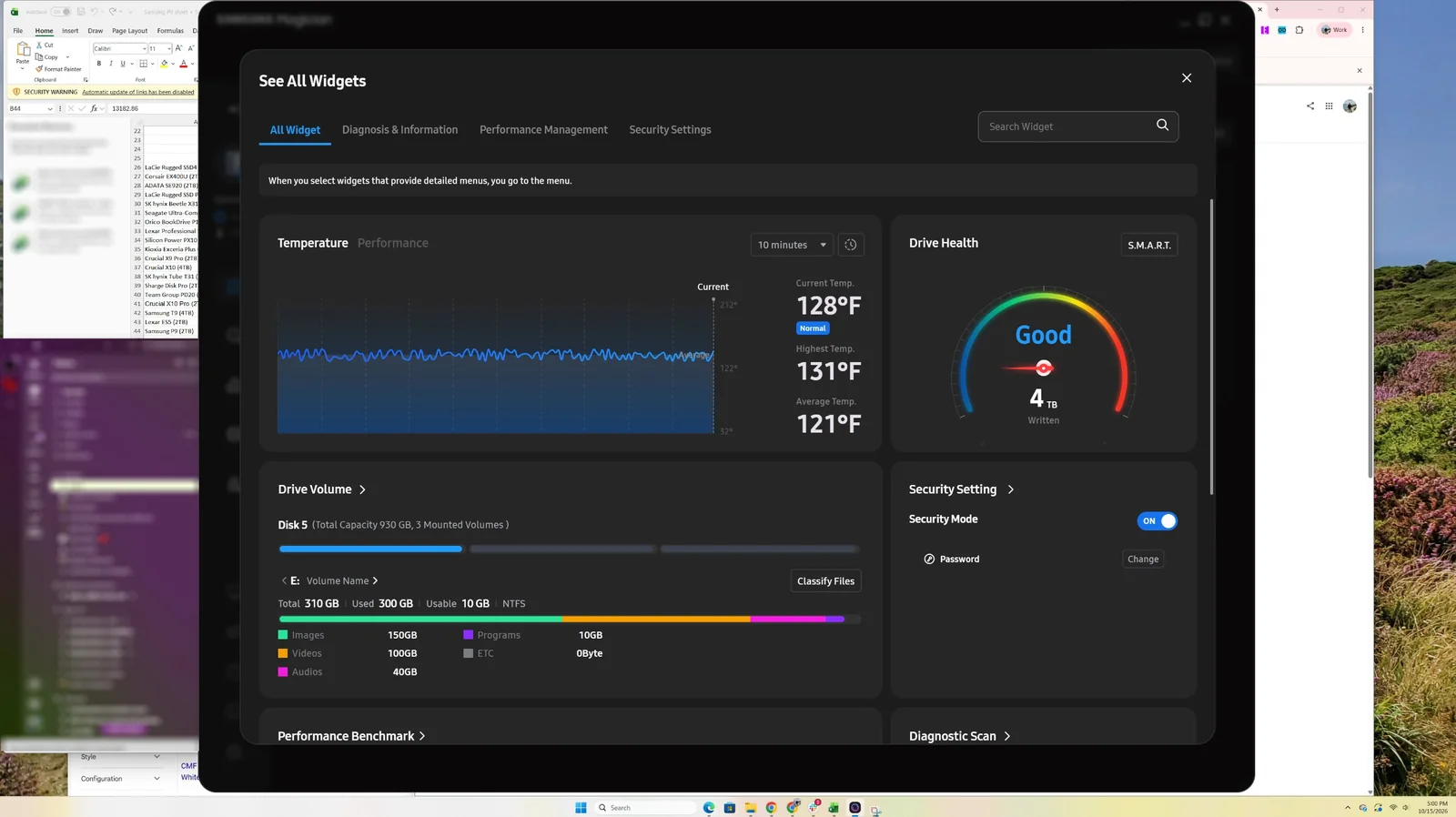
While feature-rich, the software suffers from a mobile-app-first design that can feel oversized and clunky on a desktop environment, with rounded corners and interface scaling that occupies immense screen real estate.
Market Competition
Samsung faces stiff competition on the USB4 front, though many rival options are increasingly scarce due to flash memory availability. SanDisk’s Extreme Pro serves as a primary USB4 competitor, with the 2TB version priced around $549.
Other alternatives like LaCie’s Rugged SSD4 perform admirably on both Windows and Mac systems, but are difficult to find in stock through major retail outlets, frequently commanding high prices when available.
Alternative USB4 drives from manufacturers like Corsair have long been praised for value and compact dimensions, though stock shortages have driven their market prices upward.
For users who do not require full USB4 speeds, 20 Gbps alternatives such as Crucial’s latest X10 offer lower performance classes at reduced price points.
Ultimately, the $649 price tag for the 2TB Samsung P9 remains steep. It commands a premium over competitors like SanDisk, prompting a thorough look into its benchmark results.
Benchmark Methodology
Testing was conducted on an AMD Ryzen-based PC featuring native USB4 support via an Asus ROG Crosshair X870E Hero motherboard to ensure optimal hardware compatibility.
Drives were re-tested under updated system conditions using CrystalDiskMark 8, excluding sustained Iometer sequential tests which specifically measure cache endurance over extended workloads.
Trace Testing - PCMark 10 Storage Benchmark
PCMark 10 employs a trace-based benchmark utilizing real-world application traces to measure everyday storage performance.
The Samsung P9 trails behind specialized Thunderbolt 5 drives and select competing USB4 options in the PCMark 10 trace suite, though it outperforms several other prominent USB4 alternatives.
Transfer Rates — DiskBench
File transfer testing utilizes a custom 50GB dataset comprising 4,617 files, including images, videos, and software ISO images, measured across both write and read operations.
Samsung’s P9 secured the lead in real-world write speed tests. While its read speeds landed slightly lower in the rankings, it comfortably outpaced competing USB4 solutions.
Synthetic Testing: CrystalDiskMark
CrystalDiskMark evaluates how storage devices handle varying file sizes under default synthetic conditions.
The Samsung P9 excels in synthetic testing, capturing first place in both read and writes among high-end drives, outperforming rivals by significant margins.
Sustained Write Performance
External SSDs utilize a high-speed SLC write cache to absorb incoming bursts of data before writing to native flash memory.
Sustained write speeds degrade when the cache saturates. Iometer testing subjects the drive to 15 minutes of continuous sequential writes to measure cache capacity and post-saturation behavior.
Although Samsung does not disclose SLC cache specifications, the P9 exhibits largely positive sustained performance characteristics during extended test runs.
During the initial minute, the P9 wrote near its maximum specification at roughly 3,750 MB/s before dropping to a stable 2,200 to 2,400 MB/s range, maintaining this velocity for 12 minutes.
Competitors like SanDisk maintained initial speeds longer, but experienced deeper performance drops post-saturation, whereas the P9 successfully recovered part of its write speed late in extended testing.
Other USB4 drives displayed more consistent behavior but failed to reach the peak transfer ceilings achieved by Samsung's hardware.
Bottom line
Despite a lofty price tag, the Samsung P9 delivers exceptional testing results, consistently outperforming rival hardware in real-world and synthetic workloads.
While alternatives offer lower entry prices, market stabilization is expected to narrow pricing gaps as Samsung's drive establishes a firmer footprint.
Ultimately, the Samsung P9 proves faster in critical professional scenarios such as sustained writing, and its travel-friendly dimensions make it a top-tier option for demanding storage workflows.