When examining the history of computer monitor reviews, it's clear that while many brands dominate the market, other companies possess comparable engineering expertise and deliver high-quality displays, particularly in the realm of gaming monitors.
For those familiar with older display technologies, the Sony Trinitron CRT tube stands out. This advanced display featured a cylindrical shape, differing from the typical bubble screens of other CRTs, and was highly regarded for its sharp, undistorted image quality.
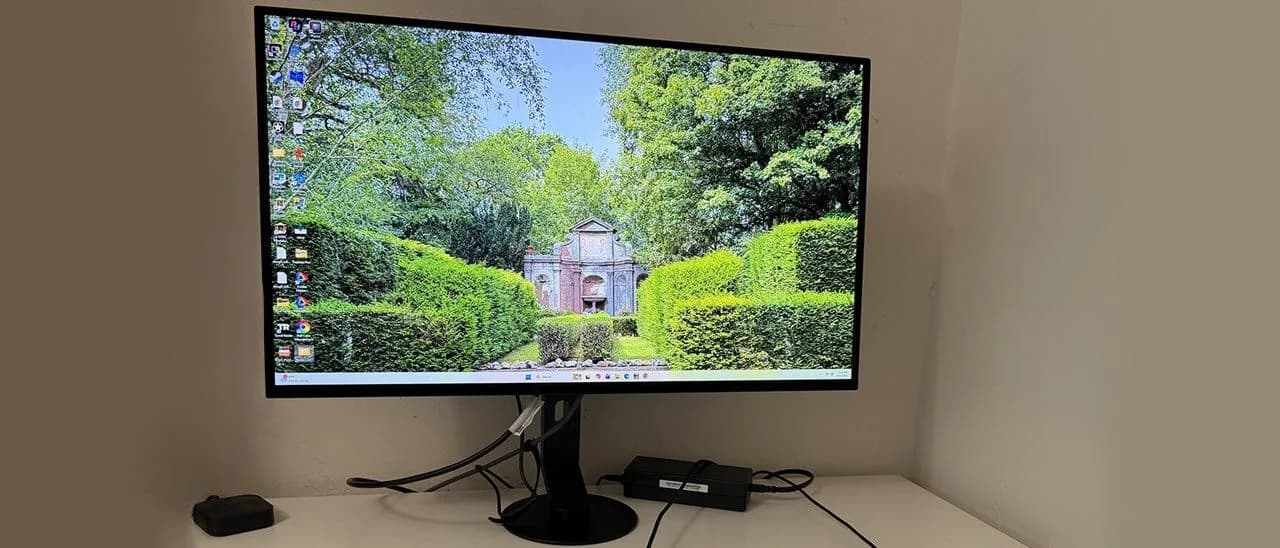
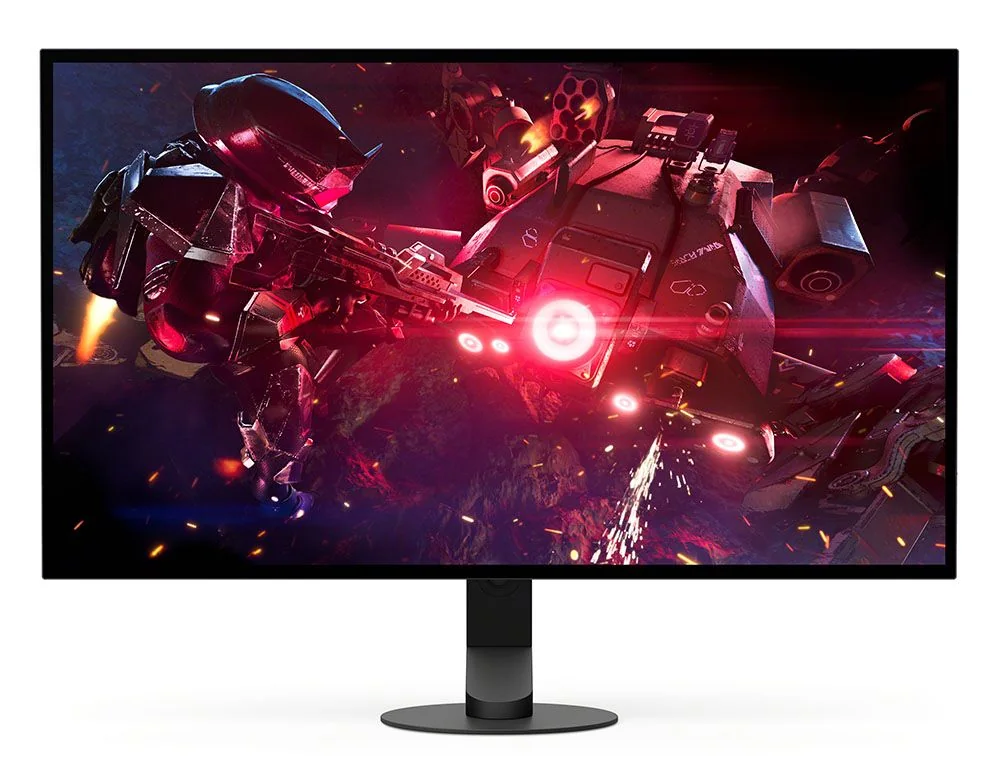
Sony continues its legacy with premium gaming monitors, introducing its latest model: the INZONE M10S II. This 27-inch OLED display offers QHD resolution and an impressive 540 Hz refresh rate. It also supports 720 Hz in HD mode, Adaptive-Sync, HDR, and wide-gamut color.
Key Display Features
The M10S II features an OLED panel with a native 2560x1440 QHD resolution and a 540 Hz refresh rate. A dual-refresh mode allows for 720 Hz at 1280x720 HD resolution. Adaptive-Sync is supported on both AMD and Nvidia platforms, and it offers HDR support with calibration capabilities for HDR10 content. The display utilizes an uncommon matte screen coating, which is highly effective at eliminating ambient light reflections without visible grain.
The monitor delivers a wide color gamut, covering nearly 110% of DCI-P3 in tests. While calibration was necessary, it resulted in a richly saturated image. An sRGB mode is available for tasks requiring a smaller color space. Variable brightness settings enhance dynamic range, with two options positively impacting both practical use and testing. Peak brightness reaches approximately 475 nits in SDR and 543 nits in HDR when measuring a 25% window pattern.
For gaming, the M10S II includes static and dynamic aiming points, OLED anti-flicker technology, black frame insertion for blur reduction at lower frame rates, an FPS indicator, and various timers. It lacks internal speakers and LED lighting but provides USB ports for peripherals. Panel protection features include advanced heat management and OLED care options like panel refresh and pixel orbiting. Connectivity is robust with one DisplayPort 2.1 and two HDMI 2.1 ports, plus a 3.5mm headphone jack. Control is managed via a comprehensive OSD or Sony’s free INZONE Hub app.
Priced at $1,100, the M10S II is positioned to compete with other high-speed displays. While it may not offer as many extra features as some Asus ROG Swift screens, it delivers comparable performance and image quality.
Unboxing and Setup
The M10S II is packaged entirely in cardboard. The panel, upright, and base can be assembled without tools. For VESA arm mounting, a 100mm VESA mount and fasteners are included. The box also contains a DisplayPort cable and an external power brick.
Design and Ergonomics
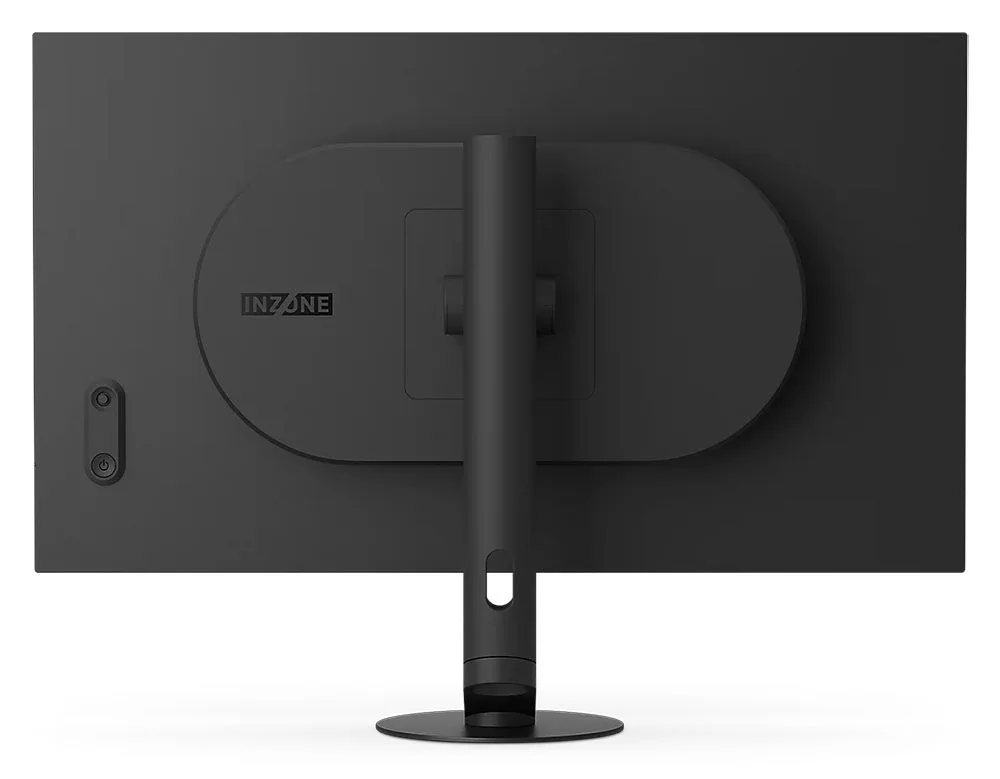
A notable design element of the M10S II is its compact base. Despite its small, heavy metal disc (six inches across) and offset upright, the monitor proved stable during testing. The stand allows for 360-degree swivel, 5/35-degree tilt, and 4.8 inches of height adjustment, though it lacks a portrait mode. Movements are smooth and firm, without wobble.
On the back right, a small protrusion houses the power button and an OSD joystick. The power LED is uniquely positioned on the side, illuminating the user's hand when pressed, and can be turned off if desired.
The monitor features a thick component bulge that transitions into a thin screen, backed by a metal plate, measuring just 5mm thick. The bezels are narrow: 7mm on top, 8mm on the sides, and 12mm at the bottom, appearing flush when the power is off.
The I/O panel, located underneath, includes two HDMI 2.1 ports, one DisplayPort 2.1, one upstream USB port, and two downstream USB ports. There are no internal speakers, but a 3.5mm jack is provided for headphones. An additional USB port is available for service and firmware updates.
On-Screen Display Overview
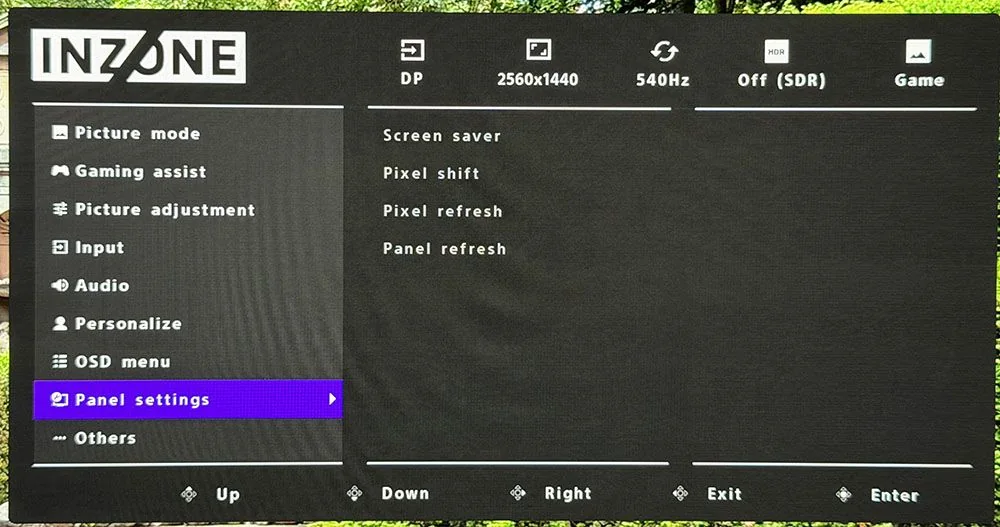
Activating the M10S II’s joystick reveals an efficiently organized OSD, divided into nine sections, offering a wide array of calibration and convenience options.
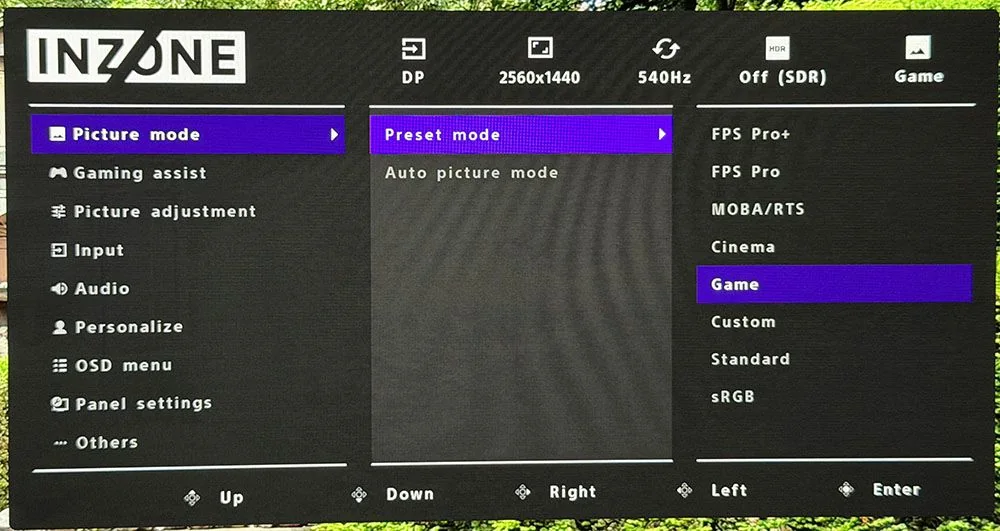
The OSD starts with eight picture modes. The default 'Game' mode provides a good initial image but benefits from minor adjustments to meet broadcast standards. Other modes cater to specific game types or tasks, including an accurate sRGB mode. Optimal results were achieved using the 'Standard' mode with a grayscale calibration.
Gaming Assist features include refresh rate switches and 24.5-inch modes, which deliver 1080 vertical pixels with 1:1 mapping to prevent image softening from scaling. Motion blur reduction is available via a backlight strobe, effective at lower frame rates but reducing brightness by about 30%. Anti-VRR flicker, unique to OLED monitors, prevents flickering during rapid frame-rate transitions. The menu also provides an FPS counter and both static and dynamic aiming points.
The Picture adjustment menu contains variable brightness options, labeled 'Brightness stabilizer.' Counter-intuitively, 'off' means variable brightness is fully engaged. Experimentation showed the 'Mid' setting yielded the best gamma and picture quality. Gamma presets and color temperature controls with RGB sliders are also present, though a color gamut selector is absent, with sRGB available through its dedicated picture mode.
For panel care, the M10S II includes pixel shift, a screen saver, and refresh routines. Sony distinguishes between pixel and panel refresh, with the latter recommended only once a year, suggesting it's a more intensive maintenance process.
Calibration and Picture Quality
The M10S II's default 'Game' mode presented a cool grayscale and light gamma, which could be corrected for grayscale but not gamma. Switching to 'Standard' mode proved more effective, allowing for improved grayscale, gamma, and color tracking after RGB slider adjustments. The monitor's gamut volume is just under 110% of DCI-P3, which, while larger than the SDR standard, produces a visually appealing image. An sRGB preset mode is available with good gamut accuracy and grayscale calibration support, but no gamma adjustment.
For HDR content, the M10S II automatically switches to HDR mode, offering four specific picture modes. The 'Game' mode performed best, allowing for grayscale calibration and brightness adjustment in HDR, a capability not found in most HDR monitors.
Gaming and Hands-on Experience
Sony markets the M10S II towards competitive and hardcore gamers, and it delivers on this promise with exceptional speed. Regardless of whether 540 Hz is fully utilized, the monitor is incredibly quick. Motion resolution is flawless, ensuring moving objects and backgrounds maintain clarity akin to stationary elements, with camera pans free from blur or smearing. Adaptive-Sync functioned perfectly with an Nvidia GeForce RTX 4090, achieving frame rates between 350 and 540fps in Doom Eternal at maximum detail.
While the M10S II includes features to reduce motion blur and smooth the image, they were largely unnecessary given the high frame rates. Anti-flicker technology effectively prevented flickering during rapid frame rate transitions, even with shifts of 80-100fps. Blur reduction via backlight strobe, which works below 270 Hz, was not engaged as speeds remained above this threshold, but it performs well without phasing or ghosting when activated (requiring Adaptive-Sync to be off).
Input lag is sufficiently low to provide instant response to control inputs during intense gaming. The 720 Hz mode, while offering only slightly lower input lag, feels incredibly fast, though full-screen resolution is limited to 1280x720. Additionally, 24.5-inch modes allow for 1920x1080 at 720 Hz or 2368x1332 pixels with 1:1 mapping.
Across all scenarios, color and clarity are exemplary for an OLED display. The M10S II's expansive color gamut, nearly 110% of DCI-P3, enhances both SDR and HDR content. HDR content benefits from calibration capabilities, a rare feature among HDR monitors. The variable brightness options are also effective; when 'Brightness stabilizer' is off, variable brightness is fully engaged at maximum, with 'Mid' offering the best gamma and picture quality.
As a 27-inch QHD flat panel, the M10S II is well-suited for productivity, delivering a clear and vibrant picture for general use. Small text appears sharp without color fringing, graphics and photos exhibit deep textures, and video content looks excellent, making it a capable personal TV. The only notable omissions are internal speakers and LED lighting, but it provides all essential features for gaming, entertainment, and work.
The M10S II is a dream for competitive gamers, offering rapid response, smooth motion resolution, and a variety of refresh and resolution options. It delivers a clear and colorful picture for both SDR and HDR content. Its anti-glare layer is exceptionally effective, eliminating ambient light reflections. While a premium purchase, it excels in all aspects.
MORE: Best Gaming Monitors
MORE:
MORE: How to Buy a PC Monitor