Ugreen NASync DXP8800 Ultra: Overview
Ugreen has developed a strong reputation for engineering ambitious network-attached storage solutions. Following the success of the original flagship, the NASync DXP8800 Plus, the manufacturer has introduced the NASync DXP8800 Ultra as a more powerful successor.
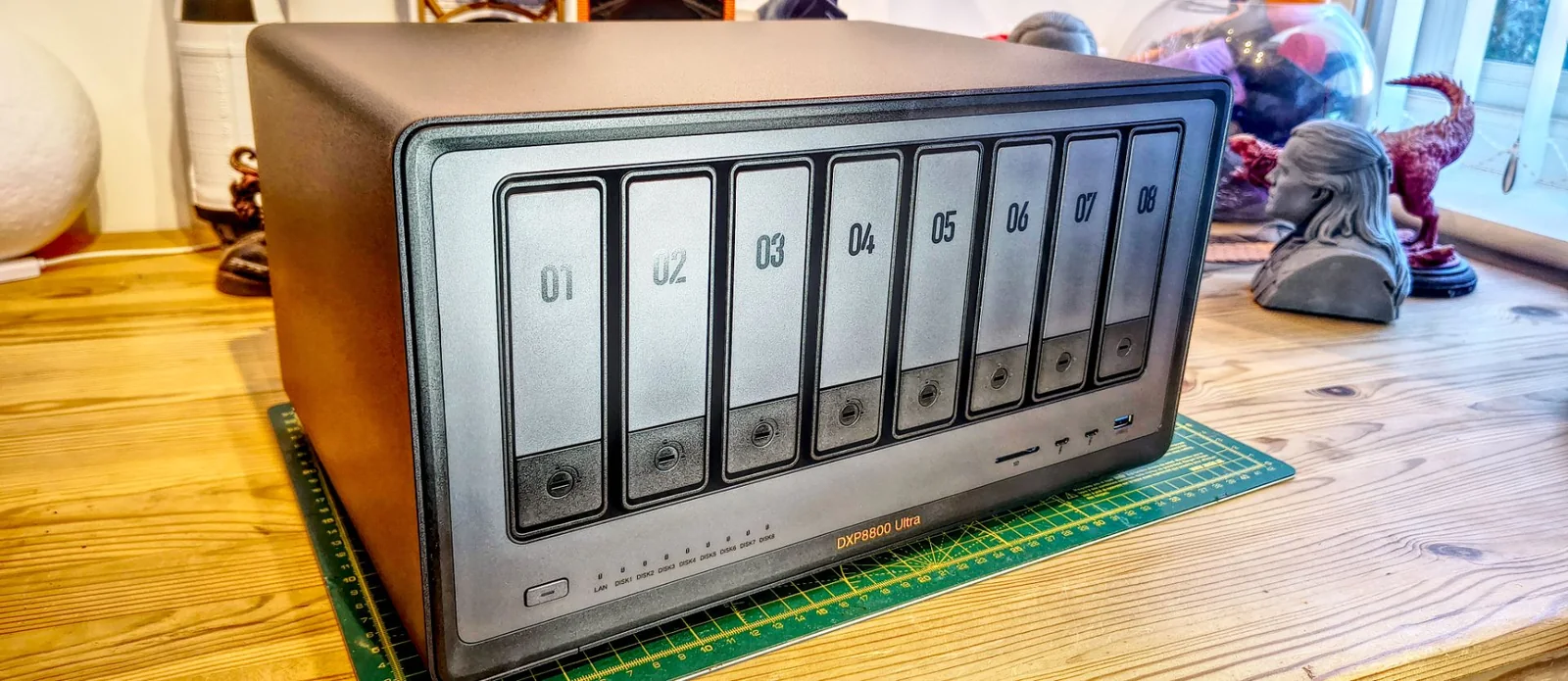
The Ultra model is not a ground-up physical redesign. The outer chassis, bay count, and general port layout remain identical to its predecessor, measuring 365 x 258 x 189mm. All of the structural changes reside internally.
The device retains eight SATA bays and two M.2 slots, capable of delivering up to 272TB of storage when fully populated. Dual 10GbE ports, two Thunderbolt 4 ports, an 8K-capable HDMI output, and a PCIe slot are also carried over. The key revisions involve a newer Intel Core 7 150U processor and an expanded memory ceiling reaching up to 96GB.
These hardware upgrades carry a steep financial penalty, with the Ultra retailing around $1,779.99. Prospective buyers must carefully weigh whether the internal performance gains justify the cost premium over the Plus model.
The value proposition depends entirely on use cases. Standard file serving will rarely benefit from the hardware upgrade, whereas heavy virtualization and local AI workloads can leverage the extra computing headroom.
Unlike early crowdfunding releases, the Ultra launched directly to the commercial market.
The system runs on the UGOS Pro operating system, which continues to mature as a comprehensive environment relying heavily on Docker containers.
Given the solid foundation established by the DXP8800 Plus, the Ultra enters the market as a high-performance alternative for demanding power users.
Pricing and Market Availability
The system carries a retail price of approximately $1,779.99 or €1.779,99 depending on the region.
It is widely available for purchase directly from the manufacturer and mainstream online retailers.
Distribution spans standard retail channels including Amazon and Newegg.
Moving away from crowdfunding campaigns ensures more predictable retail availability for consumers.
With the Plus model selling at a lower price point, the Ultra commands a substantial markup of over $500 for a machine sharing an identical physical layout of bays and ports.
European pricing incorporates local exchange rates and taxes, pushing the effective cost even higher.
Regional availability may vary dynamically across global markets.
The price premium secures a faster clock speed, improved integrated graphics, and support for up to 96GB of memory, while power consumption profiles remain virtually unchanged.
High market costs for modern DDR5 memory modules mean that populating the system to its 96GB ceiling represents a major secondary investment.
Direct competitors in this specific prosumer category are scarce, as traditional brands have largely shifted focus away from versatile multi-bay hardware.
The Ultra remains competitive against enterprise alternatives, but evaluating its value against its own stablemate is more challenging.
Value score: 3.5 out of 5.
Design and Build Quality
The chassis architecture carries over directly from previous iterations.
Internal layout accommodates high memory configurations.
The form factor and structural integrity maintain a high standard, utilizing a thick aluminium enclosure.
Drive trays, dust filters, and cooling fans are fully preserved from the Plus model.
Number-labelled, lockable drive trays and magnetic fan filters provide good baseline usability, though 2.5-inch drives still require manual screws.
Front-panel interface connections include an SD card reader, dual Thunderbolt 4 ports, and a USB 3.2 port.
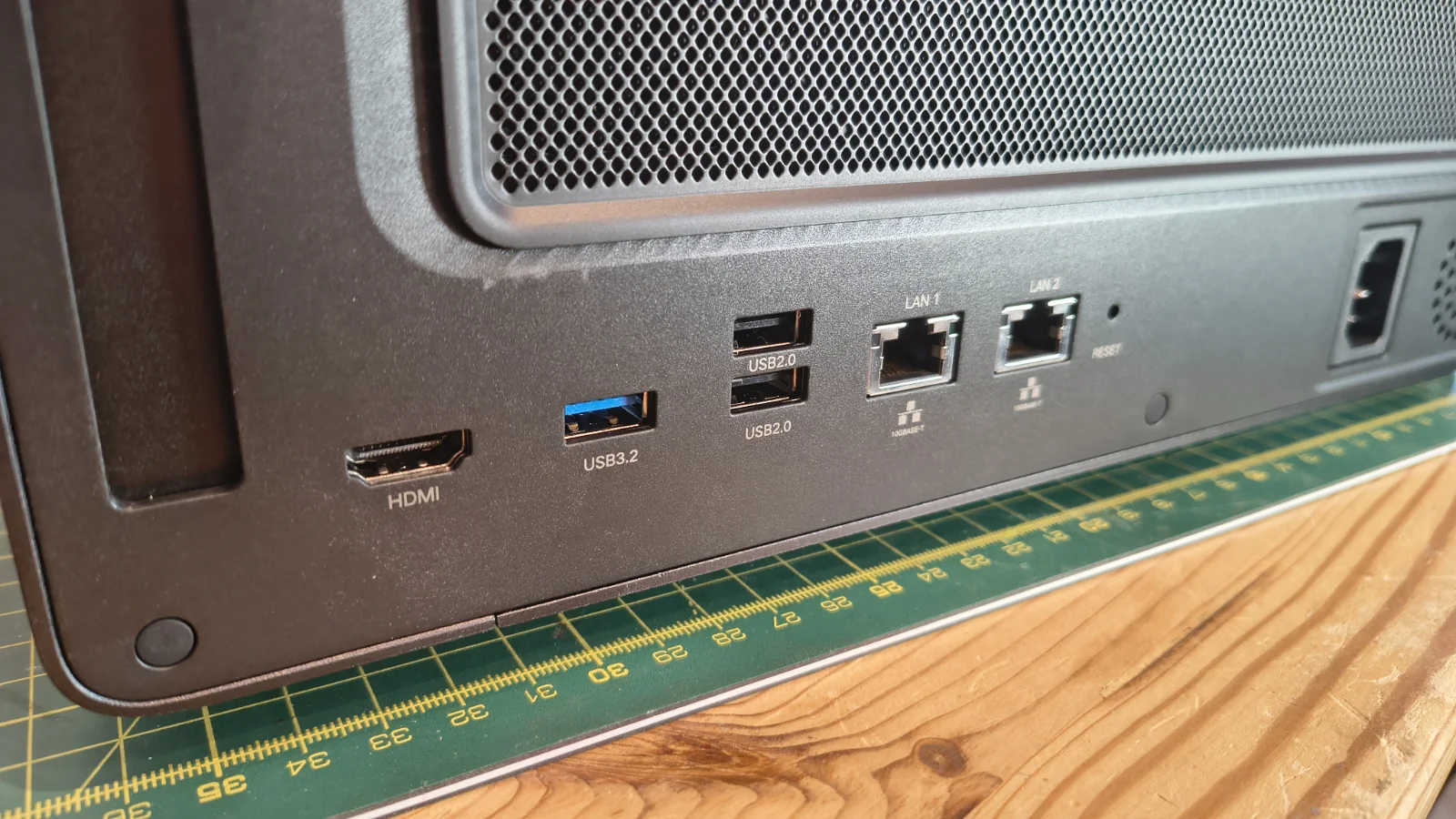
Rear connectivity features a PCIe slot, HDMI output, dual USB ports, and dual 10GbE network interfaces.
The PCIe slot is properly specified as Gen 4 x4, providing ample bandwidth for high-speed networking expansion cards or storage adapters.
Underneath the chassis, an accessible service panel conceals two M.2 slots and two DDR5 SODIMM sockets, alongside an embedded 128GB SSD dedicated to the operating system.
Maximum memory expansion reaches 96GB via paired modules, though high component costs make this an expensive upgrade.
An internal power supply eliminates external power bricks, though it contributes significantly to the overall weight of a fully populated unit.
The hardware engineering remains exceptionally polished and robust.
Design score: 4.5 out of 5.
Hardware Specifications and Features
Intel Core 7 150U processor integration.
Extended memory capacity up to 96GB.
PCIe Gen 4 x4 expansion slot support.
The transition from an i5 processor to the 13th-generation Core 7 150U introduces higher turbo clock speeds and improved integrated graphics execution units.
Enhanced graphical processing capability benefits media transcoding performance within applications like Plex and Jellyfin.
While network transfer limits constrain basic file sharing speeds, the upgraded computing platform delivers noticeable gains in multi-threaded workflows.
A notable limitation for business deployments is the lack of explicit ECC memory support on the processor platform, despite on-die error correction features.
High baseline component costs mean that omitting dedicated enterprise memory features keeps consumer pricing more manageable.
The unit ships with high-speed 5600MHz memory modules, offering a minor performance bandwidth advantage over older revisions.
Memory compatibility accommodates standard SODIMM upgrades.
High memory ceilings are primarily advantageous for advanced hypervisors and heavy caching setups.
The PCIe Gen 4 x4 slot offers ample bandwidth for specialized networking cards or bus-powered expansion options.
General connectivity ports match the specifications of the previous generation.
Features score: 4.5 out of 5.
UGOS Pro Software Environment
UGOS Pro operating system platform.
Comprehensive support for Docker containers and virtual machines.
Flexibility to install sanctioned third-party operating systems.
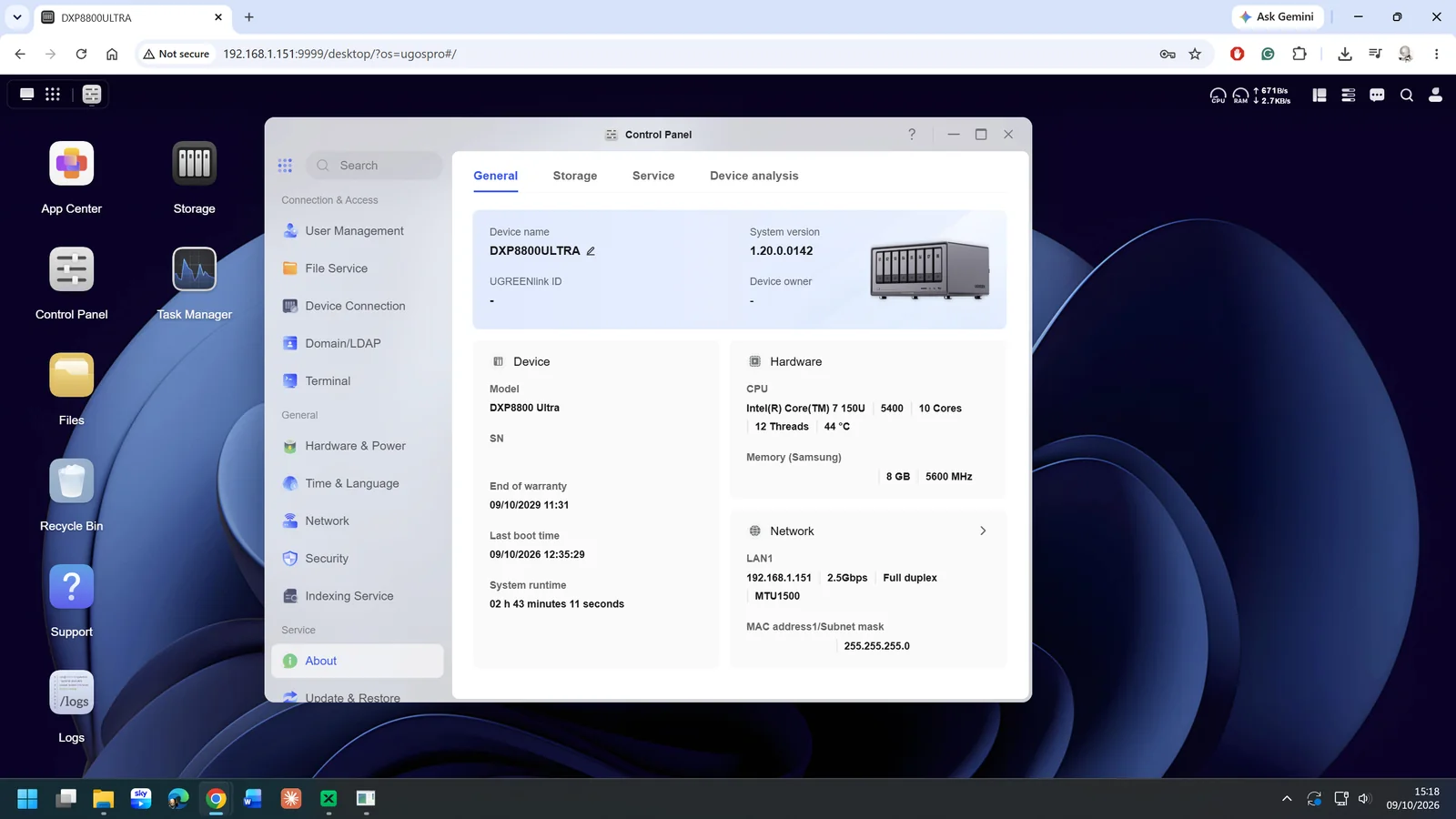
The proprietary UGOS Pro platform has evolved into a clean, effective environment centered around Docker containerization.
Centralized management tools, encrypted remote access, and virtual machine deployment leverage the upgraded processing architecture.
Software updates have successfully introduced requested features like two-factor authentication and jumbo frames, though write-once-read-many volumes remain absent.
File system support is currently limited to Btrfs and EXT4, with flexible mixed-drive RAID modes still unsupported.
Filesystem expansion options remain an area for future platform improvement.
Mobile application utility stands out as a strong point, matching core web administration functions.
Hardware warranties remain intact even when alternative operating systems are installed.
Third-party platform compatibility requires careful verification regarding specialized hardware controls.
Alternative operating system licensing structures may incur extra costs for fully populated configurations.
Platform versatility caters well to advanced enthusiasts.
UGOS Pro continues to close the feature gap with established market competitors.
Software score: 3.5 out of 5.
System Performance Metrics
Upgraded processing power with standard network architecture.
Dual M.2 caching configurations.
High-speed 10GbE networking interfaces.
Network data transfers utilize minimal system resource overhead.
Network interface limits dictate baseline file-serving speeds rather than CPU capacity.
Advanced computational tasks fully leverage the upgraded processor and memory architecture.
Sustained single-client transfer speeds reach near saturation limits over single 10GbE connections.
Thunderbolt host mode enables alternative high-speed data transfer pathways.
Port aggregation and PCIe expansion cards offer scalable networking upgrades.
Core expansion capabilities match previous generation standards.
M.2 NVMe slots operate at mixed PCIe generation speeds.
Motherboard specifications designate distinct speeds for each internal storage slot.
Storage management software automatically adapts to hardware configuration adjustments.
Drive throughput capabilities align well with available network interface bandwidth.
Acoustic noise levels remain acceptable during full operation.
Performance advantages manifest primarily during complex multi-tasking workloads.
Final Verdict
The DXP8800 Ultra represents a measured hardware refresh, addressing processing performance while maintaining successful structural design elements.
For standard operations, the cost premium over the Plus model is difficult to justify.
Power users managing heavy virtualization or large local datasets will benefit most from the hardware expansion capabilities.
Component pricing trends will dictate long-term hardware adoption rates.
Alternative market options struggle to match the versatile hardware feature set provided by the Ugreen series.
Specific enterprise omissions like ECC memory support should be noted by prospective corporate buyers.
Most current users have little reason to upgrade immediately.
Alternative configurations in the product family provide scalable choices for different budget levels.
Should You Buy It?
Suitable for environments requiring advanced networking capabilities and high-speed data distribution.
Ideal for users requiring extensive RAM scaling for heavy computational workloads, keeping component costs in mind.
Budget-conscious buyers may prefer standard models or alternative bay configurations.
Existing owners of the Plus model will see limited practical benefit from switching.