Xreal Aura Smart Glasses Introduction
Xreal has launched its new Xreal Aura wired smart glasses, powered by the Android XR and Qualcomm Snapdragon Reality Elite platforms. The companies had previously teased the wearable devices at Google’s developer conference.
As technology companies expand their push into smart glasses, competitors are keen to release their own devices. Google is relying on hardware partners to bring devices powered by its Android XR platform to consumers.
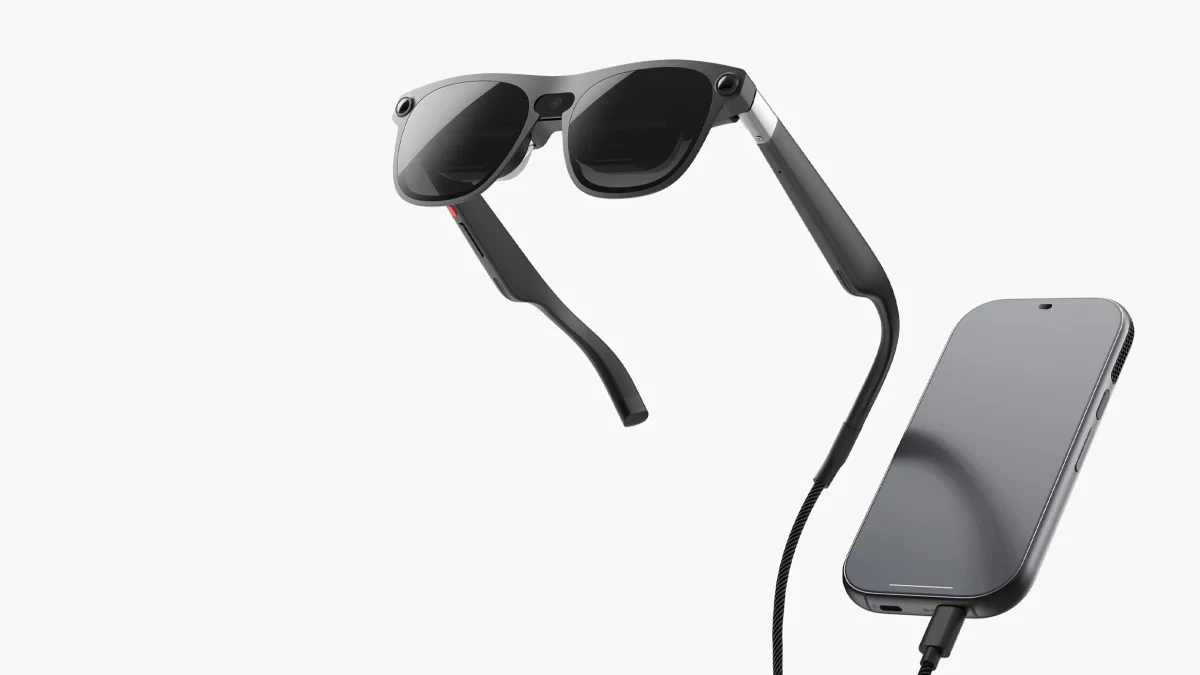
The new Xreal Aura smart glasses are tethered to a separate processing puck for computing power, rather than handling all processing internally. The glasses then project content directly into the wearer’s field of view.
Display Specifications and Hardware
The hardware design closely resembles lightweight smart glasses rather than bulkier head-mounted displays.
Xreal Aura utilizes Sony Micro-OLED panels featuring 1200p resolution at 120 Hz alongside a 95-degree field of view. The glasses weigh 95 grams, and users must carry the tethered processing puck during operation.
Software and Entertainment Ecosystem
At launch, the Aura supports various Google Play applications, games, and specialized extended reality experiences, including dedicated entertainment and media apps.
Users can connect a computer or handheld gaming console directly into the Xreal Aura via USB-C to use it as an external augmented display. The device also supports productivity workflows by enabling virtual multimonitor setups.
For audio output, the Xreal Aura incorporates Bose acoustic technology to handle sound delivery during media playback.
Because the wearable runs on Android XR, the Gemini assistant is available to users as a Q&A assistant capable of interpreting on-screen visual context.
Pricing and Availability
The Xreal Aura is available to order in the United States, Canada, Japan, and South Korea. The 12GB RAM and 256GB storage configuration costs $1,279 with a promotional launch price of $1,099 through December. The 16GB RAM and 512GB storage version is priced at $1,499 with a launch price of $1,299 through December, with shipping scheduled to begin by mid-November.
Leadership notes that building a smart glass ecosystem requires aligned hardware, mature operating systems, and refined user interfaces to achieve market scale.
Achieving commercial viability depends on having all key architectural components ready simultaneously.