
Apple's new iPhone and iPad security feature can protect you from scammers
Apple wants you to stop falling for scammers, and this feature adds more safeguards.
Apple has delivered a new security feature with iOS and iPadOS. Called Impersonation Risk Detection, it analyzes device behavior in real-time to flag active social engineering scams — the kind that trick you into handing over access yourself, even when your passwords and two-factor codes are working as intended.
It runs entirely on-device, so personal content remains private. When a supported app requests a risk assessment, it receives a label with none of the underlying data behind that determination. This is an opt-in feature, making it a complementary tool to other online safety measures.
Security features like two-factor authentication are helpful, but Impersonation Risk Detection is built for a different kind of danger. Social engineering scams convince users to open the door themselves. From callers posing as a bank to texts that look like fraud alerts, they create urgency to bypass protections. Two-factor codes cannot flag this type of manipulation, but this feature can.
Understanding Impersonation Risk Detection
Impersonation Risk Detection works to detect the signs of a scam as it occurs. When you take a sensitive action, such as making a payment or changing account security details, a supporting app can request a real-time risk assessment. Your phone generates that assessment by analyzing interaction patterns, timing, context and basic sensor data entirely on-device. Based on this analysis, the system assigns one of three risk levels:
Unknown: The system did not detect suspicious activity.
Medium: The tool detected some signs of suspicious activity.
High: Major signs of suspicious activity were detected.
An attacker posing as a bank representative or government official can pressure people into approving shady transactions or sending passwords, which can be even more convincing with AI. Apple's tool fills a gap by catching suspicious behavior during moments scammers rely on. However, the decision on what to do next belongs to the app developer. Depending on the risk level returned, the app might ask you to verify your identity, impose a short waiting period or display a warning.
How to enable Impersonation Risk Detection
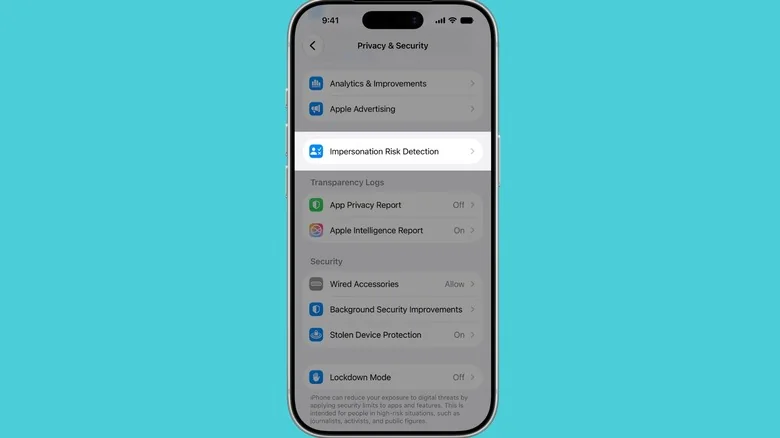
If you want to enable this function for yourself or loved ones, follow these steps on your iPhone or iPad:
Go to Settings > Privacy & Security.
Scroll down to Impersonation Risk Detection and toggle on Share with App Developers.
On the same menu, you can see which apps have requested a risk assessment and why, and adjust their access. If someone contacts you and insists you turn this feature off, treat it as a red flag. For security reasons, toggling the feature off can take up to 24 hours to take effect.
This feature works with compatible apps designed to support it. Impersonation Risk Detection is an extension of Apple's privacy-first security focus, addressing a blind spot that browser settings and password managers cannot fully solve: human manipulation.