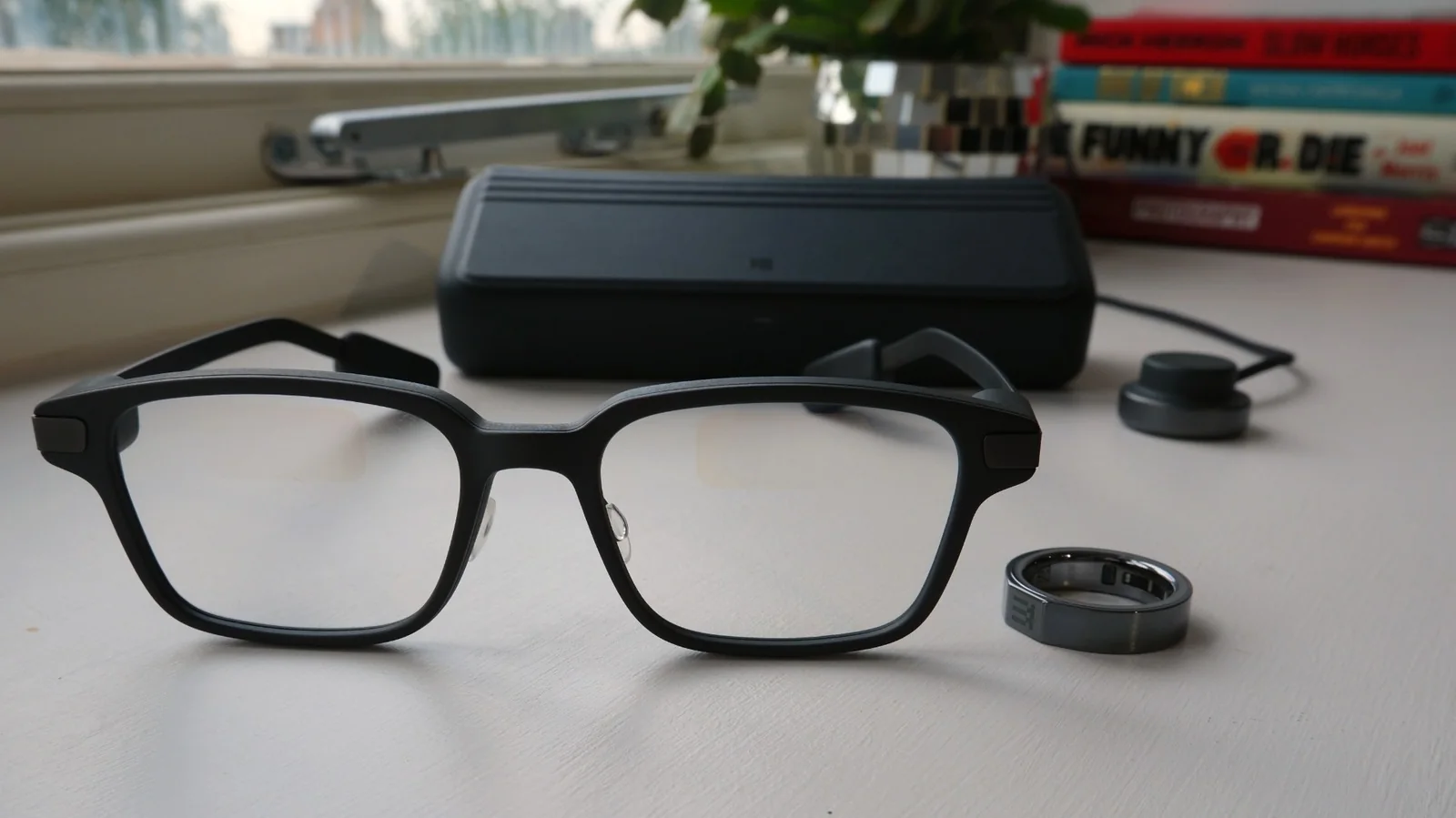
Last year, I reviewed Even Realities' G1 and came away deeply impressed by what I saw. In fact, I'd say they're the smart glasses to beat. I was surprised, then, to see my colleague Sam Rutherford have issues with the second-generation unit when he tested an early beta version. After all, it's not often a hardware platform goes backwards, especially once it's established a solid series of fundamentals. But it seems that, in trying to broaden the usability of its glasses, Even Realities has regressed.
Hardware
Daniel Cooper for Engadget
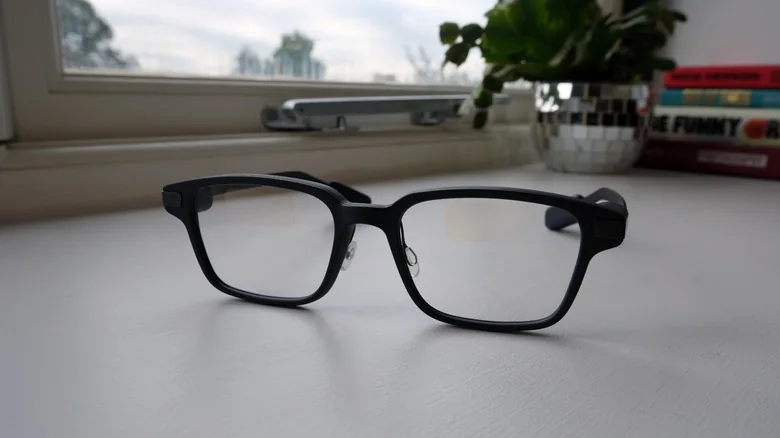
Even Realities makes smart glasses without a forward-facing camera that act as an alternative to a smartwatch. A pair of waveguide prisms in the lenses project data into your field of vision, including notifications, news headlines and turn-by-turn directions. You can also use them for real-time translation, as a teleprompter or, inevitably, as a way to speak to AI. The base model is $599 in both Panto and Rectangle styles, and a choice of grey, brown or green colorways. If you need prescription lenses, you'll need to pay at least $159, although if your prescription is stronger, that figure can climb as high as $349.
Plenty has changed since the first generation. The G2s are a little lighter, and the waveguide prisms are a little taller, with a commensurate boost in resolution (640 x 350, up from 640 x 200). Those prisms have a wider field of view (27.5 degrees, up from 25), a far faster refresh rate (60Hz, up from 20Hz) and a higher peak brightness (1,200 nits, up from 1,000 nits). The battery's bigger here, too, and there are four microphones, up from two on the original.
The G1s weren't the sturdiest of devices, with a fragile build that required caution in the rain. So it's a welcome relief to learn the G2s are IP65-rated for both dust and water ingress.
There are now on-device touchpads located on the temple tips, which does and does not make sense. From an engineering perspective, placing the surfaces behind your ears helps balance the weight and ensures the arms don't get too chunky. On the downside, controlling your specs from such a position makes you feel pretty darn goofy, not to mention there are implications for those who maybe don't have the best proprioception. Which brings us to the company's smart ring.
Even R1 Smart Ring
Daniel Cooper for Engadget
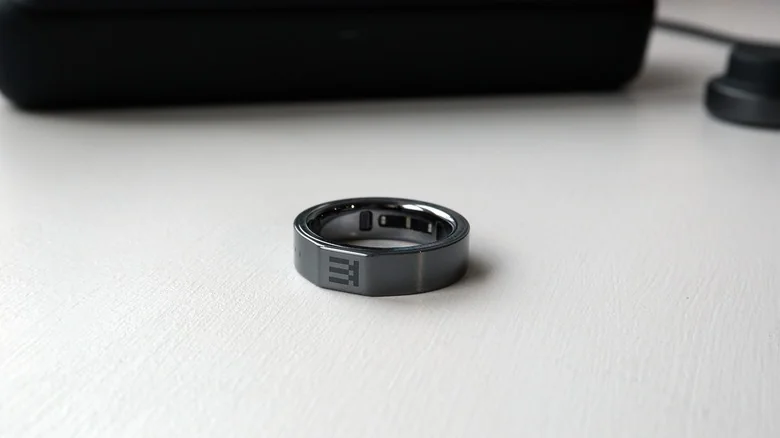
Even Realities has caught the smart-ring-as-remote-control bug. It's a separate purchase, adding $249 onto the cost of your Even G2, but it only works with this new, second-generation pair of glasses. It's a smart ring with a touch surface intended to be worn on your index finger, with its touchpad in easy reach of your thumb. Made out of zirconia ceramic, the only indication it's not a piece of jewelry is in the prominently-stamped Even Realities logo on a promontory, helping you navigate the ring by feel alone.
R1 is IP68-certified, has a four-day battery life and also tracks your activity, steps, heart-rate, HRV, SpO2, body temperature and sleep duration. All of these stats are pumped to the G2, enabling you to keep an eye on your wellness signals from your eyeline. You'll also get a productivity score, which aggregates all of those stats into a single figure for ease of use.
In-use
Daniel Cooper for Engadget
The point of using a pair of smart glasses over a smartphone, or even a smartwatch, is to both keep your focus on the real world and to free up your hands. But the more features you cram onto a face, the more complex the control scheme becomes, and that's an issue. A ring makes a lot of sense in theory, because it would let you scroll and tap through menus in a way that's both efficient and unobtrusive. You can remain focused on the world around you and you're more or less able to have the free use of your hands — in theory.
Sadly in my experience, using a ring to control your glasses doesn't quite work as well in the real world. Narrow touchpad surfaces like a ring can, if you're lucky, identify four things: Swipe up, swipe down, a tap and a press. That's a control scheme only slightly more sophisticated than you'll find on a pair of AirPods, but it's how you're expected to do everything here. And I've found that to be a lot harder process than I would have liked or expected.
When you want to open the main menu, you're asked to tap and long press on either the ring or touchpad, but the long press is at risk of being misinterpreted as a swipe. I've had enough taps identified as swipes and swipes identified as taps that after a while you stop wanting to cycle through menus. It kills your enthusiasm if you're regularly inadvertently opening apps you wanted to scroll past. My theory is that the ring's surface is too small and delicate to be able to clearly identify the gestures being used.
Now, I'm happy to accept that this is a personal issue, and Even Realities' representatives have said as much. The fact I've not found many others saying the same thing online adds weight to the idea that perhaps it's just not for everyone.
The sad thing is that, in those rare moments when it does work, you really do feel like you're living in the future. Part of this I can attribute solely to the improved refresh rate of the displays, which are fast enough now to allow for natural scrolling. In a single generation, Even Realities has gone from static frames to a setup where you can scroll through menus and text as if it was a computer. It's a dream to be able to read and dismiss notifications when I'm out with a group without having to take my phone out of my pocket.
I've always appreciated the ability to have notifications popping up in my eyeline in a way that I can triage them without having to take my focus off whatever else I'm doing. Annoyingly, you can't put those notifications on the dashboard, the default screen which pops up in your glasses whenever you activate them. And the built-in apps are easy to use; Translation is whip smart and Navigation is handy, even if you still have to use Even's proprietary maps rather than Google's. The AI is fast and responsive enough, and although the transcription features in Conversate — which is designed to run during meetings and take notes — are fine, it wasn't great at forming conclusions.
There's even an app store with little homebrew apps you can add to your glasses for free. These aren't yet massively well-developed, and tend toward the geekier side of the railroad tracks. For instance, one app will enable you to control your smartphone's audio playback from your ring or glasses, and display the album art. But if you want to use it, you'll need to access the developer dashboard on Spotify to hook into the necessary APIs. It's surely a sign of a growing ecosystem, but one that may put off less-technically-minded would-be owners.
Price and the competition
Daniel Cooper for Engadget
The smart glasses market has grown by a sufficient amount that Even Realities can't just rest on its laurels. There are plenty more companies making products in this vein now, all of which are pushing to find the limits of what these devices can do. The most natural comparison is with Xgimi's MemoMind One, which features stereo Harman audio modules and a frustratingly-limited control scheme relying on a single button.
While the hardware was appealing, two flaws hindered that model: charging contacts that caused a minor skin rash and an aggressive AI memory logging feature. Its price has been cut to $399, with an additional $280 required for prescription lenses.
Other alternatives include RayNeo's iO, which features a watch-style crown to eliminate UI hassles, live captions, translation for 55 languages, and AI meeting minutes. It is priced at $449, or $658 for the prescription lens version.
Inmo's Go3 offers similar features including AI, notifications, translation, and a teleprompter, alongside a forward-facing camera and ring control. It costs $599, though prescription lenses do not appear to be available.
Wrap-up
Daniel Cooper for Engadget
I really wanted to like Even Realities' G2. In fact, deep down, I was probably primed and ready to love them. The G1s made such a positive impression that I was sure that their successors would blow me away. But, like the rest of the industry, the company hasn't yet found a way to control an ever-growing range of features in such a small package.
I'm happy to accept that this could just be my problem, and that everyone else has found it easy to navigate. Perhaps my fingers are a little bit sweatier than everyone else's, or I am alone in having swipes that register as taps, and vice versa. But the end result is that I'm more partial to the older model than its replacement, and I'm pretty sad that Even Realities has already ended sales of the G1.
As for the G2, if you've got the money, are technically-minded and think you'll have better luck with the control scheme, then go for it. But I'd otherwise preach that maybe waiting for the next generation of hardware, hopefully solving these issues in a more elegant way, is a better approach.