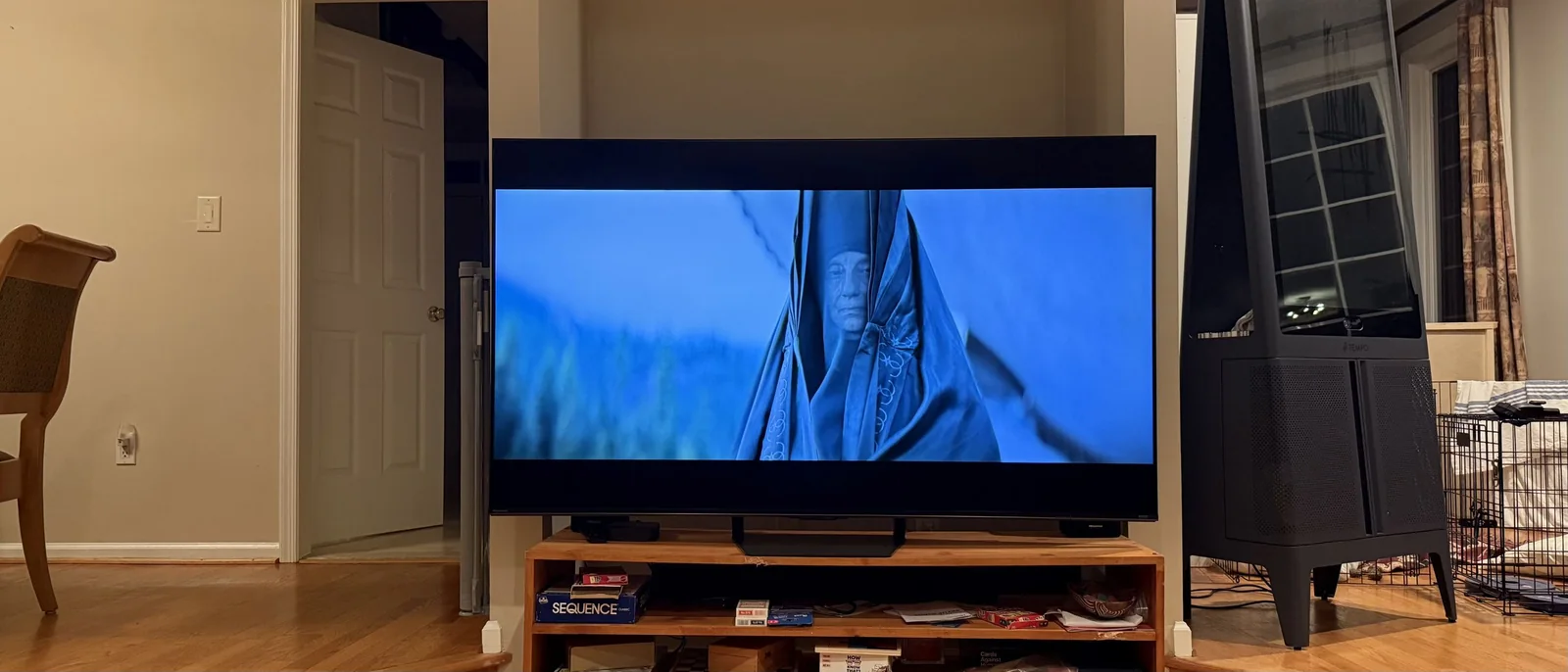
Hisense U7: One-minute review
The Hisense U7 is a mid-market mini-LED television that punches well above its weight class. It delivers strong performance and a comprehensive feature set relative to its price, while navigating a few typical compromises associated with budget-conscious engineering.
Mid-range options rarely claim the absolute crown in build quality, pristine picture fidelity, or acoustic depth, yet models like this manage to bridge the gap successfully while undercutting the market's most expensive flagships.
The source review highlights the Hisense U7 as a standout contender purely for its value proposition. While picture quality approaches the standards set by pricier alternatives from Hisense or TCL, the source reviewer noted occasional color bleeding, minor edge vignetting, and slightly reduced color accuracy under specific conditions.
Audio performance is surprisingly capable out of the box, allowing users to comfortably skip an entry-level soundbar, though it naturally struggles with deeper low-end frequencies during demanding cinematic moments.
Modern necessities are fully addressed, including rapid refresh rates and an intuitive game menu designed to compete directly with dedicated gaming displays.
Among high-value televisions in its class, the Hisense U7 holds its ground firmly, though a noticeable gap remains between it and ultra-premium alternatives.
Hisense U7 review: Price and release date
Release date: March 2026
55-inch: $799.99
65-inch: $999.99
75-inch: $1,299.99
85-inch: $1,699.99
100-inch: $2,999.99
116-inch: $19,999.99
Hisense launched the U7 series as part of its early 20th-century spring lineup, positioning it as a distinct sweet spot in terms of price-to-performance ratio.
Market pricing has adjusted over time, cementing the display as a premier sub-$1,000 choice for screen sizes like the 65-inch configuration.
Consumers should note that distinct variants exist across software ecosystems, with Google TV and Fire TV models populating different retail channels.
Has all HDR formats except the IQ version of Dolby Vision
Hands-free Google Gemini integration offers conversational assistance
Seamlessly integrates into a Google Home smart home ecosystem
The feature set covers nearly all industry-standard formats, supporting regular Dolby Vision, Dolby Atmos, surround sound protocols, and DTS Virtual:X spatial audio processing.
AI capabilities drive modern display adjustments, managing automated picture and sound mode switching alongside ambient light compensation.
Google Gemini powers the hands-free voice assistant features, allowing users to control settings and query general information conversationally.
While conversational flexibility is a strong suit, large language models continue to exhibit occasional navigational inaccuracies when directing users to specific streaming content.
Functioning as a smart hub, the display connects natively to wider residential automation setups.
Hisense U7 Series MiniLED TV review: picture quality
Comes with dedicated Film Maker Mode
Saturated colors can experience minor bleeding
Overall brightness and accuracy remain highly competitive
As a mid-range model, minor hardware compromises surface during critical examination, including subtle corner vignetting and occasional color bleeding in dense, uniformly saturated visual fields.
Despite omitting Dolby Vision IQ, proprietary picture modes and Film Maker Mode successfully preserve cinematic intent.
Source measurements indicate solid luminance performance and wide color gamut coverage that comfortably rival pricier tier-one alternatives.
Real-world testing across movies and console gaming reveals a vibrant, engaging picture that delivers substantial visual depth relative to its price class.
Hisense U7 Series MiniLED TV review: sound quality
Delivers robust sound relative to built-in TV standards
Noticeably lacks deep low-end impact
Includes extensive software audio tuning options
The integrated 2.1.2 speaker configuration provides enough clarity to bypass external soundbars for casual viewing, though dedicated home theater setups are still recommended for cinematic immersion.
High-end frequencies maintain good clarity without sounding harsh, while mid-range body ensures dialogue remains distinct over background soundtracks.
Action sequences and bass-heavy tracks lack the physical thump and subterranean rumble expected from larger dedicated subwoofers.
Stereo separation is handled competently within the physical boundaries of the chassis.
Extensive software features include automated sound profiles, a multi-band EQ, room calibration, and dialogue enhancement tools.
Hisense U7 Series MiniLED TV review: Design
Features ultra-thin bezels
Center pedestal stand simplifies furniture placement
Equipped with four full-bandwidth HDMI 2.1 ports
A utilitarian chassis houses the internal components cleanly, highlighted by minimal bezels and a wide central base that avoids the footprint constraints of traditional feet.
Assembly requires assistance due to the panel size, though thoughtful packaging design streamlines the mounting process.
Integrated cable routing through the center base helps manage peripheral wires effectively.
Connectivity options are comprehensive, featuring multiple HDMI 2.1 inputs, USB ports, optical audio, and Ethernet.
The bundled remote is standard for the brand, offering functional shortcut keys though missing dedicated media playback controls.
Hisense U7 Series MiniLED TV review: smart TV & menus
Offers extensive free syndicated content channels
Hands-free voice commands occasionally struggle with deep content navigation
Deep menus offer vast customization at the cost of complexity
Google TV offers a familiar, content-forward layout featuring curated recommendation banners and direct streaming application access.
Interface responsiveness is generally adequate, though occasional navigation stutter appears when compared against pricier hardware.
Voice control limitations surface when attempting to launch specific media directly across third-party streaming applications.
Navigating settings menus can feel convoluted due to segregated AI control toggles that dynamically lock manual picture adjustments.
Hisense U7 Series MiniLED TV review: Gaming
Supports rapid refresh rates up to 165Hz
Dedicated Game Bar facilitates quick parameter adjustments
Features AMD FreeSync Premium Pro certification
Gaming on the Hisense U7 is exceptionally smooth, backed by robust local dimming zones, HDR support, and high refresh rate compatibility.
Testing with modern consoles via HDMI 2.1 inputs demonstrates crisp motion handling and responsive execution across fast-paced titles.
Dedicated game modes optimize both visual clarity and directional audio cues effectively.
The custom Game Bar provides convenient access to overlays, crosshairs, and frame-rate counters, though accessing it requires cycling through standard system menus.
Competitively priced against similarly specified alternatives
Outperforms direct rivals in peak brightness metrics
Value represents the display's greatest market advantage
Different software variants offer alternative price points, though performance consistency across operating systems remains a variable factor.
Aggressive pricing across larger panel sizes makes high-inch home theater immersion much more accessible.
When weighed against close market competitors like the TCL QM7L, the U7 maintains a distinct advantage in peak luminance output.
Alternative options from manufacturers like Roku offer competing mounting designs, yet trail significantly in raw brightness output.
Ultimately, the Hisense U7 secures its reputation as a high-value purchase even when measured alongside closely matched market rivals.
Should I buy the Hisense U7 Series MiniLED TV?
You prioritize overall value: The Hisense U7 packs essential features, strong audio, and a bright display into a reasonable budget, serving as an ideal upgrade from entry-level screens.
You want extensive features: The package includes comprehensive HDR formats, spatial audio, and conversational AI controls at a very accessible price point.
You want to skip external soundbars: Built-in audio performance is robust enough for general daily viewing without requiring immediate secondary speaker investments.
You demand pristine picture quality: Minor vignetting and color blooming mean uncompromising cinematic enthusiasts should explore higher-end alternatives.
You require absolute format parity: Premium proprietary features like Dolby Vision IQ are omitted in favor of brand-specific alternatives.
Hisense U7 Series MiniLED TV review: also consider
Alternative options include the Roku Pro Series, which offers flush-mounting design capabilities, and the TCL QM7L, which utilizes refined local dimming to compete directly on price.
Buyers seeking premium OLED contrast can also examine high-end panels from manufacturers like LG as market prices continue to shift.
LG C6: A strong upgrade over past generations, delivering brilliant picture quality, perfect contrast, and top-tier gaming features.
Score breakdown
Scored out of 10Price & Release Date
Hisense U7SG