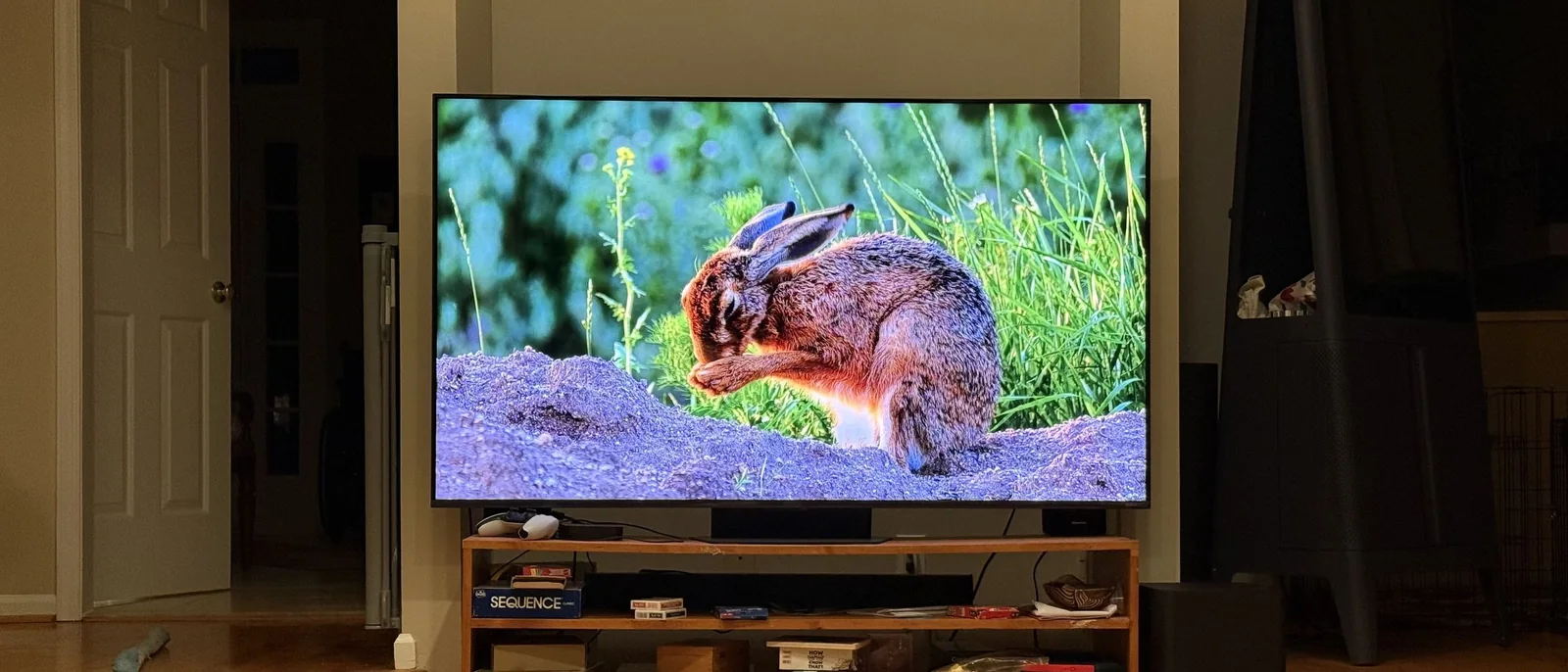
Hisense UR9 RGB Mini-LED TV Overview
The Hisense UR9 serves as a strong showcase for the potential of RGB LED display technology. By utilizing RGB LED hardware instead of standard configurations, this television achieves a significantly broader color gamut alongside high peak brightness levels.
Supporting refresh rates up to 180Hz alongside features like AMD FreeSync, the display positions itself as a capable option for gaming enthusiasts. Furthermore, its overall color coverage and accuracy compete strongly with top-tier alternatives currently available on the market.
Despite these visual strengths, the technology exhibits noticeable blooming artifacts that more mature mid-range panels have largely resolved. Combined with an elevated retail price, the Hisense UR9 struggles to match the cost-to-performance ratio offered by standard QLED or mini-LED competitors.
The operating system is heavily equipped with smart features, including an AI-driven Google Gemini voice assistant, Dolby Vision 2 support, and Dolby Atmos integration.
While the baseline pricing is substantial, prospective buyers willing to pay an early-adopter premium will find the hardware serves as a commanding centerpiece for a modern home theater setup.
Pricing and Configurations
Release date: April 2026
65-inch model: $3,499.99 / £1,699 / AU$2,995
75-inch model: $4,999.99 / £2,299 / AU$3,995
85-inch model: $5,999.99 / £2,999 / AU$4,995
100-inch model: $8,999.99
Because RGB LED panels represent a relatively new class of consumer displays, introductory costs remain higher than traditional mini-LED or micro-LED equivalents.
The hardware spans multiple large-screen form factors, ranging from the baseline 65-inch configuration up to an expansive 100-inch variant. Retail discounting has lowered actual transaction prices significantly across various major electronics distributors since launch.
Smart Features and Connectivity
The platform incorporates updated Dolby Vision 2 processing capabilities.
Google Gemini integration provides conversational voice navigation, though occasional inaccuracies can occur.
Additional software utilities include AI-powered ambient screensavers and automated picture adjustments.
The feature set includes Dolby Vision IQ, adapting image parameters automatically to room lighting conditions. Wi-Fi 6E networking support ensures fast wireless streaming performance.
Broad ecosystem compatibility spans Apple HomeKit, Amazon Alexa, and Google Cast, alongside far-field voice recognition for remote-free operation.
The conversational AI assistant allows users to issue generalized queries beyond basic television controls.
However, assistant reliability can be inconsistent when handling specific content playback commands across various streaming applications.
Artificial intelligence integration extends throughout the chipset architecture, influencing algorithmic image upscaling and dynamic energy management behind the scenes.
Picture Quality and Performance
The panel delivers high BT.2020 color volume and strong overall chromatic accuracy.
High luminance capabilities ensure bright highlights in HDR playback.
Minor halo blooming is visible in high-contrast cinematic scenes.
In practical usage, the RGB mini-LED arrangement produces a vibrant, saturated image that proves immersive for casual viewing.
Color measurements indicate strong coverage across wider professional color spaces when operating in filmmaker mode.
Preset picture modes alter color profiles significantly, requiring users to select calibrated modes for optimal color fidelity.
Peak luminance metrics register exceptionally high figures, providing ample headroom for HDR mastering.
The sheer output brightness handles complex lighting scenes effectively without crushing fine structural details.
Motion handling remains fluid during fast-moving sequences such as sports broadcasts and cinematic action scenes.
Aggressive motion smoothing settings can introduce digital artifacts, making conservative configuration adjustments preferable.
Upscaling algorithms effectively clean up lower-resolution legacy video sources without introducing excessive edge enhancement.
The primary optical limitation stems from pixel proximity in the RGB architecture, which occasionally causes light bleeding around high-contrast objects.
Dark-room testing reveals that glowing elements against black backgrounds exhibit slightly more halo artifacts than competing single-LED local dimming panels.
Specialized viewing presets like IMAX Enhanced offer tailored presentation options for supported media.
Audio Performance
Integrated audio output delivers 110W of power via a virtualized multi-channel layout.
Midrange frequencies can sound forward out of the box but are easily adjusted.
Automated room calibration tools help optimize frequency response for individual living spaces.
Acoustic tuning by Devialet results in an integrated speaker system that performs above typical television audio standards.
While virtualized spatial audio creates a wider soundstage, dedicated external surround speakers remain necessary for true multi-dimensional immersion.
Manual equalizer adjustments or intelligent audio profiles effectively mitigate a slight mid-bass bloom present in default settings.
High frequencies remain articulate and clear, though low-end sub-bass extension requires an external subwoofer addition.
Calibration utilities analyze room acoustics to balance audio output automatically.
Expansion options include pairing with dedicated Hisense sound systems to utilize synchronized driver arrays.
Design and Physical Build
A semi-adjustable central pedestal stand simplifies furniture placement.
Chassis depth is slightly thicker than ultra-slim OLED counterparts.
Connectivity includes multiple HDMI 2.1 ports and a DisplayPort-compatible USB-C port.
The inclusion of a sturdy central base simplifies installation on standard media consoles compared to wide-stance corner feet.
Narrow bezels frame the screen cleanly, though the overall cabinet depth measures close to two inches.
Connectivity provisions are robust, featuring high-bandwidth video inputs and a versatile USB-C interface tailored for PC users.
Physical controls are minimal, relying primarily on the included backlit remote or voice commands.
Gaming Features
Supports 4K resolution at high refresh rates via modern video inputs.
Dedicated game bar provides quick access to performance metrics.
Accessing specific gaming tools requires navigating system menus.
Testing with current-generation consoles demonstrates responsive input handling and vibrant HDR integration.
The onscreen game overlay displays frame-rate counters and variable refresh rate toggles conveniently.
Accessing the overlay requires specific button sequences rather than a direct shortcut.
Automatic low-latency mode switches streamline the gaming experience.
Visual performance during fast-paced titles remains sharp and smooth.
PC gamers will benefit significantly from the high-refresh USB-C connectivity option.