Screenless fitness trackers are often seen as more of a fashion statement than a true alternative to a proper smartwatch, yet a crowded market exists alongside brands like Whoop, Fitbit, and Garmin. Qalo, primarily a jewelry brand known for smart rings, is now expanding into screenless bands with the Qalo SL-1, a subscription-free device that aggregates vital signs into a single score.
Qalo traditionally sells silicone rings for individuals who cannot or choose not to wear metal bands due to industrial work hazards, physical activities, or finger-swelling.
Having launched two generations of rings previously, the company states that the SL-1 is built around Qalo's own software, data, and design.
For existing owners of Qalo smart rings, the SL-1 serves as a complementary device. Users can wear a ring during the day and switch to the band for the gym, aggregating all health data to the same location.
Priced at $199.95, the Qalo SL-1 costs the same as rival fitness bands like the Garmin Cirqa, creating a direct benchmark against hardware from brands with decades of experience.
Hardware
Daniel Cooper for Engadget
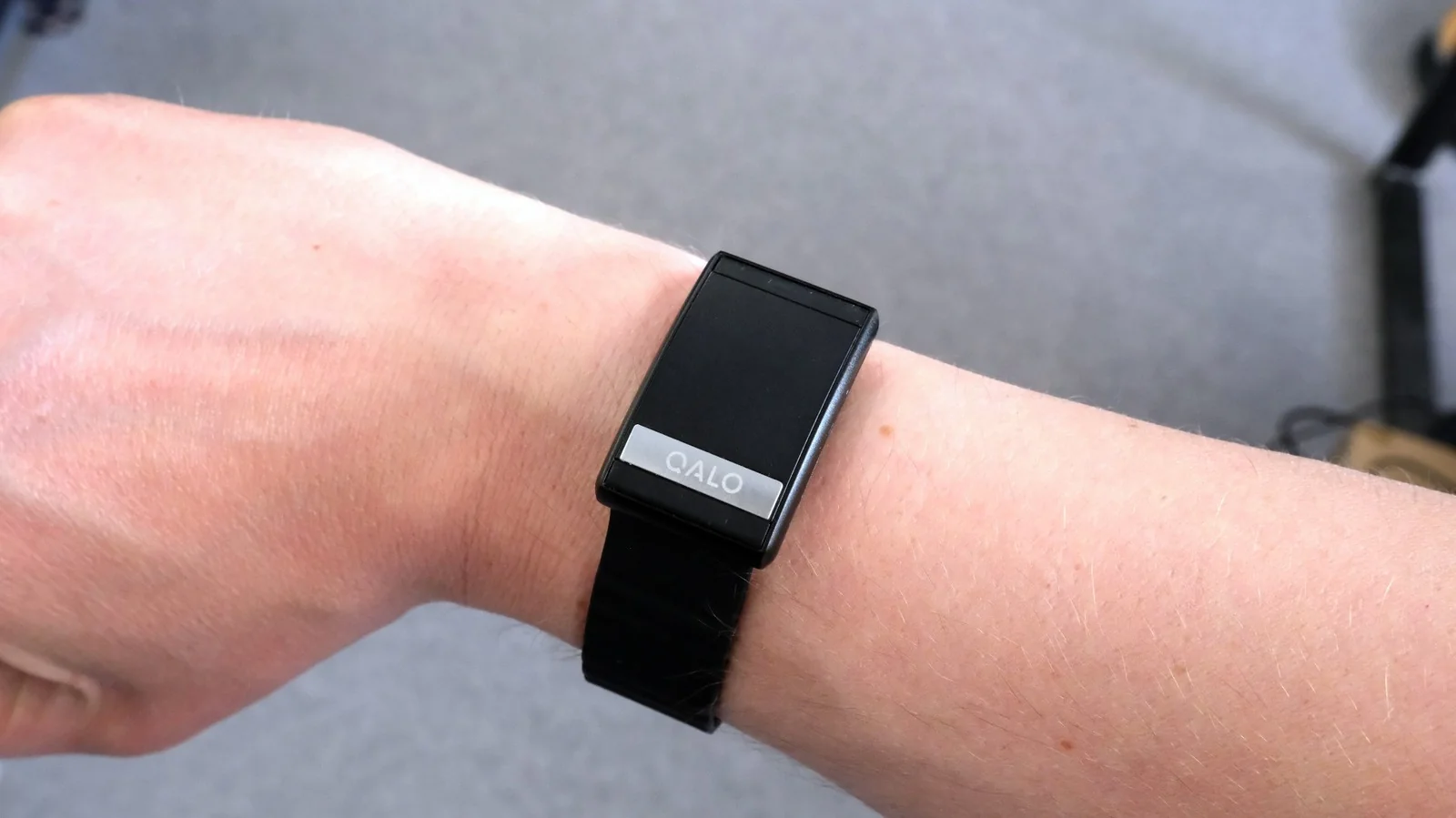
The Qalo SL-1 is a screenless tracker featuring a slightly longer chassis and more pronounced bend than a Whoop band, outfitted with a silicone strap that secures magnetically.
While the magnetic strap initially appears innovative, it can easily dislodge if a sleeve brushes against it at the wrong angle.
The water-resistant band promises a 12-day battery life and tracks activity, sleep, heart rate, SpO2, HRV, stress, temperature, and menstrual cycles. It ships with a heavy magnetic USB-C charging cradle.
In-use
Daniel Cooper for Engadget
To prevent data overload, the SL-1 generates a single 1-100 Q Score indicating overall well-being, supported by three distinct metrics for Sleep, Movement, and Vitality, the latter of which combines resting heart rate, HRV, blood oxygen, and skin temperature.
Opening the app each morning presents a pop-up with the previous day's Q Score, rewarding consistent sleep, exercise, and healthy habits with streaks.
The home screen displays live updates of the Q Score, though its conclusions are delivered in the past tense without broader contextual awareness, potentially penalizing users for missed morning workouts before the day has unfolded.
A notable drawback is the absence of automatic workout detection for basic activities, requiring manual activation. This omission is particularly glaring given that similarly priced alternatives like Garmin's Cirqa include this capability.
Active workout tracking provides detailed metrics including heart rate zones, maximum and average heart rates, steps, and calories burned, with live stats available on a phone's lock screen.
Battery performance is a major strength, easily meeting expectations. After a full week of continuous wear, the battery indicator remained at 59 percent.
Wrap-up
Daniel Cooper for Engadget
The Qalo SL-1 struggles to stand out in a competitive market, offering no standout killer feature to recommend it over established screenless fitness trackers. It serves primarily as a basic, commitment-free entry point for users looking to test the category.
At a price point equivalent to the Garmin Cirqa—which handles fundamental features like automatic activity tracking much better—the SL-1 faces stiff competition.
While a lower price tag would make the SL-1 an appealing beginner device, its cost makes it difficult to choose over superior alternatives, even when factoring in subscription fees for rival platforms.