Overview
Launched at the Berlin IFA event, the RugOne Xsnap 7 Pro fuses two well-known product categories into something genuinely new.
Overview
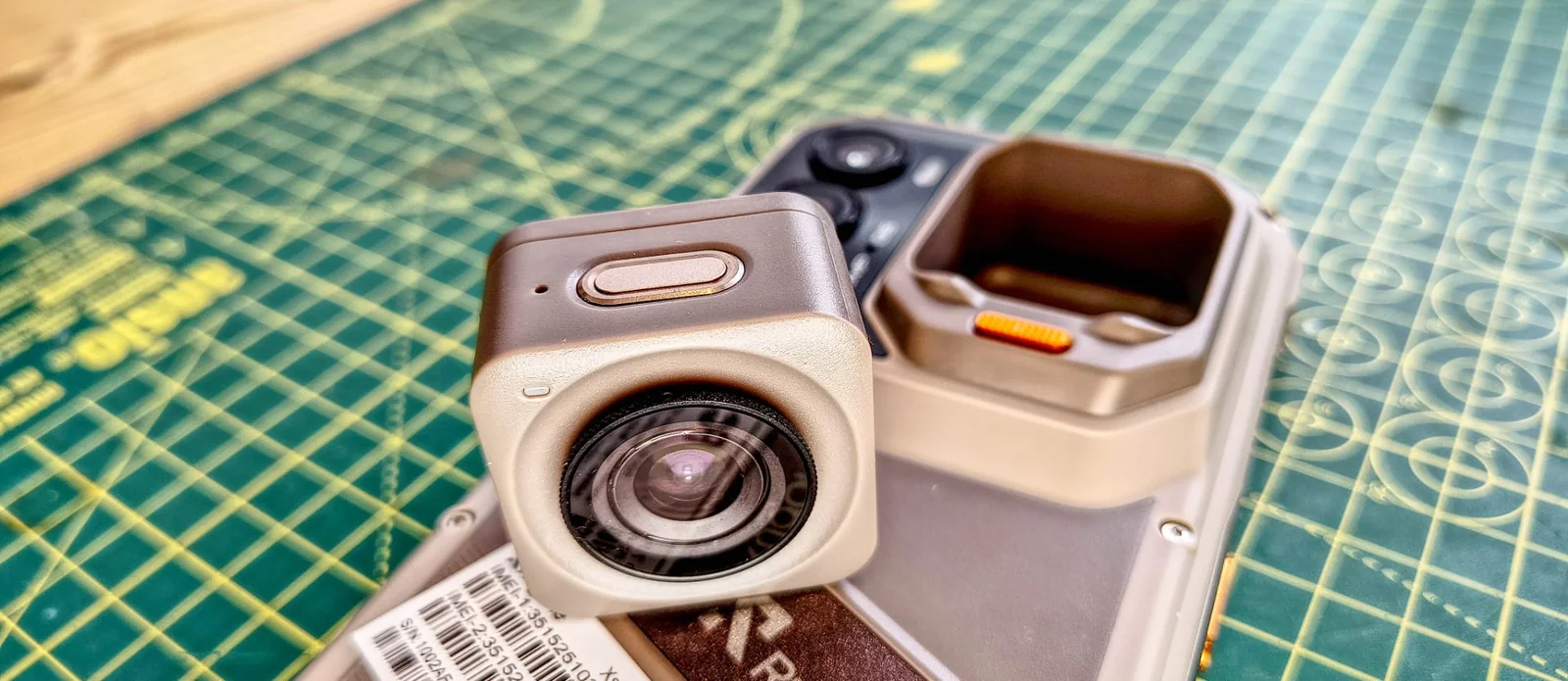
In this design, a rugged Android smartphone is paired with a small detachable action camera, the Xsnap Go, which can be popped out whenever an external viewpoint is needed.
Overview
Ignoring the detachable aspect for a moment, the Xsnap 7 Pro delivers solid specifications for a rugged device, featuring a capable processor, generous RAM, and ample storage.
Overview
The built-in standard cameras are reliable, but the true party trick is the tiny square camera module that docks securely into the back of the phone to charge and can be controlled remotely.
Overview
It connects via a Wi-Fi hotspot and stores all captures on 64GB of internal camera storage before a transfer is initiated. It supports a maximum video resolution of 2.7K alongside anti-shake and lens distortion compensation.
While it may not directly rival dedicated action cameras from GoPro or DJI, its inclusion in the device price provides useful versatility for awkward shooting locations.
The action camera integration does slightly compromise the phone's overall design ergonomics, but for users needing a powerful rugged handset with a detachable lens, it represents a unique option.
RugOne Xsnap 7 Pro: Price and Availability
The standard retail price for the device is set at $999.
The phone is available now following a crowd-funding campaign launch.
The hardware initially appeared on Kickstarter before rolling out to wider international retail markets.
Wider retail availability places the cost at $999 in the United States and approximately €1,099.99 across European markets.
Evaluated purely as a phone, the price point sits on the higher side, but the bundled action camera alters the overall value proposition.
Standalone compact action cameras command separate market prices, making the combined package worth considering for specific workflow needs.
The primary convenience lies in having the camera securely housed and continuously charged directly within the smartphone chassis.
Because direct market alternatives for this specific form factor are scarce, buyers must weigh the integrated phone-and-camera combo against carrying separate devices.
Value score: 3.5 out of 5
RugOne Xsnap 7 Pro: Design
The phone features an unusual structural layout to accommodate the removable hardware module.
The detachable Xsnap Go camera sits flush within a dedicated rear housing slot.
Several supplementary accessories are included in the retail package to support the camera module.
Fusing two disparate electronic devices into a single hybrid chassis presents notable engineering and industrial design challenges.
Accommodating a deep camera module inevitably creates an uneven profile, resulting in a pronounced thickness at one end of the device.
While modern smartphones routinely feature raised camera bumps for optics, this particular design takes depth expansion to an entirely different level.
The substantial camera bulge affects pocketability, making the phone easier to stow upside down depending on pocket dimensions.
Extracting the camera module leaves the structural chassis dimensions unchanged.
The detachment mechanism relies on a physical release button combined with internal magnets, requiring a firm grip during removal to prevent the module from snapping back into place.
Magnets ensure proper alignment with internal contact pads, keeping the charging pins flush against the base of the recess.
Re-inserting the module is seamless, as the magnetic pull automatically guides it into position.
The space occupied by the removable camera forces the primary integrated sensor array to shift toward the left side in a vertical stack.
Elsewhere, the rear panel remains flat and incorporates a backlit logo strip intended to pulse for incoming calls and notifications, though its illumination level can be difficult to notice in ambient light.
The flat portion of the lower back supports wireless charging, though the shifted weight distribution requires careful placement on charging pads to prevent tipping.
The physical button layout follows standard rugged phone conventions, featuring power and volume controls on the right alongside customizable keys on the left. The device maintains an IP68 water-resistance rating.
An integrated infrared blaster sits at the top edge, allowing the smartphone to double as a hardware remote control.
The 6.67-inch AMOLED display delivers sharp resolutions with a 120Hz refresh rate and high peak brightness, protected by Corning Gorilla Glass Victus.
This screen specification outperforms many competing rugged devices that typically compromise on panel quality to reduce manufacturing costs.
An under-display optical fingerprint sensor adds convenient biometric security accessible from multiple hand orientations.
Aside from the necessary rear swelling required to house the action camera, the chassis reflects standard rugged construction standards.
Design score: 3.5 out of 5
RugOne Xsnap 7 Pro: Hardware
Powered by a modern mid-to-upper-tier processor platform.
Equipped with high-speed UFS 4.0 internal storage architecture.
Features a physical USB 3.2 Gen 1 data port configuration.
Incorporates a substantial 9,300mAh internal battery capacity.
The internal processing architecture is paired with ample physical RAM and high-bandwidth storage, ensuring responsive multitasking.
Virtual memory expansion features should not be confused with physical hardware memory capacity.
The implementation of UFS 4.0 storage translates directly into fast application installation times and snappy file read-write speeds.
Unlike many mobile devices that limit Type-C ports to slower legacy data speeds, this hardware embraces faster data transfer standards.
The USB 3.2 Gen 1 wired connection enables rapid media offloading, fully complementing the high-speed internal storage.
While a 9,300mAh battery provides solid day-to-day endurance, intensive usage patterns will deplete the capacity faster than manufacturer maximum claims suggest.
Charging options include fast wired and wireless protocols, though docking the action camera automatically draws power from the phone to replenish the module's internal cell.
Users looking to conserve smartphone battery life during field operations can choose to charge the camera module separately.
The phone battery can repeatedly recharge the action module when docked, expanding cumulative field capture sessions significantly.
An independent external charger is also supplied in the kit for maintaining power to the camera via portable power banks.
Hardware score: 4.0 out of 5
RugOne Xsnap 7 Pro: Cameras
Features a dual-sensor rear camera array alongside dedicated modules.
Includes a high-resolution front-facing selfie camera.
Incorporates the detachable Xsnap Go action camera as an auxiliary module.
The complete imaging setup spans four distinct optical capture units.
The device integrates multiple specialized sensors to handle varied lighting and environmental conditions.
Sensor hardware includes a primary 50MP shooter, a dedicated night-vision sensor, a high-megapixel front camera, and the removable action module.
The primary sensor delivers sharp, capable photographs in well-lit environments using optical image stabilization.
Automatic software settings can sometimes push color saturation, but adjusting HDR modes yields balanced, natural image output.
For complete darkness, the infrared night-vision sensor captures clear monochrome imagery within illuminated ranges.
The front-facing camera provides crisp detail suitable for video calls and self-portraits.
The standout feature remains the detachable Xsnap Go module, providing a wide-angle perspective independent of the phone body.
Operating the detachable module requires familiarization with its software workflow and connection protocols.
A dedicated companion application manages communication with the remote camera module over local wireless connections.
Network configurations require specific wireless hotspot management during remote operation.
Stable links can be established whether the module is locked into the phone chassis or placed remotely.
Wireless range is bounded by physical obstructions, and dropped connections occasionally require hardware restarts to re-establish pairing.
Physical shutter buttons on the module allow standalone operation without the app, though storage monitoring requires phone synchronization.
The compact module supports multiple capture modes including time-lapse and interval stills, storing media locally on non-expandable internal memory.
Manual exposure adjustments and stabilization tools provide flexibility for creative remote framing.
Placing the detached camera in tight spaces offers practical utility for specialized trade and automotive inspection tasks.
Motion-compensated video and time-lapse modes produce clean results, though rapid lighting shifts can occasionally challenge automatic exposure adjustments.
Module battery runtimes support extended time-lapse sequences, aided by dedicated mounting accessories included in the bundle.
Accessory design limitations prevent simultaneous mounting of external power banks directly to the camera housing during standalone use.
Despite minor software and hardware limitations, the detachable camera concept delivers genuine utility for unique use cases.
Camera score: 4.0 out of 5
RugOne Xsnap 7 Pro: Performance
Performance evaluations highlight strong overall processing capabilities alongside efficient power management.
Comparative analysis against alternative rugged flagship models demonstrates the computational advantages of the updated chipset.
Benchmark outputs reveal consistent processing gains and superior graphics rendering capabilities under load.
Graphics test suites demonstrate how modern GPU architecture pairs effectively with high-speed internal storage.
Power consumption metrics during extended testing cycles confirm efficient thermal and electrical optimization.
High-speed storage operations do not incur excessive battery drain, maintaining competitive endurance figures.
Display panel efficiency contributes positively to overall battery longevity during standardized testing procedures.
Continuous background charging of the docked camera module introduces a minor power draw, though users retain full control over charging behavior.
Performance score: 4.0 out of 5
RugOne Xsnap 7 Pro: Final verdict
The build quality of the hardware is exceptionally robust, making the device well-suited for outdoor professionals and harsh working environments.
Underlying processing power ensures responsive execution across demanding applications, multimedia, and gaming workloads.
While the standard camera array excels, the detachable action module serves as a capable secondary tool rather than an outright replacement for dedicated standalone action cameras.
Field workers requiring simultaneous multi-angle observation will find significant utility in the remote camera concept.
Ergonomic compromises such as added pocket bulk and potential battery drain must be weighed against its unique modular benefits.
Ultimately, it represents a specialized hybrid product that brings genuine innovation to the rugged smartphone category.
Buy it if...
You need remote viewing capabilities. Being able to detach the camera and monitor feeds from another location offers distinct advantages for specialized professional tasks.
You need a powerful phone. The high-performance processor, fast UFS 4.0 storage, and modern USB port make it ideal for demanding workflows.
Don't buy it if...
You already own a dedicated action camera. The Xsnap Go module is capped at 2.7K resolution and does not match the advanced feature sets of specialized 4K action cameras.
Maximum battery endurance is critical. Power consumption from intensive processing and camera recharging reduces overall field stamina.