The financials Anthropic shared with investors this week suggest that its AI coding tool, Claude Code, is every bit the business success the frontier lab wanted. The company recorded an operating profit in the second quarter, and 900% net revenue retention, meaning spending from the same customers in Q3 2025 grew nine times in Q3 2026.
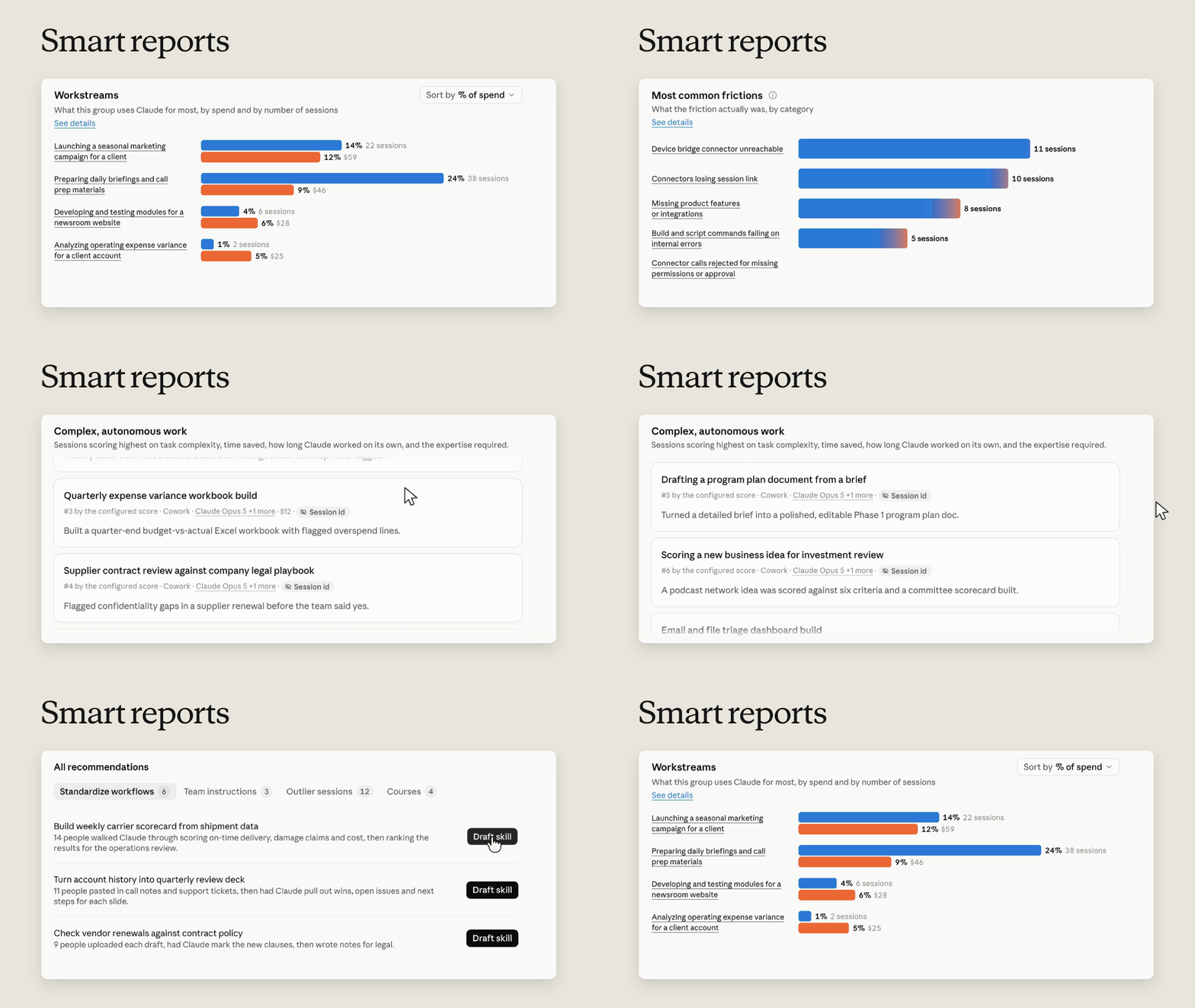
Anthropic has focused on getting enterprise users to stick around and announced a new suite of reporting tools designed to give those customers a more granular understanding of the value they get from their token spend.
Measuring AI Productivity
Using internal analytics and employee surveys, managers can view a team’s work over a given date range, what the team produced, how much it cost, and where its workflows broke down. Anthropic states it will not use this data for model training by default. The reports will also offer recommendations on how to improve the results.
This is an attempt to demonstrate the return on investment of Anthropic’s tools and to show customers how to improve it, which remains a major concern among large clients. Anthropic is also creating pooled group budgets to allow teams to better manage token spending.
Businesses have been hunting for that kind of information as they figure out how best to deploy AI tools. While usage among venture-backed firms is driving token spend, most Fortune 500 companies are not seeing major gains from deploying AI.
Market Adoption and Growth
Jellyfish, a company that makes tools for software developers, released a report based on the use of agentic coding tools by 276,000 of its customers. Claude Code and other tools built on Anthropic models remain the most widely used in the survey, responsible for nearly a third of all proposed code changes submitted for review. Spending on those tools has grown tenfold since the beginning of the year, with their cost now equal to about 2% of total engineering costs.
Even if 2% remains relatively small, that tenfold growth is growth that most chief financial officers did not plan for. Organizations are reaching the point where it is no longer enough to simply spend heavily on technology, requiring optimization to make operations work effectively.
Competitive Enterprise Landscape
Anthropic’s new reports speak to that challenge. Anthropic leads among enterprise customers, but what makes an agentic coding tool truly sticky is difficult to identify. The release of OpenAI’s Astra model seemed like a potential threat to Anthropic, but so far it has not slowed Anthropic’s adoption numbers.
While online discussions suggest that competition is heated, Anthropic has benefited from strong enterprise motions and incumbent weight. Many organizations have put significant effort into standardizing workflows around its ecosystem, resulting in a high barrier to switching.
The realities of business mean that once a frontier lab has established a presence with a customer, switching is harder than it is for an individual programmer or small organization. Major AI labs are investing in forward-deployed engineering organizations, embedding consultants inside customer organizations to help them get started. These new reporting tools function as a lighter version of that hands-on help.
As platforms mature, once an organization adopts a system, switching becomes increasingly difficult due to the invested effort. Different platforms feature distinct quirks in how they handle configuration files and workflows, meaning the cost to switch is not zero.