Joint Venture Expansion
The $5.8 billion joint venture between Rivian and Volkswagen Group is expanding to include AI assistants.
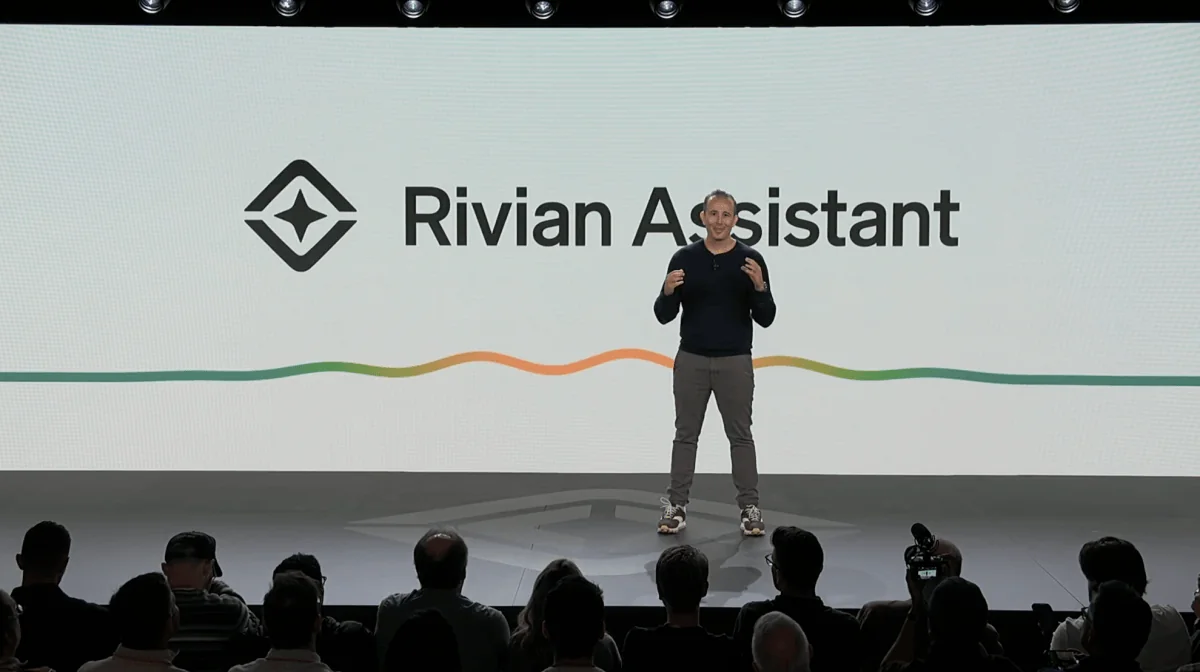
Rivian is now licensing elements of its AI voice assistant technology to Volkswagen Group as part of the broader joint venture, according to the company’s third-quarter investor presentation.
Rivian did not disclose the licensing fees, payment terms, or which Volkswagen vehicles will use the technology. However, the AI assistant, which recently rolled out to Rivian vehicles, could make its Volkswagen debut in the automaker’s low-cost EV called the ID EVERY1. The small four-door hatchback is slated to be the first VW vehicle to use Rivian’s software and electrical architecture under the joint venture established in 2024.
Financial Commitment
The joint venture between Rivian and VW Group has already expanded once before financially. The companies initially announced a joint venture valued up to $5 billion, but within months VW increased its commitment to invest up to $5.8 billion in Rivian by 2027. The initial tie-up, formalized through an independent company that kicked off in November 2024, focused on bringing Rivian’s electrical architecture and software to Volkswagen’s next generation of vehicles.
Rivian described the expansion to include elements of its AI assistant technology as a proof point for the extensibility of the platform built in-house.
AI Development and Rollout
Rivian spent two years developing its AI assistant before showing it off. That development work continued longer than expected, with the assistant finally rolling out in May 2026 to its flagship R1S SUV and R1T pickup truck, followed by an October release for its new midsize R2 SUV.
Rivian has designed its AI assistant to allow drivers and passengers to interact with the vehicle and control various functions. The company created an in-house agentic framework that interprets user intent and routes it to the appropriate vehicle software subsystem. That capability could eventually allow Rivian vehicles to run AI agents created by external companies.
Vertical Integration Strategy
The in-house AI assistant program also aligns with Rivian’s push to become more vertically integrated, a strategy emphasized in its third-quarter earnings report.
The company noted in its investor presentation that its focus on vertical integration serves as a core competitive differentiator, unifying hardware and software architecture to deliver value to customers.
That strategy led to Rivian overhauling its flagship R1T truck and R1S SUV, changing components from the battery pack and suspension system to the electrical architecture, sensor stack, and software user interface. A new electric architecture system and compute platform reduced the amount of wiring and decreased the total number of electronic control units from 17 down to seven, providing the foundation required for advanced software and automated driving.
The technology attracted investment from VW, which has sought to offer modern, software-centric vehicle architectures comparable to competitors like Tesla.
Rivian emphasized in its presentation that controlling the entire technology stack—including compute, sensors, displays, lighting, and sound—allows the company to roll out rapid, vehicle-wide over-the-air updates.
This article was updated to provide the two separate rollout dates for the AI assistant.