Acemagic K5: 30-second review
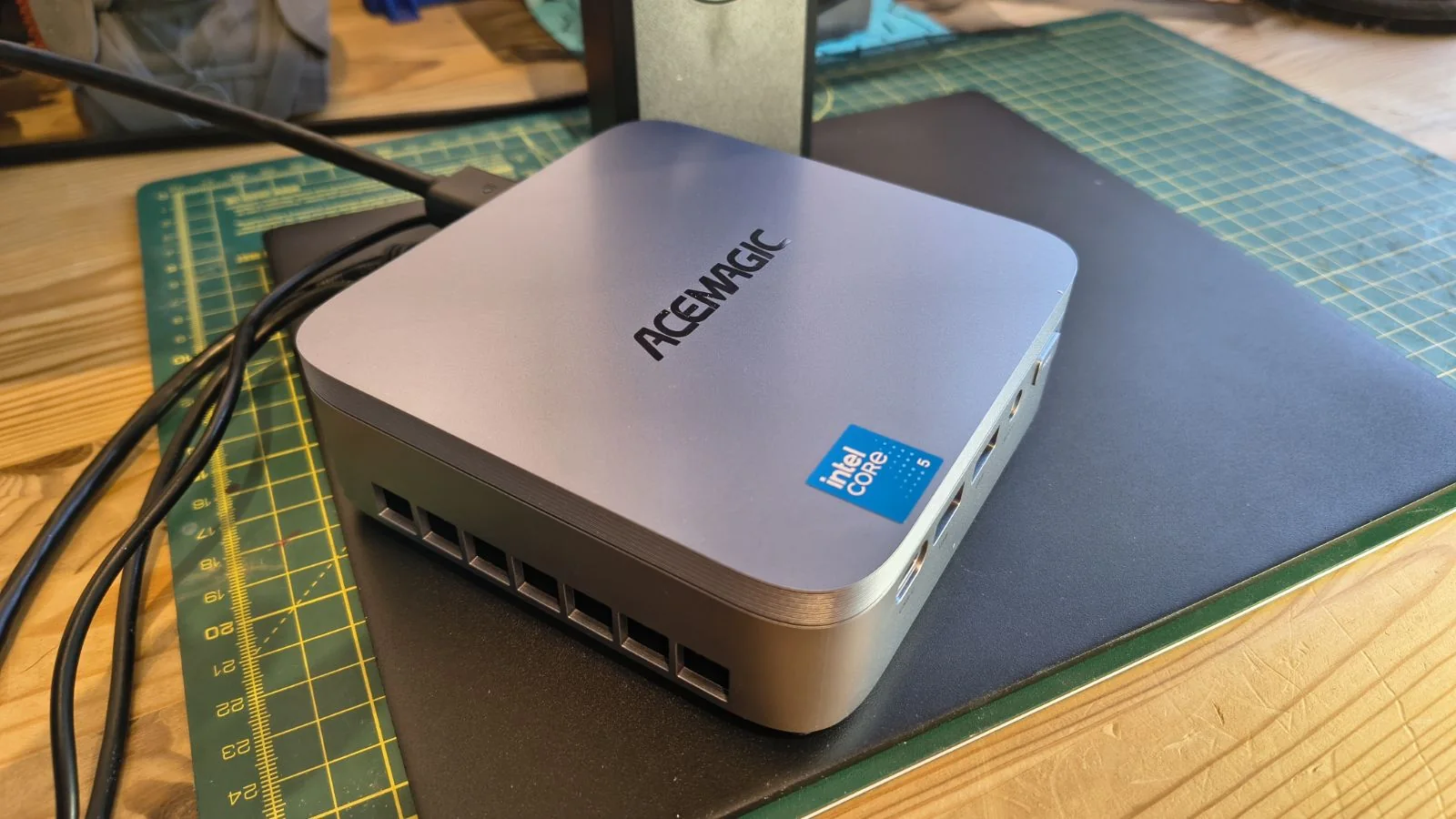
When this hardware was first introduced, it carried the name Acemagic KRON mini K5, before being streamlined to simply the K5.
Built around Intel's Core 5 Processor 320—codenamed Wildcat Lake—this machine marks Intel's mainstream mini PC debut for its 18A process, a notable milestone given its modest core count.
The silicon features a six-core split comprising two performance cores for heavy lifting and four efficient cores for background tasks, with turbo frequencies reaching up to 4.6GHz.
AI throughput is a key highlight, with the platform quoted at 40 TOPS total, distributed between a 16 TOPS NPU and up to 20 TOPS from the Xe graphics core, facilitating local workloads like background blur and image processing without cloud dependency.
However, since local processing requirements for tools like Copilot demand higher throughput, the hardware is best suited to lighter models.
Faster LPDDR5 memory running at 6400MT/s replaces older LPDDR4X setups, efficiently feeding both CPU and integrated graphics, though the trade-off is that the 16GB of memory is soldered down and non-upgradable.
The machine misses out on USB4 ports and restricts its NVMe slots to Gen4 x2 lanes, lagging behind cheaper competitors that offer more robust connectivity.
While prices may adjust as more Wildcat Lake systems enter the market, the current configuration feels relatively expensive for its specific limitations.
It represents a clear generational step forward, though it stops short of industry-leading status.
Acemagic K5: Price and availability
Pricing for the system begins at $559.
Shipping is slated to commence from mid-October 2026.
Availability spans direct manufacturer channels and prospective online retail partners.
The K5 is available for pre-order directly from the manufacturer, with wider retail availability anticipated following its launch.
The US configuration priced at $559 includes the Intel Core 5 320 CPU, 16GB of LPDDR5 memory, and a 512GB SSD.
European markets receive two variants in October: a matching specification model and a more affordable version built around the Intel Core 3 304 CPU with 12GB of RAM and 256GB of storage.
UK availability details are expected to be confirmed in subsequent weeks.
As the Wildcat Lake silicon is newly introduced, competing hardware vendors are rolling out alternative implementations.
Alternative options include competing mini PCs utilizing the Core 3 304 chip at lower price points, though carrying reduced core counts and processing capability.
Industrial and enterprise alternatives based on the Core 5 320 offer expanded memory capacity and dual network ports at a higher cost tier.
Market positioning for the K5 places it above historical entry-level pricing tiers established by older N-series processors.
Value score assigned in the source review: 3 out of 5.
Acemagic K5: Design
Enclosure construction relies primarily on plastic rather than metal.
Internal access is facilitated through an unlocking mechanism.
USB4 connectivity is omitted from the port selection.
While previous manufacturer designs utilized metallic builds, the K5 opts for a plastic chassis finished with metallic paint.
The primary advantage of this material choice is a remarkably lightweight build, complemented by an included VESA mounting bracket for display attachment.
Measuring 128 by 128 by 41.3mm with a restrained 25W TDP, the chassis maintains a small footprint suitable for continuous desktop operation.
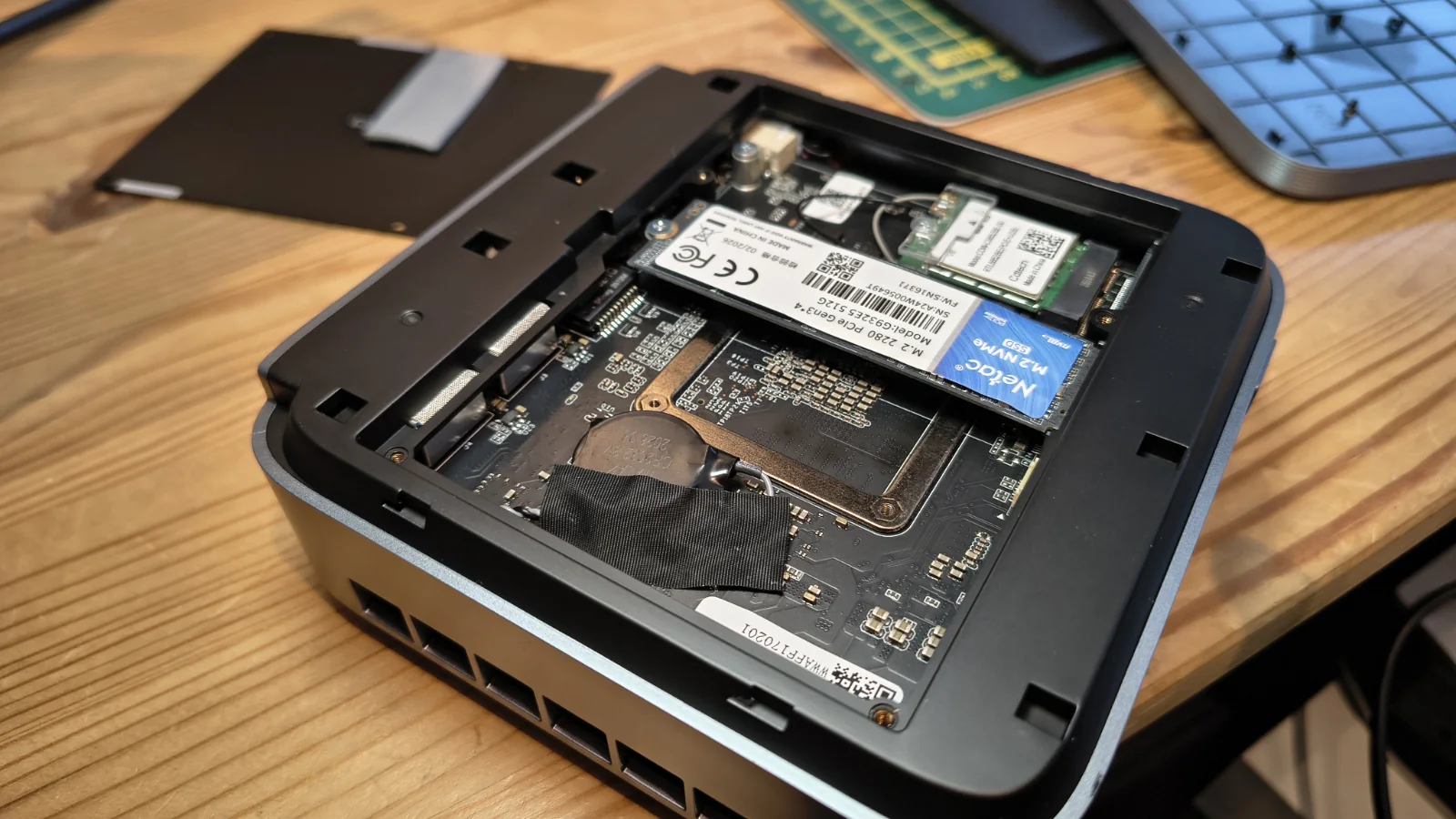
Accessing the internal components requires unlocking a rear switch, followed by removing four screws to lift an inner thermal plate.
The internal plate incorporates a thermal pad to assist with SSD heat dissipation.
Beneath the plate lie multiple M.2 slots, housing the primary operating system drive and the wireless networking module.
The inclusion of multiple M.2 slots is offset by platform-specific bandwidth constraints.
Memory expansion is unavailable due to the LPDDR5 architecture being soldered directly to the mainboard.
External ports are distributed across the front and rear panels, leaving the sides clear for ventilation.
The front panel features an illuminated power button, two USB 3.2 Gen 2 ports, a USB-C 3.2 Gen 2x2 port, and an audio jack.
The rear panel houses additional USB-A ports, HDMI and DisplayPort video outputs, a 2.5GbE LAN port, and a security slot.
The front-facing USB-C port supports DisplayPort Alternate Mode and 20Gbps data transfers, though power delivery input functionality is absent.
The lack of charging capabilities on this port introduces some functional ambiguity.
The absence of USB4 support remains a notable drawback for modern peripheral compatibility.
These hardware limitations stem directly from constraints within the underlying Intel silicon architecture.
Design score assigned in the source review: 4 out of 5.
Acemagic K5: Features
Intel Wild Lake Core 5 320 processor configuration.
Integrated LPDDR5 memory subsystem.
Restricted PCIe lane allocation.
The Wildcat Lake processor lineage succeeds older entry-level Atom and N-series architectures.
While historical entry-level chips focused primarily on low-power, light-duty applications, recent iterations have expanded functional capabilities significantly.
The introduction of higher core counts has broadened the operational scope of these compact systems.
Intel's latest design shifts away from purely efficiency-core configurations toward a hybrid layout.
The Core 5 320 pairs two performance cores with four efficiency cores.
Operating within a power envelope scaling from 15W to 54W, the processor achieves boost clock speeds up to 4.6GHz.
These architectural enhancements yield roughly double the aggregate computing capability of previous entry-level N-series platforms.
Performance positioning relative to higher-tier Core Ultra chips is carefully managed by architectural boundaries.
A primary constraint involves the PCIe lane budget; although upgrading to PCIe 4.0 doubles per-lane bandwidth over predecessors, the total lane count remains restricted to six.
By comparison, competing AMD mobile platforms offer substantially higher lane counts and overall bandwidth.
This lane limitation is a fundamental platform trait of Wildcat Lake rather than an oversight by the manufacturer.
For general office tasks and web browsing, the limitation goes largely unnoticed, though heavy storage workloads encounter bottlenecks.
Features score assigned in the source review: 3 out of 5.
Acemagic K5: Performance
Comparing the new platform requires looking at previous-generation N-series mini PCs.
Testing against an N150-powered system highlights generational performance improvements.
The Wildcat Lake architecture significantly outperforms older Twin Lake configurations across most testing metrics.
Single-core benchmarks indicate that the Core 5 320 surpasses certain Core Ultra 5 processors, while graphics performance exceeds specific older Core i7 parts.
These performance gains stem from the addition of performance cores, dual-channel memory support, Xe graphics, and integrated NPU hardware.
The upgraded architecture integrates two performance cores, four efficiency cores, dual-channel DDR5 memory, Xe3 graphics, and an NPU.
Higher performance profiles are accompanied by an increased power draw, operating within a 9-25W envelope.
Despite these gains, the platform restriction on PCIe lanes impacts overall system potential.
Storage subsystem speeds are constrained by these lane allocations.
Intel's allocation of six PCIe 4.0 lanes leaves insufficient bandwidth to fully power high-performance M.2 NVMe slots when shared with LAN and USB controllers.
The resulting dual-lane configuration restricts maximum transfer speeds.
Peripherals and network controllers consume adequate bandwidth to leave storage slots running at PCIe 4.0 x2.
Benchmark testing reveals drive read and write speeds falling below theoretical maximums due to these lane limitations.
Drive speeds hover below 1800MB/s in read and write operations, constrained by the dual-lane setup.
The inclusion of a Gen3 drive in a Gen4-capable slot further impacts storage throughput.
While Intel's silicon design introduces bandwidth bottlenecks, hardware choices regarding storage components compound the restriction.
Performance score assigned in the source review: 3.5 out of 5.
Acemagic K5: Final verdict
The K5 delivers a mixed performance profile, combining capable new Intel silicon with platform-level hardware restrictions.
Architectural limitations appear intentionally structured to prevent cannibalization of higher-tier processor families.
The absence of USB4 and full x4 M.2 slots protects market separation from Core Ultra offerings.
Manufacturer choices regarding component selection further influence overall value.
At its launch price point, the system competes directly with alternative mini PCs offering superior processors, upgradeable memory, and dual Gen4 x4 storage slots.
Direct comparison reveals that the K5's asking price exceeds what its hardware specifications fully justify.
Buy it if...
You want early access to efficient new processor architecture that demonstrates significant improvements over older entry-level silicon.
You require ample connectivity options, benefiting from multiple USB ports without needing an external docking station.
Don't buy it if...
You rely on USB4 or Thunderbolt peripherals for high-speed data transfer.
You demand maximum storage performance, as the restricted lane configuration caps maximum transfer speeds regardless of installed drive capability.
Also Consider
Alternative systems featuring AMD Ryzen processors provide competitive multi-core performance, upgradeable memory configurations, and full Gen4 x4 storage support.
Older platform variants provide cost-effective alternatives for basic daily computing needs.
Higher-tier configurations utilize multi-core processors with generous RAM and storage allocations at competitive price points.