Return of 3D V-Cache to Data Centers
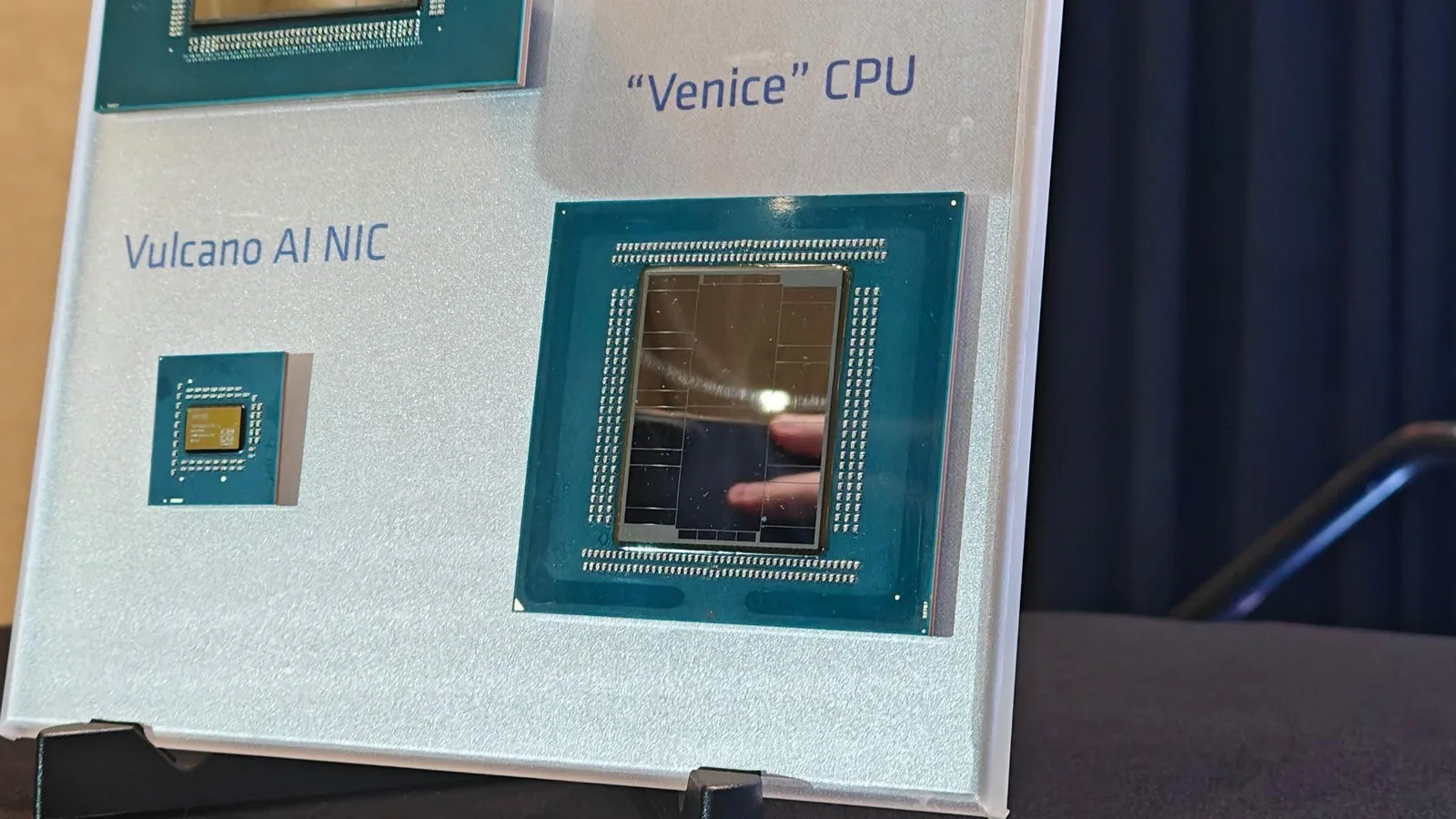
AMD is set to reintroduce its 3D V-Cache technology to the data center with the upcoming Venice-X lineup, scheduled for release in the second half of next year. The new processors will feature 96 cores and 1,152 MB of L3 cache, matching the capacity of the previous Genoa-X generation while introducing significantly higher clock speeds, PCIe 6.0 support, and nearly four times the per-socket memory bandwidth.
Following the absence of stacked SRAM in the Turin generation, Venice-X marks a return to the technology. The primary advancement is not in core counts, but in the 5.3 GHz boost clock speed, which provides a critical performance advantage for the high-performance computing (HPC) workloads that Venice-X is designed to handle.
Previous EPYC -X chips were characterized by lower boost clocks compared to their standard counterparts. Venice-X breaks this trend by offering the maximum 5.3 GHz boost clock across the range, effectively unifying high-frequency operation with the large L3 cache pool.
Platform Specifications and Performance
While specific SKU counts and base frequencies remain unconfirmed, the chips are expected to utilize the SP7 socket. The platform supports 96 PCIe 6.0 lanes and a 16-channel memory configuration, with support for MRDIMMs at 12,800 MT/s, enabling up to 1.6 TB/s of per-socket memory bandwidth.
AMD intends for Venice-X to serve as a single-chip solution for its internal EDA workloads, which require both high cache capacity and high frequency. By eliminating the need to split these tasks between different specialized CPUs, the company expects to see significant gains in efficiency for logic simulation and functional verification tasks.
Although formal benchmarks for Venice-X are not yet available, AMD has demonstrated the performance potential of its high-frequency EPYC 9686F against Intel's Xeon 6980P in computational fluid dynamics, where the 9686F outperformed the competitor while utilizing 32 fewer cores.
The broader Venice platform, including SP7 and SP8 variants, is currently rolling out, with Venice-X expected to follow in the second half of 2027. Additionally, AMD plans to launch its Verano AI host node, which will leverage SOCAMM2 LPDDR5X memory, in the same timeframe.