Apple M5 Ultra and Local AI Potential
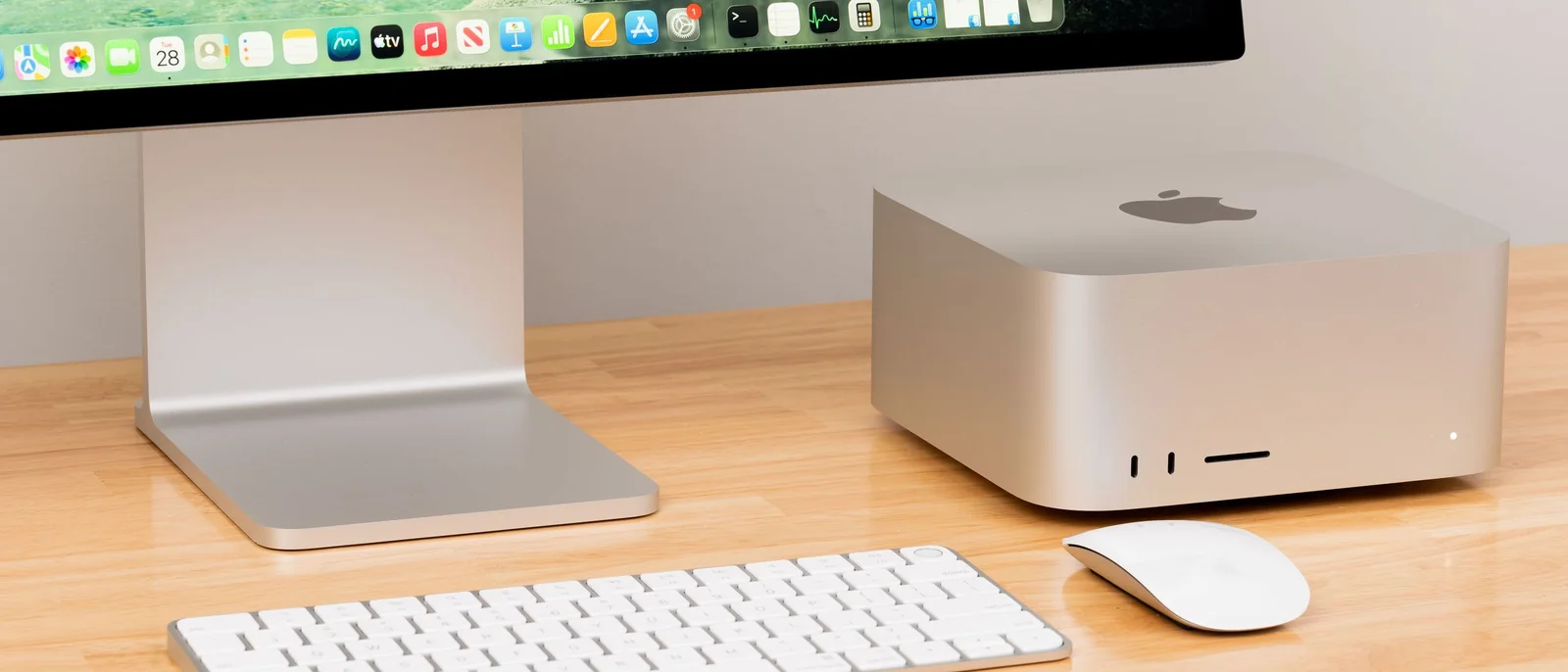
Apple’s updated Mac Studio with the M5 Ultra SoC has proven itself as a powerful system, featuring a 36-core CPU and an 80-core GPU equipped with Neural Accelerators for AI compute. With options for up to 512GB of unified memory, it has attracted local AI enthusiasts despite extended shipping lead times.
We tested a high-end M5 Ultra configuration to see how it handles large language models, moving beyond compact dense models to fill its memory pool with cutting-edge open models like DeepSeek V4.1 Flash and GLM 5.3 Flash.
We also examined new benchmarks to evaluate how the Mac Studio stacks up in agentic GPU tasks compared to systems powered by Nvidia architecture.
Agentic AI performance and power efficiency
Our local AI testing began with Artificial Analysis' AgentPerf-Local benchmark, which plays back recorded inference traces across agentic AI workloads. Because the bulk of this workload focuses on prompt processing rather than token generation, it favors systems with high raw compute capabilities.
The M5 Ultra's 80-core GPU offers significant compute scale, and the Mac's 1.2 TB/s of memory bandwidth provides substantially higher decode bandwidth than comparable workstation alternatives. However, delivered performance in AI tasks can vary greatly from raw paper specifications.
Using the dense Qwen 3.8 27B model with llama.cpp as our inference backend, we enabled native multi-token prediction support for a decode speed boost on both platforms.
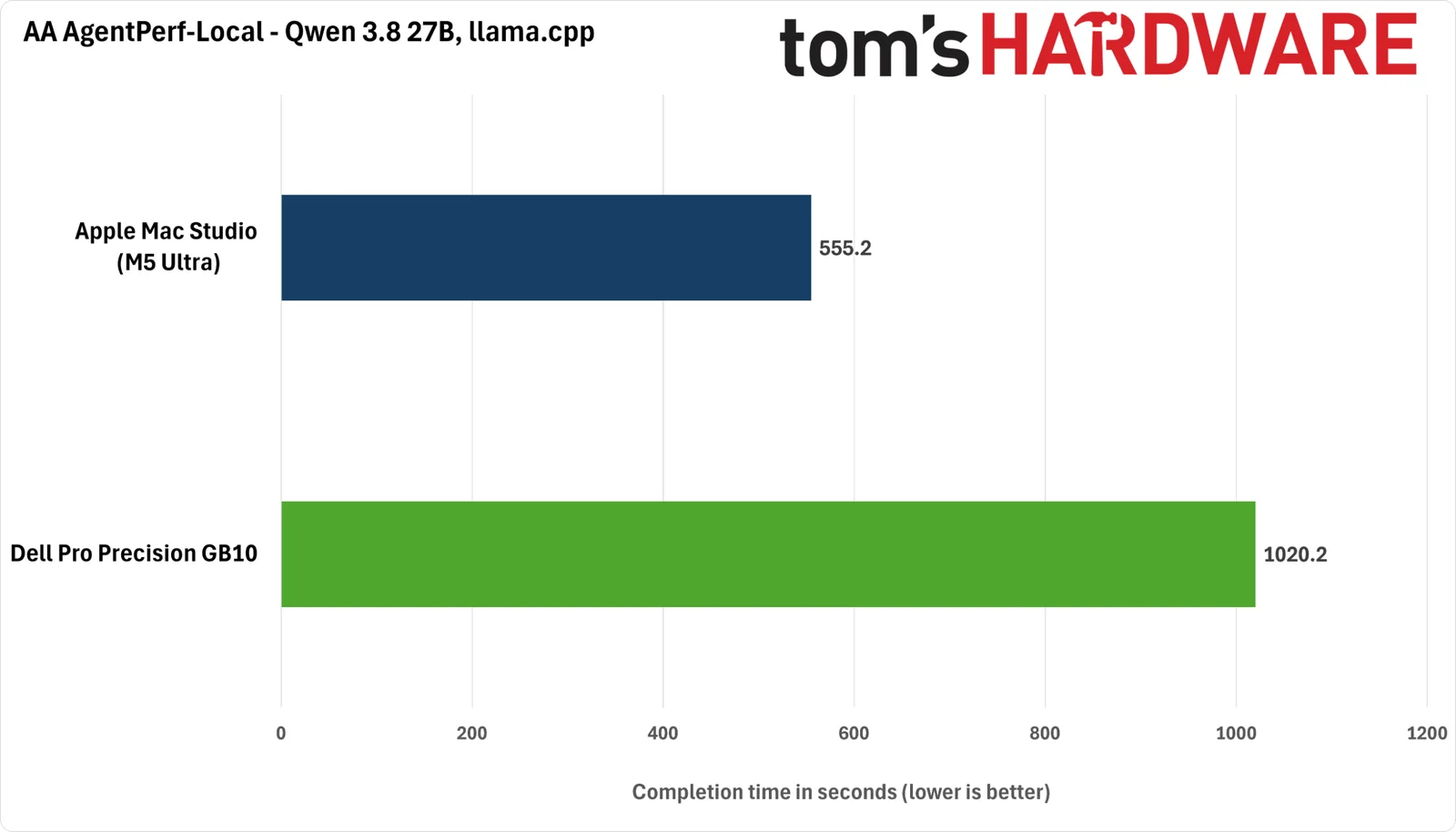
The M5 Ultra Mac Studio finished the agentic test in under half the time of a single DGX Spark-like system. Given the pricing of comparable professional workstations, a head-to-head comparison against high-end desktop configurations remains relevant.
Because AgentPerf-Local performs a fixed amount of work, we recorded wall power consumption to convert figures into task energy measured in kilojoules.
Using llama.cpp, the Mac Studio completed the benchmark faster and consumed about 16% less task energy overall compared to the DGX Spark setup.
Multiplying task time and consumed energy yields the energy-delay product for each system, combining completion speed and energy efficiency into a single metric.
The Mac Studio achieved an energy-delay product under half that of the DGX Spark in this test, demonstrating strong efficiency with dense models.
Large Model Scaling
To stretch the hardware capabilities further, we tested larger open models including GLM 5.3 Flash and DeepSeek V4.1 Flash. The M5 Ultra Mac Studio can natively fit quantized versions of these models within its 256GB of unified memory.
While single systems with limited memory require clustering solutions to handle these larger weights, the Mac Studio's unified memory pool provides sufficient capacity for single-box execution of heavily quantized versions.
Nvidia platforms rely on clustering capabilities to scale local inference capacity, which becomes a key factor when evaluating cost and performance against unified memory architectures.
Rising component costs and market pricing volatility for professional workstation hardware complicate value analyses, with high-end modular setups commanding substantial investments.
Configuring multi-node workstation clusters often exceeds the purchase price of a single high-capacity Mac Studio, making single-box solutions financially compelling if software support aligns.
Evaluating prompt processing and decode performance offers directional insight into which system delivers faster execution for larger models.
Due to inference engine choices on Apple Silicon, running DeepSeek V4.1 Flash requires llama.cpp. The Mac Studio cannot simultaneously hold both model weights and specialized speculative decoding models in memory for this specific configuration.
In contrast, serving recipes for competing cluster architectures leverage speculative decoding and specialized inference engines to extract higher performance.
Without optimized serving recipes, llama.cpp performance for DeepSeek V4.1 Flash on Apple Silicon lags behind specialized cluster configurations, resulting in slower prompt processing.
Community-developed serving recipes utilizing specialized inference engines remain a major asset for cluster owners, despite the setup and management overhead.
While a Mac running llama.cpp requires significantly more time to digest long context lengths for DeepSeek V4.1 Flash, cluster setups equipped with optimized inference engines complete identical workloads much faster.
Testing GLM 5.3 Flash yielded different results, as multi-token prediction does not require a separate drafting model, avoiding the memory headroom bottlenecks seen with DeepSeek.
GLM 5.3 Flash executes more efficiently on llama.cpp than DeepSeek V4.1 Flash, though cluster hardware still maintains an advantage in prompt processing times.
The availability of specialized model quantization and inference engine recipes for Apple Silicon demonstrates how much additional performance can be unlocked.
Optimized serving recipes significantly accelerate Mac Studio performance, bringing prompt processing times closer to cluster levels while substantially improving decode throughput.
Continued software development and expanded inference engine support are expected to unlock further performance potential for large models on Apple Silicon.
Conclusions on Hardware and Software
A single M5 Ultra Mac Studio delivers impressive local AI performance and energy efficiency when paired with suitable workloads and software stacks.
With professional workstation pricing climbing due to component supply constraints, high-end Mac configurations are becoming increasingly competitive on cost.
However, the M5 Ultra's performance varies depending on the chosen model and inference engine, particularly when utilizing large models that occupy the full 256GB memory capacity.
While smaller models run quickly with basic backends, larger models benefit significantly from specialized serving recipes like those available for GLM 5.3 Flash.
Raw memory bandwidth is only one factor in AI inference performance; evaluating unified memory setups requires considering the entire hardware-software ecosystem.
Although Apple hardware capabilities continue to improve, development around the MLX stack must mature further to match the broad model compatibility and inference engine variety found on established platforms.
The primary advantage of mature enterprise AI platforms lies in the velocity of community software support, ensuring immediate compatibility with newly released models.
High demand and component pricing for multi-GPU systems make single-box alternatives attractive, provided software ecosystems continue to evolve.
For users seeking general-purpose workstation performance alongside local AI capabilities, the Mac Studio remains a capable and quiet compact option.
Buyers willing to wait for software optimization to match hardware potential will find strong performance, though extended shipping lead times apply.
Those prioritizing immediate software support and broad model compatibility for dedicated local AI inference workloads may still favor clustered hardware configurations.