GMKtec EVO-X5 Pro: Overview
The EVO-X5 features the latest Strix Halo CPU. While updates to the Ryzen AI Max+ PRO 495 processor over previous iterations may look modest on paper, pairing it with 196GB of unified memory and internal expansion space for up to 24TB of storage creates a machine whose capabilities extend far beyond standard compact computers.
The hardware footprint remains discreet, departing from the large gaming and AI workstations traditionally associated with this level of computing power. While the integrated AMD Radeon graphics handle moderate gaming, users seeking full discrete GPU power for intensive tasks will need to connect an external GPU option.
This design makes the machine's intended use flexible. It functions independently as a powerful workstation handling office tasks, image editing, and 3D work, or it can be racked alongside additional units to build a personal AI data center utilizing remote management features.
Evaluating day-to-day functionality reveals whether a high-end system can seamlessly execute standard enterprise software, heavy creative applications, and intensive office workflows.
Given the premium cost compared to standard workstations, buyers must determine whether the latest AI-enhanced processors and hardware headroom genuinely justify the investment.
The hardware's unified RAM configuration provides substantial headroom, allowing the system to tackle complex coding tasks, swift image generation, and large language models without hitting processing walls.
Performance evaluations demonstrate the system's proficiency in editing high-resolution video streams within software like DaVinci Resolve.
The EVO-X5 Pro stands out as a formidable entry among high-end mini PCs, catering directly to professionals integrating artificial intelligence into everyday workflows.
GMKtec EVO-X5 Pro: Price and Availability
Pricing starts at approximately £5,299 / $6,799.
The hardware is available now.
Units can be purchased directly from the manufacturer or major online retailers.
The system is sold globally across regional web storefronts.
Configurable storage options include 2TB or 4TB base tiers, with storage upgrades carrying standard retail price adjustments.
GMKtec EVO-X5 Pro: Specs
CPU: AMD Ryzen AI Max+ PRO 495, 16 cores/32 threads
GPU: AMD Radeon 8065S, 40 RDNA 3.5 compute units
NPU: AMD XDNA 2, 55 TOPS
RAM: 192GB LPDDR5X-8533 unified memory, non-upgradeable
Storage: 2TB or 4TB PCIe 4.0 M.2 2280 SSD, three slots, up to 24TB total
Front Ports: 2 x USB 3.2 Gen 2, 2 x USB4, 3.5mm audio, P-Mode button, CMOS reset
Rear Ports: HDMI 2.1, 2 x USB4 v2 80Gbps, 2 x USB 2.0, 2 x 10GbE RJ-45 DASH, 3.5mm audio
Wireless: Wi-Fi 7
VESA Mount: No
Dimensions: 221 x 80 x 195mm
Weight: 2.5kg
Power: 54W–120W selectable power modes, external power adapter
Operating System: Windows 11 Pro
GMKtec EVO-X5 Pro: Design
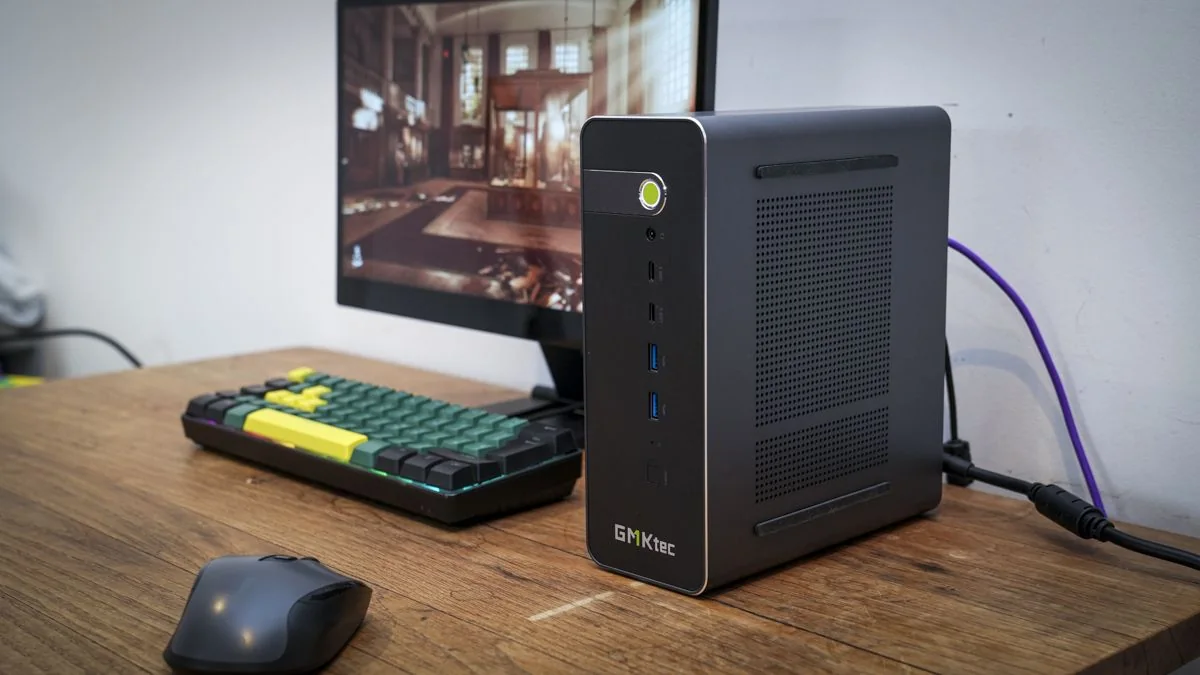
The computer sits between a small tower desktop and a traditional mini PC. The chassis features an understated all-metal black finish with a fingerprint-reader power button, supporting both flat and vertical orientations.
Measuring 221 × 80 × 195 mm and weighing 2.5kg, the unit remains substantially lighter than conventional desktop workstations while occupying minimal desk space.
Build quality reflects its premium market position, offering robust construction suitable for studio environments and enterprise scaling.
The front panel houses essential connectivity alongside a physical P-Mode button, which allows users to cycle through silent, balanced, and performance profiles ranging from 54W to 120W.
The included external power brick is substantial but can be easily tucked out of sight.
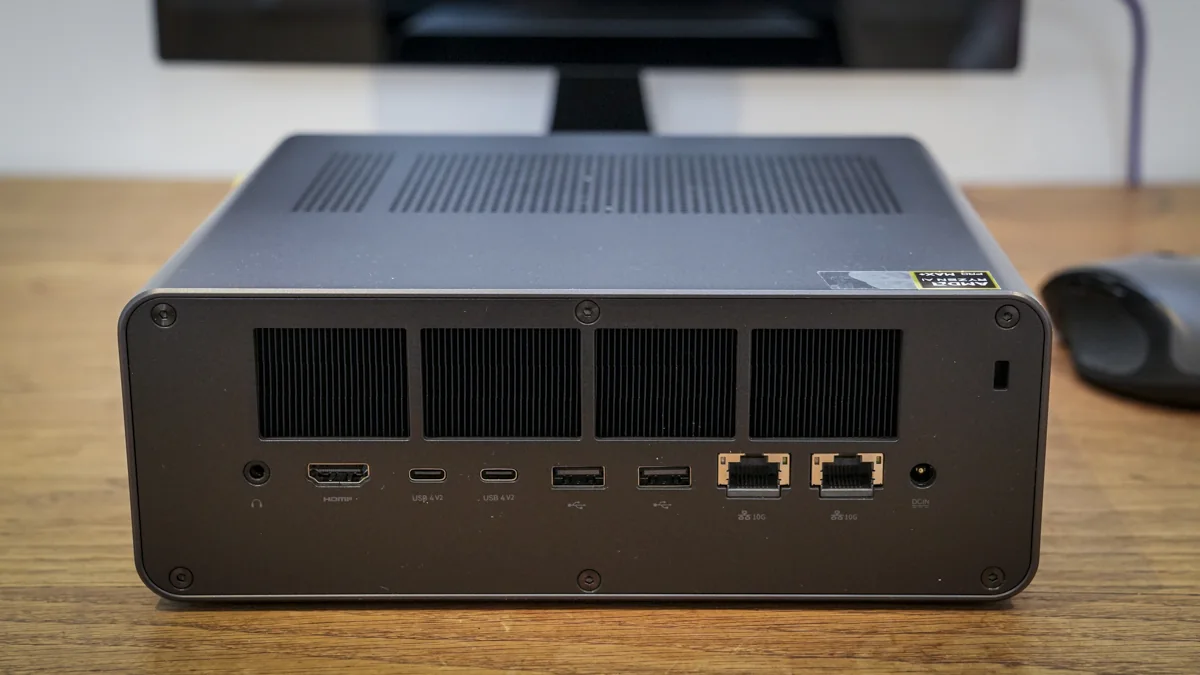
Rear connections include HDMI 2.1, dual USB4 v2 ports, USB 2.0 ports, dual 10GbE RJ45 DASH ports, and audio outputs, supporting ultra-fast network speeds.
Internal cooling arrays manage thermal output efficiently, though fan noise increases under heavy multi-threaded workloads.
Internal components are densely organized. While additional M.2 storage slots are easily accessible, the unified LPDDR5X RAM is soldered directly to the motherboard and cannot be upgraded.
GMKtec EVO-X5 Pro: Features
The primary hardware advancement centers on the Ryzen AI Max+ PRO 495 processor, bringing significant improvements to integrated graphics performance and massive RAM support.
Support for up to 196GB of unified memory allows the machine to host exceptionally large language models locally, backed by a 55 TOPS neural processing unit.
The integrated Radeon 8065S graphics feature 40 compute units, while the system memory bandwidth operates at 8533MT/s for accelerated data transfer.
Creative professionals benefit from dual USB4 v2 80Gbps ports and external eGPU compatibility.
Expansion slots accommodate multiple M.2 SSDs, permitting total internal storage scaling up to 24TB.
Integrated 10GbE networking facilitates rapid file transfers over network-attached storage environments for collaborative media production.
Wi-Fi 7 integration ensures high-speed wireless connectivity for demanding data-transfer tasks.
Enterprise-focused protocols like AMD DASH and Trusted Platform Module security are included for remote administration.
Pre-installed utility software assists users with local model management and workflow automation out of the box.
Supported software leverages both GPU and dedicated NPU architecture for artificial intelligence processing.
GMKtec EVO-X5 Pro: Performance
Benchmark results indicate strong scores across storage read-write tests, multi-core CPU evaluations, and graphics processing benchmarks.
The system ships with Windows 11 Pro alongside proprietary management software for local inference tasks.
Users can utilize native management tools or alternative interfaces to monitor token generation and oversee local workloads.
Standard office productivity suites operate with complete fluidity, allowing rapid switching between demanding documents and spreadsheet applications.
Productivity scores match high-tier desktop expectations, registering competitive metrics in standard system benchmarks.
RAW image editing and batch processing in professional photo applications execute quickly without noticeable system lag.
High-resolution 4K video editing runs smoothly utilizing local storage configurations.
Network-attached editing over high-speed Ethernet links functions efficiently with local caching.
Complex video timeline rendering remains responsive, though extreme editing projects benefit from external graphics card integration.
Testing very large language models demonstrates the system's ability to host massive parameter files, though smaller optimized models yield faster response speeds.
Local image generation pipelines render graphical assets rapidly using supported diffusion models.
Coding tasks execute swiftly, generating functional code structures efficiently via specialized developer models.
Comparative tests show measurable performance advantages over previous generation hardware when handling memory-intensive models.
Model selection and command token limits remain critical factors in maximizing hardware efficiency.
Local LLM execution is practical, delivering reliable response times and enhanced processing capabilities.
Additional memory headroom enables simultaneous execution of development environments and creative software.
Built-in managers allow users to balance system resources across concurrent tasks.
Gaming performance with modern titles at 1080p is capable, though dedicated gaming hardware remains preferable for high-refresh-rate demands.
Overall processing capability successfully validates the machine's utility for advanced administrative and creative workflows.
GMKtec EVO-X5 Pro: Final verdict
The EVO-X5 stands out as a uniquely powerful AI-focused mini PC, though cost differentials compared to older models reflect current RAM market pricing.
Users operating previous generation hardware will find similar general utility, though memory constraints differ for extreme tasks.
Optimizations in newer software releases allow many modern language models to run efficiently across various hardware tiers.
Speed and agility for standard office and creative tasks are undeniable, scaling further with external graphics support.
While casual gaming is supported, dedicated systems offer better financial value for pure gaming focus.
The upgraded processor and memory capacity justify the premium for users requiring large local model execution.
Buy it if...
You want to run large AI models locally.
The massive unified memory capacity and robust processor allow the system to handle demanding language models that exceed standard mini PC limitations.
You need a powerful compact creative workstation.
Media workflows, 4K editing, and AI-accelerated creative apps run exceptionally well within a space-saving footprint.
Don't buy it if...
You only need a mini PC for everyday work.
General office productivity and web browsing do not require this level of hardware investment.
You need a workstation with powerful dedicated graphics.
Heavy 3D rendering and complex video pipelines benefit more from traditional desktop workstations featuring dedicated discrete GPUs.
Professional buyers seeking alternative desktop form factors can explore a range of business-class computing options.