GMKTec NucBox EVO-X1 Pro: 30-second review
Unless users specifically want an Intel-powered NUC, AMD-powered machines typically offer more power and features for less money.
A classic example is the GMKtec EVO-X1 Pro AMD Ryzen AI 9 HX 470 AI Mini PC, which uses the latest Zen 5 architecture and Gorgon Point silicon to deliver plenty of processing power for a wide range of applications.
Alongside its strong performance, it also supports ample memory, substantial storage capacity, and an excellent port selection. This NUC offers USB4 and OCuLink ports, dual 2.5GbE LAN ports, and triple screen outputs.
The manufacturer has a habit of refreshing hardware frequently, and the EVO X1 Pro is a prime example of an iterative update.
It keeps the compact box design from the original EVO X1, while swapping in AMD's Ryzen AI 9 HX 470 processor, moving to WiFi 7, and shipping with 64GB of soldered memory.
These updates raise questions about whether the step up from cheaper models is worth paying for, and how the AMD platform holds its ground against competing architectures.
Based on blistering performance, the GMKtec EVO-X1 Pro easily secures a place among top-tier mini PCs, though cost-effective alternatives remain worth considering.
GMKTec NucBox EVO-X1 Pro: Price and availability
Pricing for the system starts from around $1150 for baseline configurations, with higher-tier builds scaling upward significantly.
The hardware is currently shipping through direct retail channels, though stock levels can fluctuate.
Buyers can source the unit directly from the manufacturer's online store.
The US store lists the EVO X1 Pro at $1,599.99 for the 64GB and 1TB build, with a 2TB option priced higher.
Promotional reference prices shown on retail pages should be approached with caution regarding historical pricing claims.
A lower-cost alternative features an HX370 model with 32GB of RAM and 1TB of storage, though the soldered memory prevents future RAM upgrades across the board.
Regional pricing varies for international markets, reflecting local distribution and currency adjustments.
Standard manufacturer warranty periods apply, though regional consumer protection laws may offer extended coverage.
Direct competitors utilize similar platforms with alternative port layouts and pricing structures.
Some competing systems offer socketed memory for greater upgrade flexibility, trading away a fraction of raw memory speed.
Alternative AMD-powered mini PCs provide comparable hardware configurations at similar market price points.
Other flagship mini systems feature expandable memory configurations reaching up to 128GB.
Among these systems, the EVO-X1 maintains a competitive price line while favoring maximum memory speed over future modular upgrades.
Value score: 4 out of 5.
GMKTec NucBox EVO-X1 Pro: Design
The unit retains the durable metal enclosure introduced with the original EVO-X1 model.
Internal access is engineered to be straightforward for component maintenance.
However, memory modules remain permanently soldered to the motherboard.
The chassis measures compactly and remains lightweight, making it ideal for desktop placement or VESA mounting behind a display.
The dual-fan cooling layout keeps acoustic levels extremely low under heavy workloads, though exhaust air can become noticeably warm.
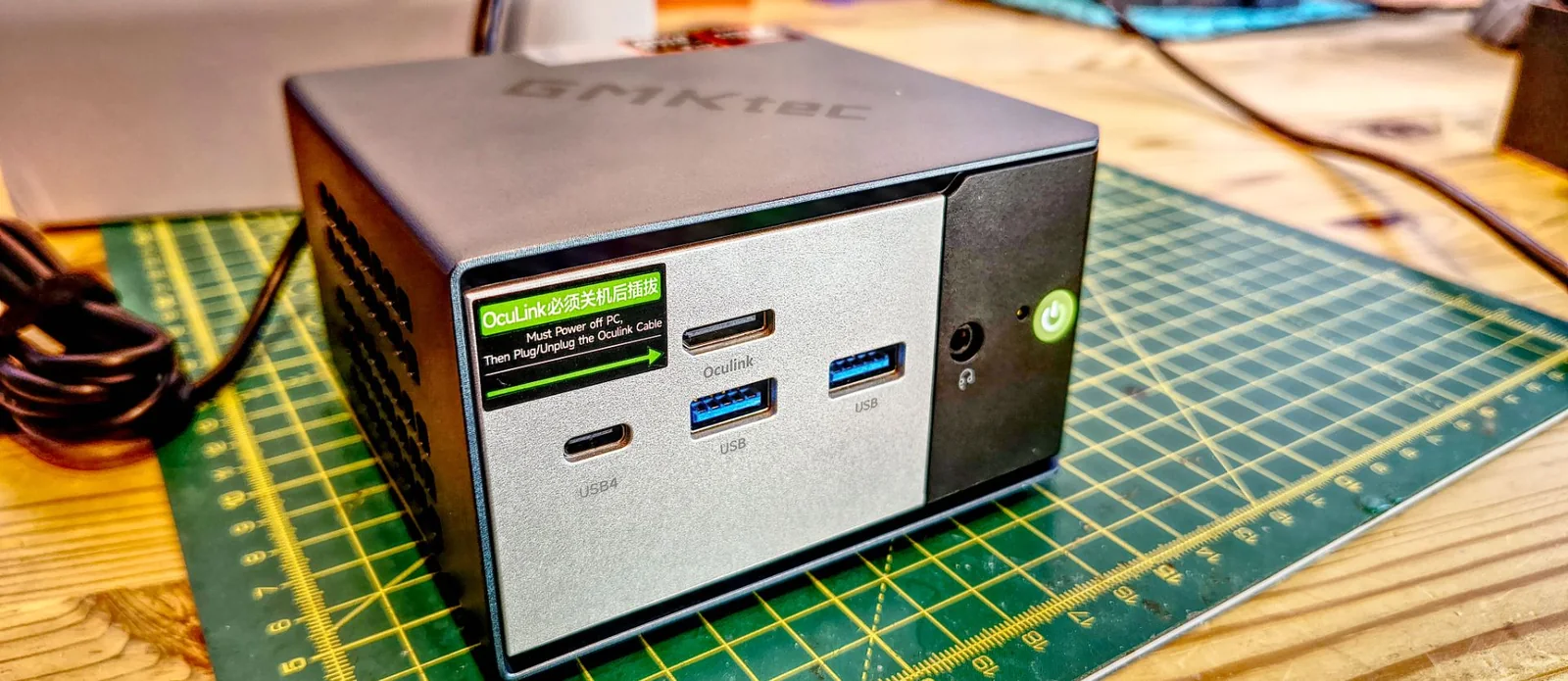
Front-facing connections include multiple USB ports, USB4, an OCuLink port, an audio jack, and the power button.
Rear I/O features dual 2.5GbE LAN ports, additional USB connections, and both HDMI 2.1 and DisplayPort 2.1 outputs.
While the port selection is robust, positioning the OCuLink port on the rear panel might have improved cable management.
Port labeling could benefit from additional detail, as general designations lack specific speed or interface classifications.
Accessing internal components requires removing threaded feet and outer metal panels with standard tools.
Removing the internal fan housing grants direct access to the storage expansion area.
Users can upgrade storage via dual M.2 Gen4 x4 slots, while memory remains fixed.
High-capacity NVMe drives allow for massive internal storage scaling within the tiny chassis.
Alternative storage configurations may be possible by repurposing the wireless networking slot, though at the expense of wireless connectivity.
Overall, the enclosure design successfully balances thermal efficiency and physical footprint.
Design score: 4 out of 5.
GMKTec NucBox EVO-X1 Pro: Features
Powered by advanced processor silicon, the system leverages high-efficiency architectures.
High-speed memory integration ensures rapid data transfer rates for demanding tasks.
The system architecture effectively utilizes available PCIe lanes for maximum peripheral throughput.
The integrated processor features a balanced core layout combining high-performance and high-efficiency cores.
Incremental silicon refinements deliver modest boosts to clock speeds and neural processing unit capabilities.
These hardware tweaks provide optimized performance scaling over previous generation architectures.
Configurable power profiles allow the system to operate efficiently at standard thresholds or scale up performance under demanding loads.
Generous cache allocations ensure low-latency instruction retrieval across the core layout.
The soldered memory design maximizes operating speeds while eliminating future upgrade paths, presenting a trade-off for buyers.
Dual PCIe storage slots provide excellent expansion capacity without sacrificing critical system bandwidth.
Native processor controllers handle general connectivity without creating bottlenecks on primary expansion lanes.
The inclusion of an OCuLink port caters to enthusiasts looking to connect external GPUs or high-speed PCIe peripherals safely.
Efficient bandwidth allocation ensures the hardware operates near its maximum potential.
Features score: 4.5 out of 5.
GMKTec NucBox EVO-X1 Pro: Performance
Comparative evaluations against alternative architectures highlight distinct operational trade-offs.
Both systems benefit from fast memory configurations, though soldered variations achieve higher native speeds than socketed alternatives.
Performance tuning profiles allow users to prioritize maximum graphical output or thermal efficiency.
Adjusting dedicated VRAM allocations yields measurable shifts in graphical benchmark metrics.
Pricing differentials between high-capacity configurations and modular alternatives require careful financial consideration.
Barebones alternatives offer customization flexibility but can approach similar total costs once components are added.
Alternative systems excel in single-threaded tasks or native AI processing depending on the underlying silicon choice.
The review hardware maintains superior power efficiency despite its fixed memory constraints.
Ultimately, the platform suits multi-core and multi-threaded workloads exceptionally well.
Lower-tier processor configurations offer better relative value for users who do not require maximum memory capacity.
Higher-performance tiers and emerging architectures exist for specialized needs, albeit at a premium price.
Performance score: 4 out of 5.
GMKTec NucBox EVO-X1 Pro: Final verdict
Fluctuating component costs impact the overall value proposition of high-end mini PCs, making purchasing decisions more complex.
Hardware engineering is largely solid, though extended warranty provisions from competing brands highlight a shortfall in manufacturer support.
Alternative configurations with slightly lower specifications provide nearly identical day-to-day performance at a substantial discount.
The well-engineered chassis and flexible storage expansion remain consistent highlights across the product line.
Market adjustments in component pricing will be necessary for high-capacity mini PCs to achieve broader mainstream adoption.
The EVO-X1 Pro is a capable mini system that shines brightest when pricing aligns with user requirements.
Buy it if...
Space is limited. As a mini system, this unit packs serious processing power into a minimal footprint, making it ideal for desk setups or monitor mounting.
You want an external GPU. The OCuLink port provides a reliable pathway to connect external graphics enclosures for enhanced graphical muscle.
Don't buy it if...
You are on a tight budget. Alternative configurations with slightly older processors or lower RAM capacities can save significant costs without sacrificing core utility.
You specifically want Intel hardware. Buyers committed to Intel ecosystems should look toward brand-specific alternatives.
Also Consider
Mid-level systems featuring older processors and flexible RAM options offer alternative entry points into compact desktop computing.
Next-generation silicon configurations from competing platforms deliver impressive results, albeit with substantial price tags.
Higher-tier chip variants cater to enthusiasts where budget constraints are secondary.
Professional hardware roundups offer further insight into business-class computing options.
Score breakdown
Scored out of 10Price & Release Date
GMKTec NucBox EVO-X1 Pro