Autonomous Chip Design Platform
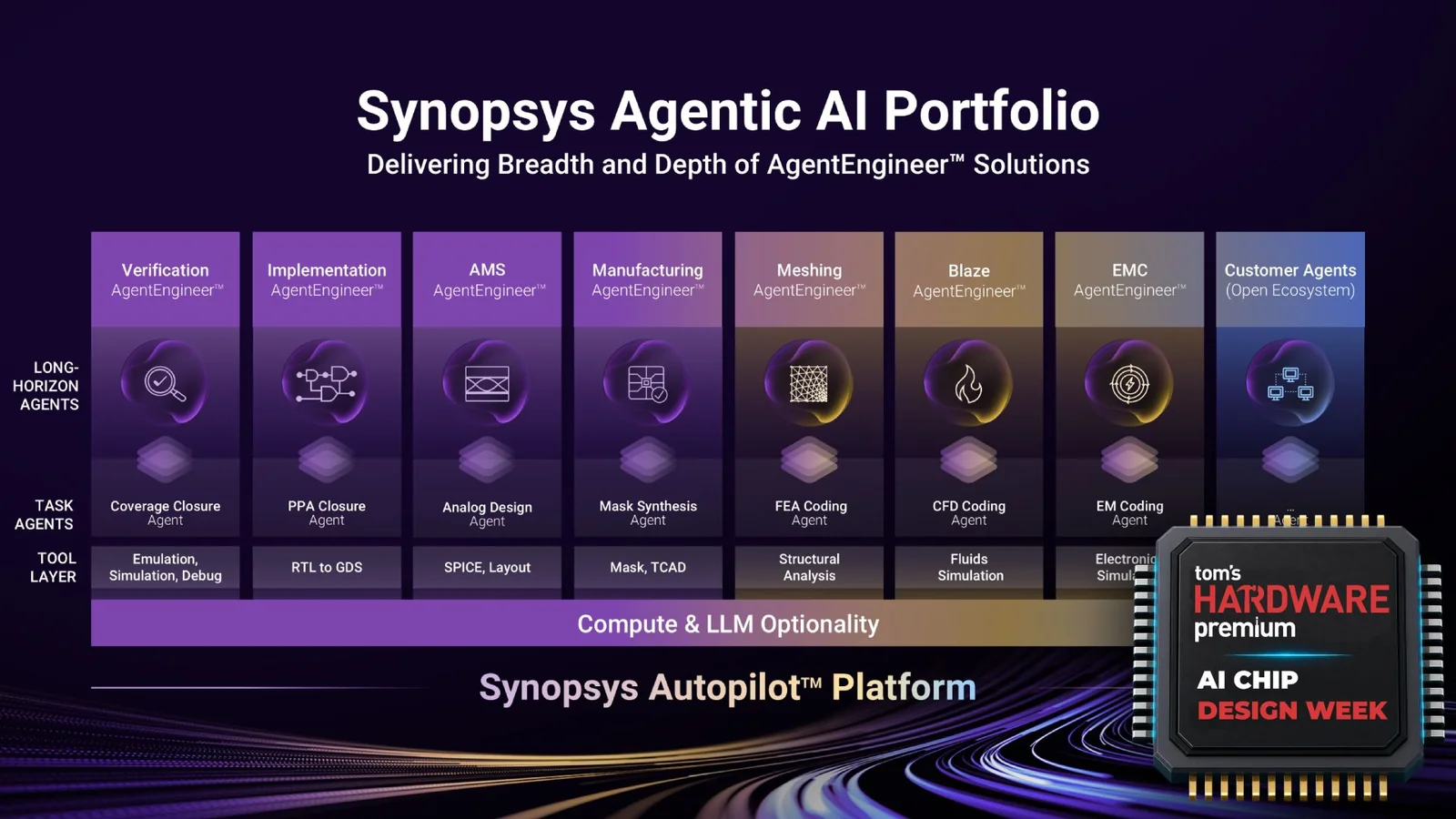
Synopsys announced its AgentEngineer solutions, a portfolio of domain-specific long-horizon agents built on its new Autopilot Platform. As the company details in a blog post, the portfolio covers six named domains: verification, system validation, implementation, analog and mixed-signal design, manufacturing, and simulation and analysis. More than 50 customer engagements are underway, and general availability is planned for the end of 2026. This follows earlier demonstrations of agentic AI workflows developed with Nvidia and Microsoft.
The launch brings Synopsys’ plans into focus with a named product line and a target release date. The platform’s agents are clearly delineated, the engagement count points to customer interest, and a goal for general availability anchors a roadmap for autonomous agents in production. While Synopsys describes the agents as autonomous, approval checkpoints remain with human engineers.
For companies designing and producing chips who want to leverage the potential efficiency gains of AI, this technology allows them to accelerate their shift from AI-assisted design to autonomous engineering, according to Ravi Subramanian, chief product management officer at Synopsys.
Architecture and Agent Layers
In a blog post published alongside the release, Anand Thiruvengadam, executive director of product management at Synopsys, detailed three layers: long-horizon AgentEngineers are domain-specific super agents that orchestrate task agents, task agents complete specific, bounded engineering tasks, and the tool layer’s engines execute the requested work without setting goals or making decisions. Unlike short-term agents, long-horizon agents address goal complexity, pursuing objectives that can take hundreds or thousands of reasoning steps.
The platform covers everything from orchestration to telemetry, powered by a cognitive model for context intelligence. Access controls, encryption, and runtime guardrails protect customer, partner, and Synopsys intellectual property. Customers can choose commercial, open-source, or fine-tuned language models and deploy them on Synopsys Cloud, private clouds, or on-premises infrastructure.
Verification and Root-Cause Analysis
The verification loop involves the agent planning, orchestrating task agents, checking intermediate results, and adjusting when performance falls short. When a test finds a bug, a root-cause analysis agent reads logs, clusters errors, forms a hypothesis, and inspects waveforms to confirm the issue. The agent then makes local rewrites of the register-transfer level code to prove that the bugs have been fixed and produces a bug fix manifest.
Performance Claims and Metrics
Performance numbers cited by Synopsys include up to 50 times faster verification closure, 20% higher coverage, a 30% productivity boost, double the token efficiency, and lower latency. The verification closure and coverage figures originate from July work with Nvidia, measured against standard verification workflows without AgentEngineer. The productivity metric aligns with the upper bound of a 10% to 30% range reported by Fujitsu for its register-transfer level code generation.
Productivity gains are measured against baseline output from human experts. The improved token efficiency is customer-reported, derived from an unnamed customer comparing Synopsys agents with internally built commercial agentic harnesses. Latency reductions are attributed in part to context intelligence, which reduces time spent waiting on model calls.
Industry Engagement
AheadComputing reported that the Implementation AgentEngineer helped reduce manual engineering effort from register-transfer level handoff through signoff. Intel, MediaTek, and Samsung also expressed support for the technology. By comparison, Synopsys’ earlier AI tool from 2020, DSO.ai, has surpassed 100 production tape-outs, whereas the new agentic platform remains in customer engagements.
Synopsys categorizes its agents under its L1-to-L5 autonomy framework, characterizing the new platform as Level 5 execution. Level 5 describes executing a complex workflow autonomously within established human guardrails. Competitor Cadence has also claimed Level 5 capabilities on its own evaluation scale.
Nvidia chief scientist Bill Dally noted earlier this year that while AI reduced a 10-month task involving eight engineers down to a single night, the industry remains a long way from achieving entirely end-to-end AI-driven GPU design.
Human engineers remain integrated into the process, with oversight adjusted based on team confidence. Guardrails are defined by human operators, and critical approval checkpoints remain human-driven. Teams can set checkpoints to inspect results and redirect workflows, reducing intervention as trust in the automated outputs increases.
With the platform capabilities established, Synopsys’ primary objective is achieving general availability by the end of 2026. Competitors are pursuing similar milestones, with Cadence expecting Level 5 early access in the second half of 2026 and Siemens promising self-verifying capabilities in future releases.