Introduction
Meta's audio-only smart glasses couldn't have come at a more opportune time. At a moment when there's increasing backlash against the company's growing lineup of camera-enabled glasses, the Ray-Ban Meta Audio frames ditch the feature most associated with creep glasses. Instead, as the name implies, the frames are all about making the most of audio.
The result is a pair of glasses that are lighter, more comfortable and have far better battery life than any other glasses from the company. They also look a lot more subtle and are the closest to normal glasses we've seen from Meta.
Design and Fit
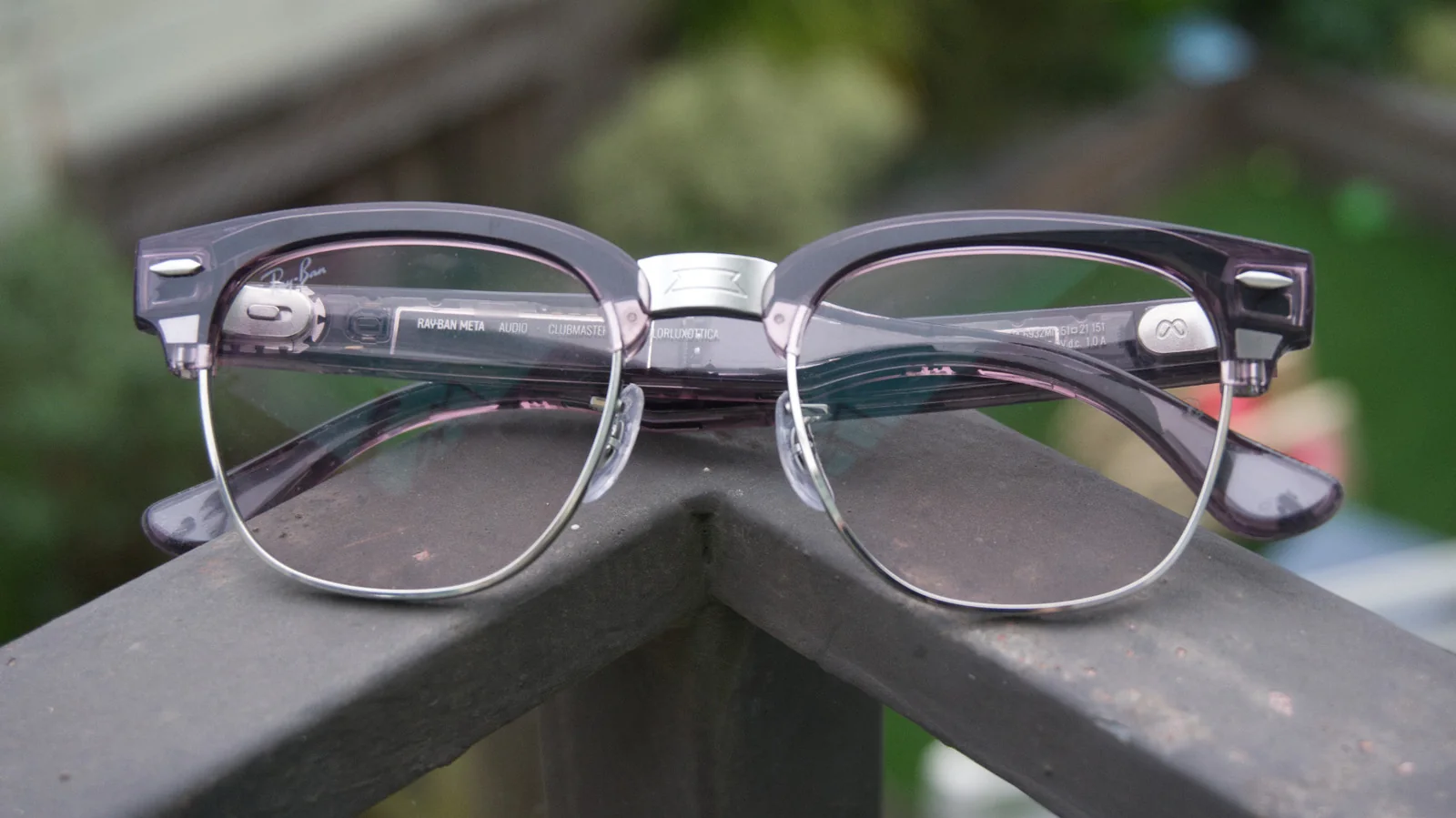
Meta has two different frame styles for its $349 audio-only glasses: Burbank, which looks a bit like a thinner Wayfarer, and Clubmaster, an immediately recognizable Ray-Ban design. I opted for the latter because it comes in a wider variety of colors and I prefer thinner frames in general.
From the front, I'm not sure anyone would recognize the glasses as having any tech abilities. My frames did have the transparent arms Meta often uses to display the inner circuitry of the glasses, but it's still relatively subtle.
Karissa Bell for Engadget
There isn't a camera or front-facing LED, but the setup is overall similar to Meta's other glasses. The right arm still has a touchpad for controlling volume, answering calls and other functions, and there's a small inward-facing LED for notifications. There's also a tiny action button, which you can use as a dedicated shortcut for certain features.
It might seem like Meta simply stripped down its existing glasses designs, but the company's wearables leadership noted that the engineering team actually had to rebuild the speaker and microphone setup to work on a smaller frame.
That work definitely paid off. The audio-only glasses are noticeably slimmer than other models. They also fit better and are far more comfortable because less of the weight sits toward the front of the frames. At 47 grams, the Clubmaster glasses are only 2 grams lighter than the Ray-Ban Meta Optics frames, but they feel significantly lighter because they put less pressure around my nose.
Karissa Bell for Engadget
If you've read past reviews of other Meta-branded glasses, you know fitting can sometimes be a struggle. Most frame styles feel like they are meant for faces just a bit wider than average, and the weight tends to cause them to slip.
But the Ray-Ban Meta Audio glasses have traditional nosepads that actually stay in place. You can also get the tips adjusted by an optician, but these fit well out of the box without any tweaks. I wore them for several long stretches and actually forgot I was wearing smart glasses because they felt so much like typical shades.
Audio and Battery
Like other recent glasses from Meta, the audio-only frames have 6 mics and open-ear speakers. Music, podcasts and phone calls sounded great. One quirk is that the microphones are in slightly different places. There are now two mics on the front of the frames, replacing the ones embedded in the nosepads in previous models. The other four are on the arms. Friends and family noted that call quality sounded clearer when wearing the audio glasses compared to traditional wireless earbuds.
The other major advantage the audio-only glasses have compared with other models is the battery life. Meta says the frames can go 12 hours on a charge with mixed use and up to six hours of continuous audio playback. Testing showed close to 50 percent battery remaining after five hours of streaming audio and a one-hour phone call. If you aren't listening to hours of music or podcasts, the glasses will easily go all day without needing to recharge.
Karissa Bell for Engadget
Even though there's no camera, you can still use most Meta AI features, including live translation and walking navigation. Meta is also planning to bring its AI agent to its glasses, so the audio frames will also be a conduit to your personal agent once that update rolls out.
One frustrating aspect of Meta's implementation of its assistant on the audio-only glasses is that the action button is severely limited. On other frames that have the control, there are quite a few options for what that shortcut can trigger.
On the audio-only frames, however, there are only two options for what this button can do. If you select music, it will play recommended playlists, or you can set it as a shortcut to activate Meta AI. The latter is useful if you don't enjoy speaking wake words in public, but you can't set it to trigger a specific prompt, nor can you use the button to answer or mute calls.
Karissa Bell for Engadget
It's an annoying limitation and an odd choice for the only physical button on the glasses. Fortunately, this is something that can potentially be addressed in future software updates.
Privacy Considerations
When interviewing Meta glasses users about how privacy backlash affects product usage, many expressed worry over how others perceive them, noting they would happily buy a pair without cameras to avoid being labeled a creep.
The Ray-Ban Meta Audio line successfully addresses those concerns. No one can accuse you of covertly recording if there's no camera. It helps that the frames themselves are more subtle, too. Not having a camera also eliminates the risk of Meta capturing visual data from your surroundings to train its AI models.
Karissa Bell for Engadget
However, eliminating the camera doesn't resolve every privacy concern. The company still stores audio recordings captured from its glasses, and these audio snippets may be reviewed by human contractors, though users can manually delete recordings from the Meta AI app.
There is also the reality that public backlash against smart glasses is unlikely to go away overnight, with growing numbers of venues and countries considering bans on the technology.
Conclusion
At the same time, one of the best things about the Ray-Ban Meta Audio glasses is just how normal they look and feel. Users can enjoy open-ear speakers and audio features without constantly feeling like they are wearing intrusive gadgets. Combined with massive improvements to battery life, these frames represent a compelling addition to the wearables market.