Design and Hardware
Although the original Game Boy remains a classic, the Game Boy Advance is celebrated for its comfortable horizontal design and expansive catalog of 32-bit and 16-bit games. Ayaneo's Konkr Pocket Advance strikes a near-perfect balance between authentically re-creating the GBA's design while updating its hardware with new controls, an improved screen, and Android flexibility at a competitive price.
The Pocket Advance nearly perfects my favorite Nintendo handheld
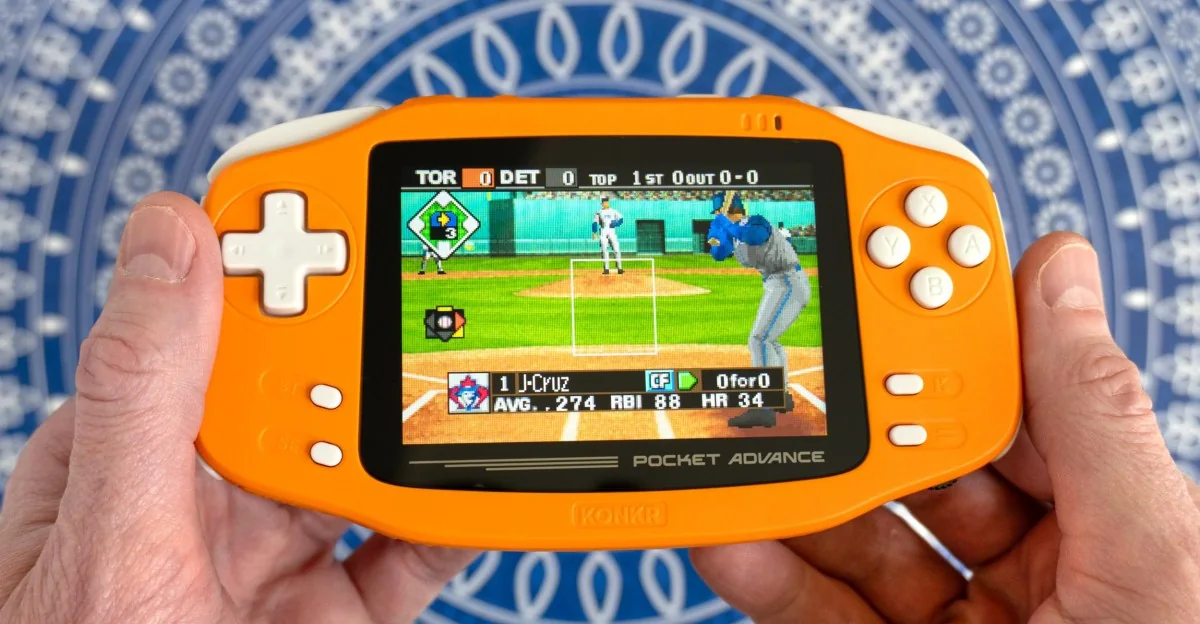
It functions as a faithful Game Boy Advance clone that runs Android, opening up possibilities beyond standard GBA cartridges.
Over the years, aftermarket upgrades like backlit LCD displays and rechargeable batteries have greatly improved upon Nintendo's original hardware. The Konkr Pocket Advance serves as a modern successor to earlier retro handhelds.
The Pocket Advance features an all-plastic build with a satisfying heft due to internal hardware, including a cooling fan for its MediaTek Helio G90T processor and a 4,000mAh battery. The base model offers 3GB of RAM and 32GB of expandable storage for $109, while a $129 version upgrades the configuration to 4GB of RAM and 64GB of storage.
The Pocket Advance next to an original Game Boy Advance.
The dimensions are close enough to fit legacy GBA cases. However, Ayaneo diverges from the original layout by adding eight extra buttons, including X and Y action buttons and four shoulder buttons. The larger D-pad is a welcome addition, though the buttons have a soft and squishy feel that requires a firmer press.
A close-up comparison of the D-pad.
The 3.5-inch LCD touchscreen features a glass cover and a 3:2 aspect ratio with a 960x640 resolution, allowing GBA games to scale perfectly at 4x. Emulating content from other systems results in letterboxing or pillarboxing to maintain correct proportions.
The device includes a headphone jack and a dedicated volume control dial.
Software and Performance
While many competitors run Linux, the Pocket Advance comes with Android 12. Setup is simplified via Ayaneo's custom AYASpace launcher, alongside full access to the Google Play Store for downloading applications and emulators directly.
Users can also install alternative Android launchers like Cannoli to match preferred retro aesthetics while keeping multiple emulators preconfigured and easily accessible.
Unlike the original hardware or systems like the Analogue Pocket, this device does not accept physical game cartridges.
Emulation capabilities are best suited for retro platforms. The processor handles older titles smoothly, spanning from the Super Nintendo and Genesis up to the PS1 and Sega Dreamcast, with capability for select PS2 and GameCube games. A quick settings menu allows performance adjustments on the fly, though the absence of analog thumbsticks limits modern 3D gameplay.
Shoulder buttons and control placement.
Native Android app performance varies. While indie titles like Teenage Mutant Ninja Turtles: Shredder's Revenge run exceptionally well, video streaming compatibility can be inconsistent depending on the application.
Comparison with alternative devices.
Software differences between systems.
Conclusion
Despite soft buttons, the hardware package outperforms cheaper Linux-based alternatives like the RG34XX, offering a superior display, layout, and overall build quality.
The Pocket Advance stands out as one of the premier retro handhelds available, delivering an exceptional platform for revisiting classic handheld titles.
Photography by Andrew Liszewski / The Verge