A Nostalgic Return to Origins
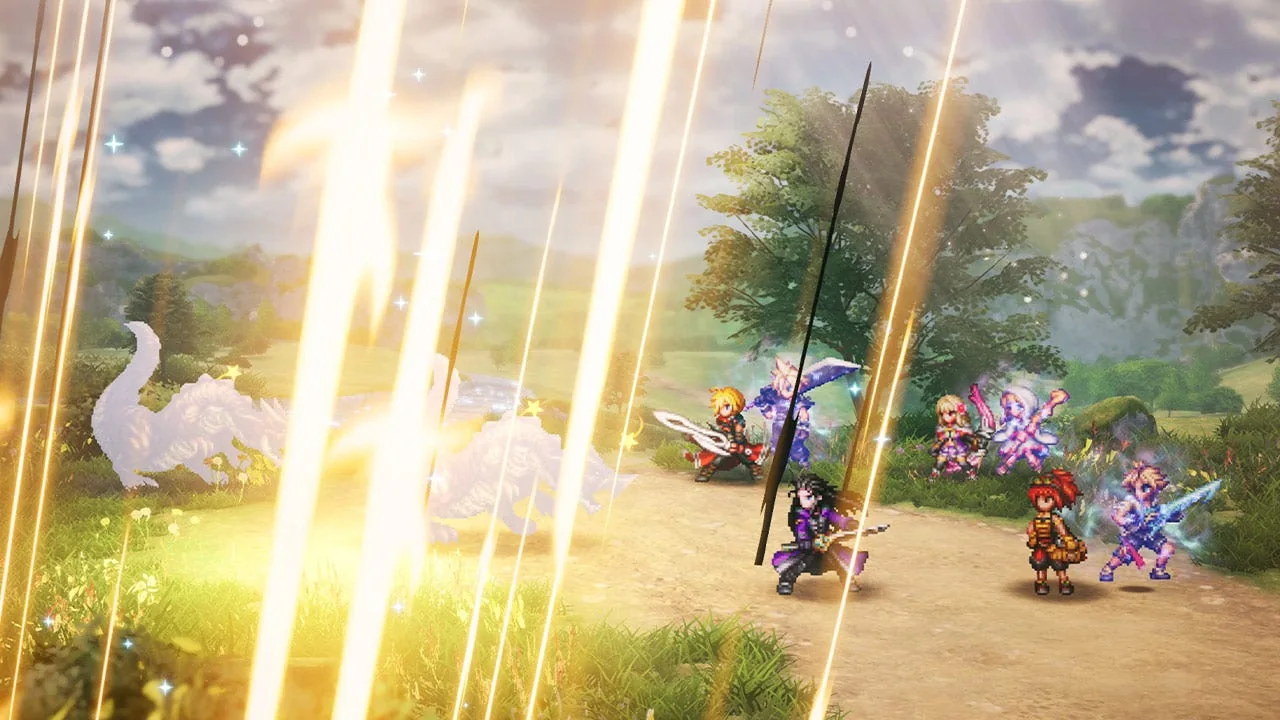
To evoke the classics is also to hold yourself to the high standard set by them. With Final Fantasy Resonance bringing the venerated series back to its origins with turn-based combat, and wielding Square’s HD-2D art style to modernize nostalgia for the pixel art era, it plucks at something long desired by those who grew up in the SNES generation. While the series has crystalized into something very different over the decades, Resonance acts as a torchbearer for classic RPGs, though it also employs a style of storytelling that occasionally rings hollow. The experience stands out as a game of memorable moments—such as when a genre-fusing boss theme plays, a turn is executed perfectly, or a cutscene brings HD-2D to life in unprecedented ways.
Resonance adapts the story and characters from the mobile game Final Fantasy: Brave Exvius by packaging them into the structure of a traditional RPG, free of gacha mechanics and microtransactions. This approach resembles previous adaptations, offering an overworld with regional towns, random encounters, an airship for free-roaming exploration, and full voice acting throughout the main campaign.
The narrative largely tracks the first season of Brave Exvius, following knights Rain and Lasswell alongside Fina on a quest to stop the Sworn Six from destroying the world's crystals. Completing the main story alongside marked side quests and optional minibosses takes roughly 45 hours. Despite chunks of the story lacking momentum, the production value helps mask its mobile origins.
Tactical Combat and Customization
The retooling extends to gameplay, retaining concepts that form an engaging turn-based combat system along a timeline order. Players must plan units and manipulate the order to their advantage, demanding strategies comparable to titles like the Octopath Traveler or Trails series.
Combat centers on elemental affinities and staggering enemies. Party members feature diverse elements via magic or physical attacks, while equipping Visions functions similarly to the Job system from Final Fantasy V. This setup provides deep flexibility in party composition to exploit enemy weaknesses.
While having the flexibility to swap Visions between party members changes overall movesets, it can occasionally trivialize encounters. For instance, anticipating a water-themed boss and deploying a purely electric build allows players to easily bypass deeper strategic adjustments.
Compared to more dynamic break systems in genre contemporaries, Resonance allows players to cruise through early segments where enemies act as pushovers. Fortunately, the late game introduces tougher challenges, increased enemy aggression, and status ailments that require rigorous tactical planning.
The combat system successfully delivers the satisfaction of unleashing powerful spells on a staggered enemy. Party members level up alongside their mastery of equipped Visions, requiring manual rank progression and the application of passive perks for buildcrafting depth.
Visions add significant fun by featuring avatars of iconic characters from franchise history, incorporating signature attacks and spells. Staggering enemies grants bonus phases culminating in a Resonance attack tied to a chosen Vision, though transitioning from pixel art to CGI summon cutscenes can occasionally feel jarring.
Visions are obtained by visiting shrines across the overworld and completing dialogue sequences that recount past stories. While initially seeming cheesy, these sequences serve as nostalgic reminders of previous series entries, amplified by recognizable musical cues.
Story Pacing and Narrative Flaws
Beyond battles, the franchise is renowned for its storytelling, which is where Resonance encounters its most noticeable struggles. The foundational premise involving crystals and complex villains is solid, but the execution and dialogue frequently feel underwhelming during long stretches.
Expanding the Brave Exvius story was a worthwhile endeavor, but much of the script reads like a middling young adult novel. It tends to be overly talkative, stretching minor points across excessive lines of dialogue while leaning on a contemporary tone and simplistic villains until the narrative improves late in the game.
Despite these pacing hurdles, the journey features endearing character bonds. Protagonists Rain and Lasswell develop a compelling brotherhood, and supporting characters like Nichol and Sakura offer genuine emotional arcs and satisfying depth, even if certain antagonists remain forgettable.
Resonance also struggles with narrative momentum due to initial vagueness, relying instead on regional societal issues such as environmental tragedies and government revolts. While these individual stories are delivered decently, overarching thematic coherence takes time to materialize.
Spectacle and Memorable Audio
Ultimately, Final Fantasy Resonance proves that visual spectacle can elevate a game beyond its structural flaws. During key moments, the HD-2D engine utilizes 3D camera movements, fluid animations, and pixelized effects to convey emotion in ways dialogue alone cannot achieve, establishing new ways of creating immersive worlds.
The musical score plays an equally vital role in leaving a lasting impression. Town themes successfully evoke industrialized empires or floating cities, while boss themes feature impressive genre fusions ranging from bouncy electronic remixes to jazz-infused orchestral metal with Latin choirs, ensuring the audio remains unforgettable.