A Sprawling Technological Triumph
Thirteen years, three console generations, 230 million copies, and over $10 billion in revenue tell a story of longevity and success that is virtually unprecedented in the gaming industry. The numbers alone do not capture why Grand Theft Auto V continues to sell briskly, but its enduring appeal lies in a meticulously crafted virtual world.
While previous entries featured a dense, strictly urban sandbox, GTA V introduced a sprawling and varied vision of Los Santos and the surrounding San Andreas countryside. The map encompasses an area far beyond the city limits, offering an entirely different spatial identity.
The aesthetic shift is striking. The bright San Andreas sunshine casts crisp shadows and saturates the environment with a sun-bleached vibe, providing a sharp visual departure from the gritty appearance of older urban sandboxes.
The city itself is splintered into dozens of distinct districts that seamlessly blend together, from the affluent mansions of Vinewood Hills to the struggling suburbs of South Los Santos.
Beyond Los Santos, the countryside opens up to include deserts, forests, and mountains, delivering a vastly expanded vision of southern San Andreas that encourages continuous exploration.
Even years after release, players continue to spot subtle architectural details and storefronts. True immersion emerges through the accumulation of small, authentic details that make the virtual world feel genuinely lived-in.
Three Protagonists and Dynamic Switching
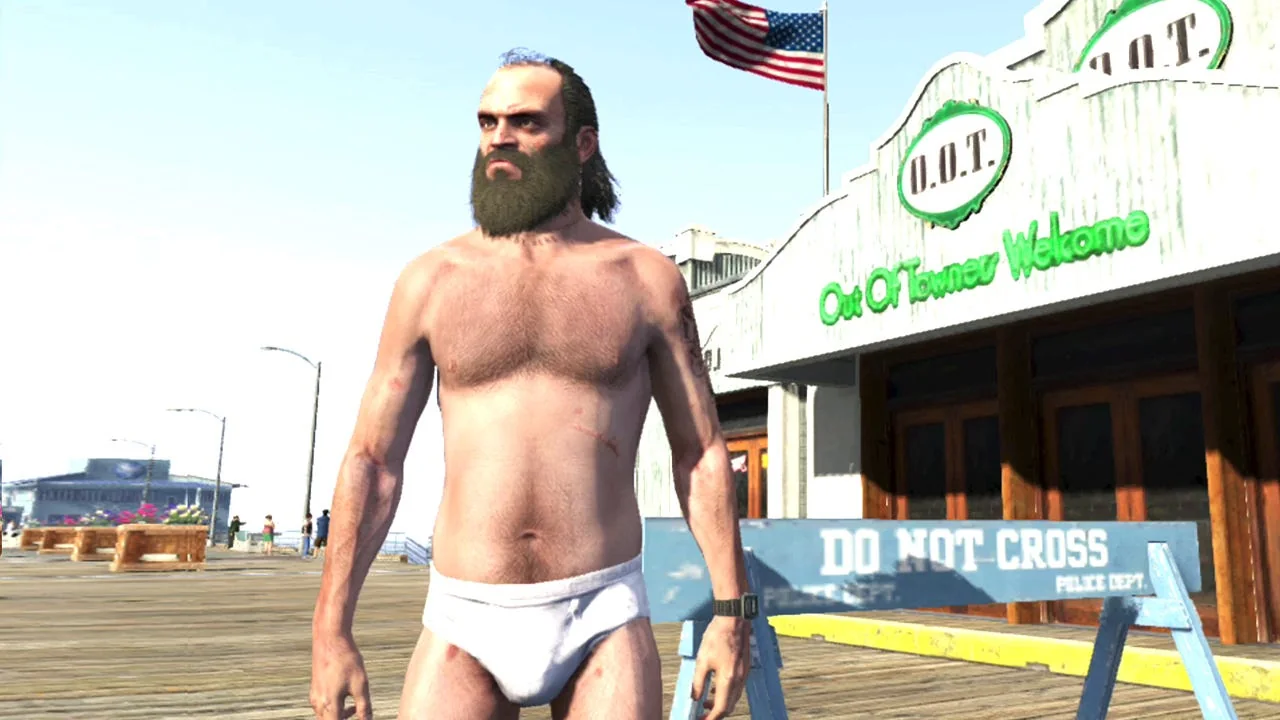
The defining innovation of GTA V is its trio of protagonists: Michael De Santa, a retired criminal restless in suburban life; Franklin Clinton, an ambitious hustler seeking a major payday; and Trevor Philips, a volatile psychopath. Swapping between them allows the game to direct players across different parts of the massive map organically.
This system functions as much more than a novelty, giving developers a structural tool to experience the world through three distinct lenses without relying on a single narrative perspective.
While predecessor titles toyed with multiple playable characters through separate expansions, GTA V integrates real-time switching seamlessly.
Transitions occur rapidly via a brief camera zoom, dropping the player straight into the daily routines of Michael, Franklin, or Trevor, thereby creating the illusion that these characters exist independently of active missions.
Varied Missions and Elaborate Heists
Mission design in GTA V is significantly more varied and layered than in past entries. The introduction of reliable mission checkpoints removed the frustrating requirement to completely restart failed missions from scratch.
Checkpoints act as a safety net, allowing designers to craft longer and more ambitious scenarios without inducing the fatigue of repetitive backtracking.
The campaign's centerpiece is its focus on multi-layered heists, which can be approached through distinct strategic options and easily replayed from a completed mission list.
The three-character structure shines brightest during these marquee operations, as planning and execution draw directly upon the unique skills of each protagonist.
Refined Handling and Combat Mechanics
Vehicle handling received major revisions, offering sharp steering responses and heavy braking that favor sure-footed sports cars and high-speed driving.
The vehicle roster spans a massive variety of transport options, ranging from massive semi-trucks to fighter jets, encouraging creative traversal across land, sea, and air.
Combat mechanics were similarly polished, featuring nimble movement, dependable cover shooting, punchy audio design during firefights, and a streamlined weapon wheel that retains collected hardware.
A Benchmark for the Industry
Launching near the end of the Xbox 360 and PlayStation 3 generation, GTA V felt remarkably ahead of its time, squeezing next-generation ambition out of aging hardware.
Early hands-on impressions recognized the title as a paradigm shift for open-world gaming, a status cemented by subsequent re-releases across multiple console generations.