Introduction to the Tool Changer
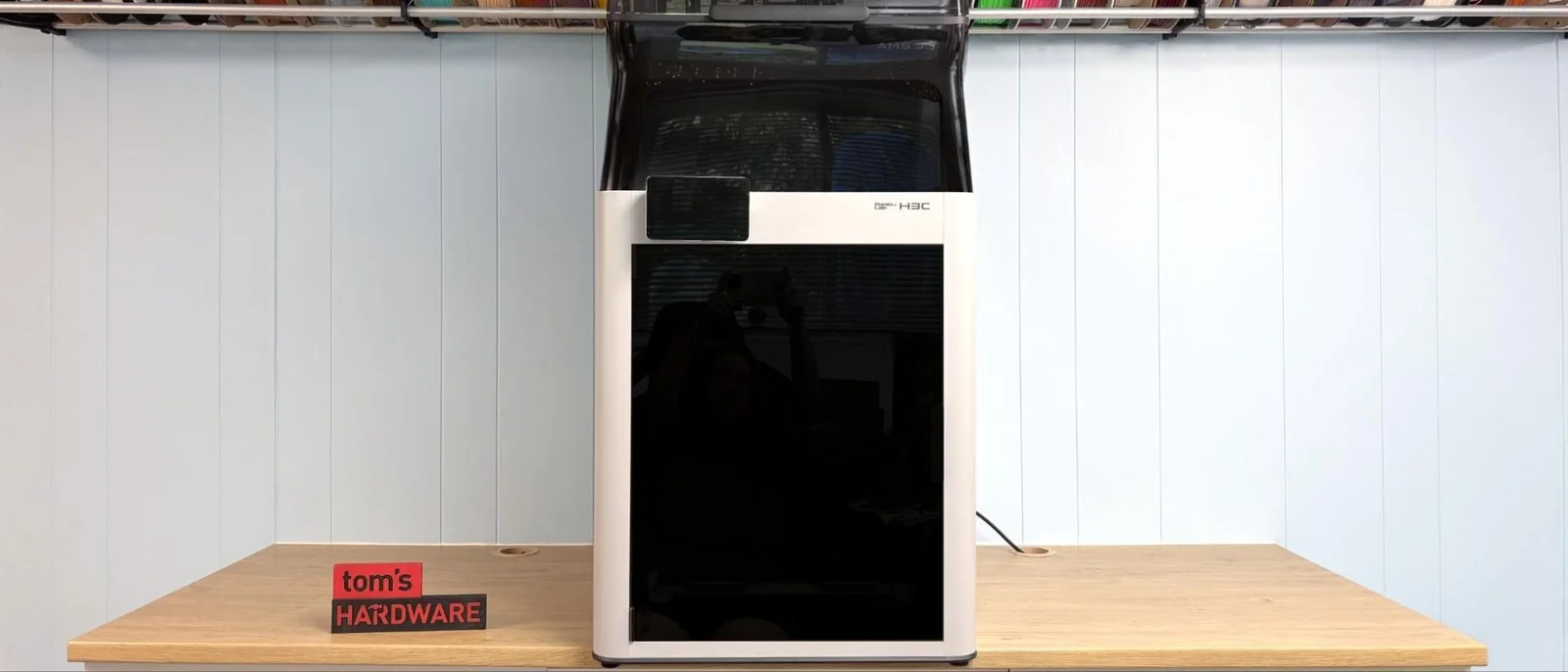
The Bambu Lab H3C is the printer we’ve been waiting for: a true Bambu tool changer. It has nine “Swaptek” tools that use a technology similar to the H2C Vortek rack, except each nozzle is built into a lightweight, hardwired tool with a dedicated filament path. The H3C is Bambu’s fastest multicolor 3D printer, and though it reduces waste, it does not eliminate it.
The H3C comes with a surprising old-school technology: the ability to print 2.85mm filament. This is in response to increasing interest in 3D-printed footwear made with a wide variety of squishy TPU. Bambu includes one special 2.85mm tool as a standard feature, though users can purchase normal 1.75mm tools separately.
Users will also be able to add cutting, drawing, embossing, and foil transfer tools to the system. These accessories expand the machine's functional versatility beyond traditional additive manufacturing.
Bambu is also enabling printing with more than one nozzle size. Because this is a software update, users gain the ability to mix nozzle configurations across compatible dual-nozzle systems.
Hardware Design and Footprint
The H3C has a 330 x 320 x 325mm build volume and a massive AMS type module perched atop the main unit that holds nine spools. This gives it a towering mushroom shape that exceeds three feet in height. Because of its height, Bambu created a special rolling cart for the machine to make loading and access more manageable.
H2C and H3C, side by side.(Image credit: Bambu Lab)
All nine tools are integrated into the bottom of the AMS 3H, meaning the H3C ships exclusively as a nine-tool configuration. Additional external AMS units can be hooked up using an optional buffer, though they must route through a standard slot.
The AMS 3H features an interior chamber for drying filament at up to 85°C. The dedicated dryer can run during active printing thanks to its independent power supply without affecting nearby spools.
The FlexFeed extruder mounted on the toolhead can self-adjust to handle normal 1.75mm filaments or expand to push 2.85mm TPU. The machine comes standard with eight 0.4mm nozzles for 1.75mm material and one 0.4mm nozzle for 2.85mm stock.
All default nozzles for the H3C are crafted from hardened steel rated at HRC 55+ for long-term durability across abrasive composite filaments.
Early review units running pre-launch firmware occasionally exhibited minor mechanical snags, though core functionality remained robust during extensive testing.
The Bambu Lab H3C launches with a retail price starting at $2,499 for all nine tools. Bundles including the rolling cart start at $2,799, positioning the printer as a premium choice for heavy-duty users.
Bambu Lab H3C: Included in the Box
The Bambu Lab H3C ships with a complete toolkit, necessary assembly cables, spare parts, and preloaded internal print files including a buildable scraper.
Review units included additional printer tools for both filament sizes alongside test spools of PLA Palette and 2.85mm TPU.
Design of the Bambu Lab H3C
The Swaptek system incorporates nine distinct tools, each featuring an independent filament path, heater, and hardened steel nozzle. Tool switches are exceptionally fast, clocking in at roughly six seconds between colors.
Nozzles are secured with three screws for straightforward swapping, while future modular attachments will introduce cutting, drawing, and foil transfer capabilities.
The tool dock rests on a retractable front-mounted rack, ensuring an unobstructed view of the build plate during initial layer deposition.
Maintenance settings allow all nine tools to lower simultaneously for inspection, while standard operation lowers only the active tool.
The AMS 3H System
Unlike previous iterations, the AMS 3H is a mandatory structural component that secures directly to the top of the H3C main unit, featuring hidden side panels for easy maintenance access.
The tools ship pre-attached to the bottom of the AMS unit, creating an integrated assembly optimized specifically for the H3C architecture.
The AMS 3H features a dedicated drying chamber for slots six and eight operating up to 85°C, alongside direct bypass ports for flexible TPU filaments.
The Flexfeed extruder handles wide variations in filament diameter smoothly, delivering reliable performance even with ultra-soft flexible compounds.
Active chamber heating reaches up to 65°C alongside a 350°C hot end and 120°C bed, facilitating engineering plastics like PPA, PPS, nylons, ABS, and ASA.
Enclosure ventilation allows lower-temperature materials like PLA to be printed securely with the front door closed.
An internal camera supports AI print failure detection and remote monitoring via companion mobile applications and slicer software.
Operating the towering printer comfortably requires significant vertical clearance and careful consideration of placement height to reach rear spool slots.
Bambu also offers a companion E1 Air Purifier designed to sync automatically with print jobs as part of premium hardware bundles.
Bambu Lab promotional photo showing the rolling cart and air purifier (on a desk).(Image credit: Bambu Lab)
Assembling the Bambu Lab H3C
Unboxing reveals two major assemblies: the main printer base and the AMS 3H unit. Lifting the AMS onto the chassis requires adequate overhead clearance and careful handling.
The touchscreen attaches tool-free via a ribbon cable, while the nine individual tools must be seated manually into the front-mounted dock.
The AMS 3H includes a dedicated power cord for its internal heating elements alongside a data connection linking back to the main printer chassis.
Leveling and Filament Loading
Automatic bed leveling executes reliably as part of the initial calibration suite and prior to every print job.
Loading Filament
Standard 1.75mm filaments load automatically via motorized feeders, with RFID tags recognized instantly on branded spools.
Unloading requires initiating the retract sequence on the touchscreen, followed by manually pulling the remaining filament free.
Softer TPUs and 2.85mm filaments utilize dedicated bypass ports on the bottom of the AMS 3H to feed directly into toolheads.
Software and Print Performance
Bambu Studio provides seamless filament mapping, printer control, and direct access to model repositories like Makerworld.
Print Performance and Testing
Tool-changing architecture eliminates long retraction cycles, reducing multi-color print times significantly while utilizing a purge tower for clean color transitions.
Complex multi-color models completed rapidly with excellent layer adhesion and minimal waste compared to conventional multi-material setups.
Testing with detailed multi-color models demonstrated clean transitions, sharp color fidelity, and robust mechanical strength.
Using a 0.2mm layer height at an average speed of 140mm/s, complex multi-color prints finished in a fraction of traditional durations with minimal purge waste.
Steampunk Dragon by Cinderwing3D(Image credit: Tom's Hardware)
Swapping tool configurations allowed flawless execution of multi-color prints featuring vibrant silks and complex overhang geometries.
Comparative benchmarks against competing multi-material systems highlighted the H3C tool changer's superior speed and efficiency.
Princess Donut Riding Mongo, by Loligo.(Image credit: Tom's Hardware)
Filament selections during test prints spanned custom dual-silk blends, matte engineering plastics, and high-performance composites.
Character models utilized specialized silk and basic PLA variations to verify multi-color boundaries.
Secondary components incorporated high-temperature PLA and basic color formulations.
Alternative structural parts combined wood-filled PLA and specialized silk formulations.
The H3C stands out as an exceptional platform for flexible TPU printing, keeping specialized elastic filaments primed and ready for instant deployment.
Integrated dual-material hinges combined rigid PLA brackets with flexible TPU joints for high-strength articulated parts.
Functional prints combining red PLA and red TPU 95A completed in just over an hour with exceptional structural integrity.
TPU Hinge by Meister Edel(Image credit: Tom's Hardware)
The 2.85mm 75A TPU delivered remarkably squishy results, handling ultra-soft material configurations flawlessly through the Flexfeed extruder.
Lightweight RC tires and ergonomic wrist rests printed using soft TPU demonstrated excellent elasticity and dimensional accuracy.
ABS test prints, including multi-color custom dice, exhibited crisp geometry and clean text reproduction despite challenging overhangs.
Ozark Expeditions Dice Studio(Image credit: Tom's Hardware)
Testing the heated enclosure with demanding PA6 GF composite filament produced durable, high-strength storage canisters.
Twist Lock Container by William B-P(Image credit: Tom's Hardware)
Conclusion
The H3C proves to be a formidable multi-material powerhouse capable of handling everything from ultra-soft TPU to high-temperature engineering plastics across nine versatile tool positions.
With a starting retail price of $2,499, the H3C delivers professional-grade tool-changing capabilities and user-friendly operation that justifies its place at the top of the market.
For users seeking alternatives, prior generation models and competing core designs offer lower-cost entry points, but the H3C remains a benchmark for tool-changer performance.