Prototype Driver for NPU Rendering
A developer group by the name of labscommunity has released a prototype driver for Windows 11 that renders the desktop using an NPU instead of the system's GPU. The new driver is called npu-driver, and the open-source code is available on GitHub. It has been tested on Intel Panther Lake systems, and while it isn't hitting its 30 Hz performance target yet, it is clever enough to fall back to the GPU on request or on any fault.
The reasoning behind the development of this driver stems from the current processor landscape. Every modern laptop ships an NPU that sits idle while the GPU composes the desktop, runs the browser, and handles local models. The project aims to test whether the NPU can take over desktop composition end-to-end without applications or the compositor knowing.
Performance and Fallback Mechanisms
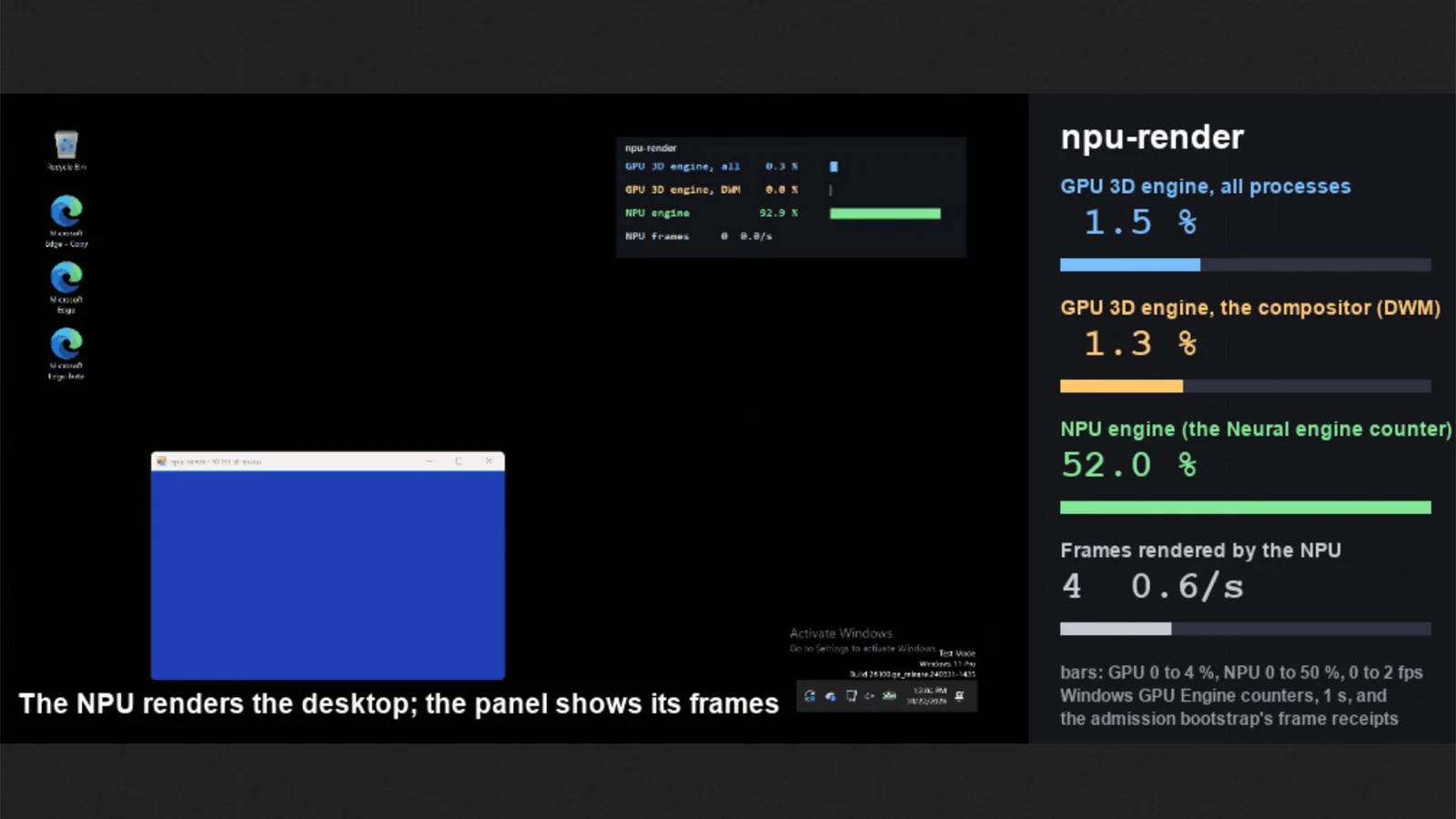
The npu-driver successfully renders the Windows 11 desktop along with applications like Notepad and Edge windows. Moreover, it seamlessly switches back to GPU rendering whenever necessary.
The developer admits that this driver is strictly a research prototype rather than a finished product, with performance remaining the primary hurdle. The GitHub documentation notes that actual screen refresh speeds hover around 2 to 3 Hz, falling short of the 30 Hz target. The driver is developed on a Panther Lake laptop featuring NPU 5 architecture silicon with performance spanning 45 to 50 TOPS.
Render your entire Windows desktop on the NPU instead of GPUfrom r/LocalLLM
Community reports indicate that while the project renders Windows 11 visuals slowly, it can reduce 3D GPU usage from 3.4% to 0.6%, effectively freeing up graphics hardware for other tasks such as inference.
Finding alternative workloads for the system NPU represents a notable shift in utilization, especially as neural accelerators remain standard hardware additions alongside video decoding blocks and digital signal processors.