Warranty Claim Rejected
When purchasing a high-end graphics card costing thousands of dollars, consumers generally expect reliable warranty service. However, according to a user on Reddit, one customer reportedly received no support when attempting to RMA a burned GeForce RTX 5090.
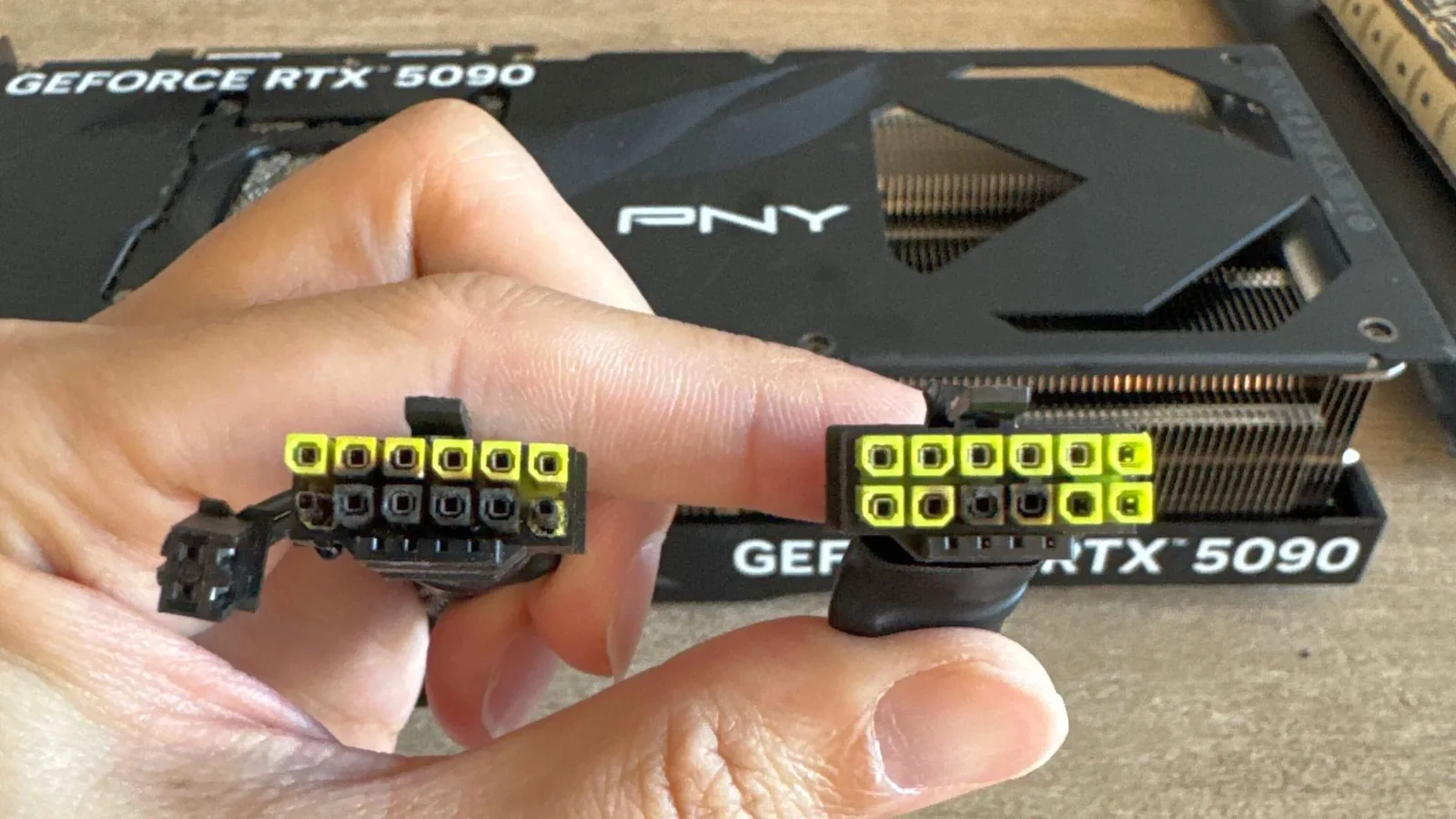
The affected user found the graphics card non-functional after the 12V-2x6 connectors melted on both ends of the modular cable included with a 1600-watt ASRock power supply. This reportedly occurred while using the stock BIOS with no overclocking and a manually reduced power limit, while the system was sitting idle. After opening a ticket, the user was allegedly denied coverage the following day.
According to the response provided by support, all PNY GPUs requiring a 16-pin input include an approved power cable or adapter in the box, which is the only configuration covered under warranty. The company stated that if a third-party power cable, adapter, or PSU cable is used and damage occurs, including melting or burning, the product cannot be accepted under warranty, shifting responsibility to the cable or power supply manufacturer.
Unwritten Policy and Documentation Gaps
Although the user was not using an approved in-box cable, the native cable supplied with the power supply was utilized. Warranty terms do not explicitly mention 12VHPWR or 12V-2x6 cables, stating only that the card must be installed in accordance with the provided installation guide, which simply instructs users to connect an unused power connector to the graphics card.
This policy creates ambiguity, as there appears to be no public list of approved cables on the manufacturer's website or in the product documentation. Furthermore, since the card did not include a 16-pin cable in the box, users are forced to rely on alternative solutions.
Support Escalation and Alternative Avenues
When the user asked which specific warranty clause was being used to deny the request, a senior technician reportedly stated that the decision was final and closed the support ticket.
Community members noted that the ASRock power supply features a temperature-monitoring function at the connector for safety, though it apparently failed or was unconfigured in this instance. Because the power supply carries a ten-year warranty, community discussions suggested contacting the power supply manufacturer as an alternative recourse.
With high-end graphics cards commanding significant market prices, vendors may face inventory constraints and high replacement costs. Whether the manufacturer will adhere strictly to unwritten technicalities to avoid replacement costs remains to be seen.