Evaluating Portable Power Banks
For many users, the tech carried to keep devices powered on the go receives little consideration. Buying a power bank with enough ports, capacity, and output generally suffices, though minor performance details make a significant difference. Of the dozen-plus chargers evaluated in recent testing, a few require four to six hours to recharge completely, which may prove problematic for users needing rapid turnaround times.
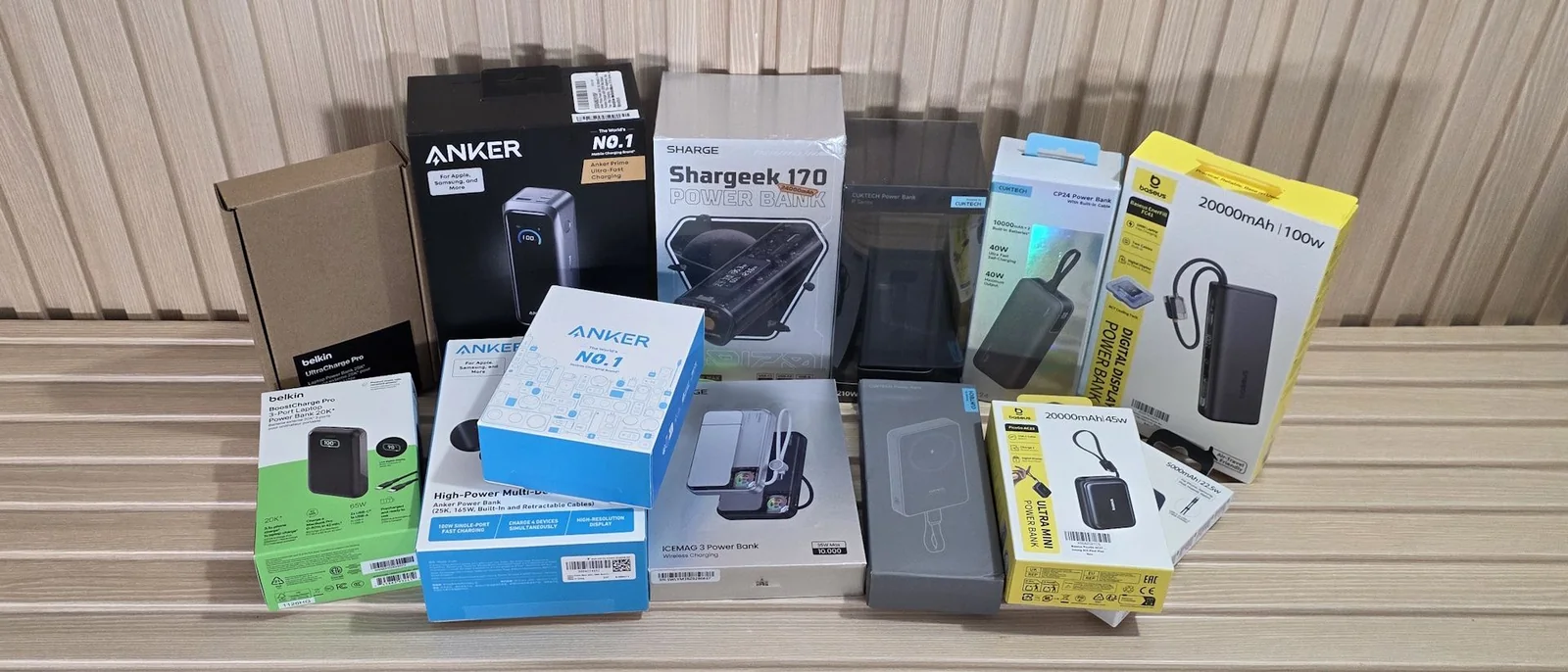
Our testing encompasses 13 power banks, ranging from slim, single-port 5,000 mAh units outputting 22W to multi-port 25,000 mAh bricks capable of delivering 220W across multiple connections. Prices range from approximately $24.99 for the Cuktech CP12 to $129.99 for the high-end Anker Prime (A110B) 20K/220W. Some include integrated USB-C cables, others provide removable cables, and some ship without auxiliary accessories.
Physical designs vary considerably, featuring advanced displays for charging and temperature metrics or simple LED indicators. Form factors range from compact grey boxes to stand-up units and transparent chassis.
Selecting the right device depends on individual requirements, budget, and design preferences. Higher output and capacity generally correlate with increased cost. Key deciding factors include port selection, travel compliance, capacity, and integrated safety mechanisms.
Key Selection Criteria
The ideal device depends entirely on the user's hardware and intended use cases. Buyers must ensure compatibility with modern charging standards such as USB Power Delivery (USB-PD) or Qualcomm Quick Charge. All models evaluated feature PD3.0 or higher.
Matching output capabilities to target devices is critical. For instance, pairing a 10K, 25W charger with a demanding laptop like the Asus Zenbook Duo is inefficient, as the laptop can draw approximately 90W at 20V under load. Conversely, that same charger easily replenishes smartphones or small tablets.
Rated capacity versus actual usable capacity is another critical factor often omitted from marketing materials. Listed specifications rely on internal battery cell ratings at 3.7V. Usable capacity fluctuates based on the charging voltage required by the connected device. Under 20V laptop charging, usable capacity can decrease to roughly 20% of the listed rating, whereas 5V charging yields closer to 60% or more.
Pass-through charging—the ability to charge the power bank while simultaneously outputting power to connected devices—is supported by most tested models. However, Belkin’s Ultracharge restricts output to 15W during simultaneous charge cycles.
Reputable brands incorporate comprehensive safety features, including overcharging, over-current, over-voltage, and over-temperature protections. Unbranded alternatives may lack these safeguards, making industry certifications like UL, CE, or CCC essential.
Testing Methodology and Equipment
Data acquisition relied on a standardized testing rig. The setup included a Satechi Chargeview 240W wall charger, an Asus Zenbook Duo, an Anker portable power station, a Chargelab Power-Z KM003C USB tester to monitor voltage, amperage, wattage, protocols, mAh, and Wh, and a TempPro TP30 IR thermometer for surface temperatures. Connections utilized certified 240W USB-C cables verified via a Bit Trade One Cable Checker2.
• USB Tester/Voltmeter/Ammeter Tester - Chargelab Power-Z KM003C ($109.99)
• USB Tester (used with multiple connections) - HDC-085C ($12.15)
• USB Cable Checker - Bit Trade One Cable Checker2 ($60.00)
• Laptop - Asus Zenbook Duo ($2,299.99)
• Charger - Satechi Chargeview 240W ($149.99)
• IR Thermometer - TempPro TP30 ($20.99)
• Wall Power Monitor - Tekcoplus TK282PLUS_US ($20.99)
• USB-C Cable (240W) - Anker 515 ($21.99)
How We Test
Initial inspections evaluated build quality, dimensions, weight, port configurations, capacity ratings, fast-charging protocols, and safety certifications.
Testing began by fully discharging each power bank. Initial chassis temperatures were logged before connecting units to the Satechi desktop charger via certified cabling and the Power-Z monitoring device. Recharging duration, maximum sustained input wattage, and peak surface temperatures were recorded.
Discharge testing utilized the Asus Zenbook Duo under a sustained real-world load of approximately 93W, running Cinebench for CPU stress and FurMark for the integrated Intel Arc B390 graphics. The test laptop features an Intel Core Ultra X9 388H processor (5.1 GHz turbo, up to 80W), dual 14-inch Lumina Pro OLED touchscreens, and a 99 Wh internal battery.
Maximum and minimum output wattage, watt-hours, and milliamp-hours were logged via the Power-Z hardware during discharge cycles alongside start and peak thermal readings.
Capacity efficiency calculations accounted for voltage-conversion losses inherent to the 3.7V internal cell architecture. Higher output voltages reduce the effective mAh capacity delivered to connected loads.
The Zenbook Duo accepts 20V and up to 93W, presenting a worst-case scenario for low-output chargers while remaining standard for high-output hardware. Smartphone charging typically occurs at lower voltages, such as 9V.
Following data collection across all units, performance metrics were compiled for comparison.
Tested Power Banks
We captured some images of all the chargers during the test below. We also included a simple chart listing all the power banks tested, along with capacity, wattage, port/count type, safety features, and the current price (at the time of publication).
Performance Results and Takeaways
Recharge times varied significantly among tested models. The Cuktech CP12 and CP24 models alongside the Baseus PicoGo AC22 required over 2.5, 4, and 6 hours respectively to reach full capacity due to lower input wattage limits. Conversely, the Anker Prime and Shargegeek 170 replenished high-capacity cells much faster, with the Shargegeek accepting nearly 140W peak input to fill its 24K mAh capacity in under an hour.
Thermal performance remained stable across all devices. Lithium batteries operate most efficiently between 20 and 30 degrees Celsius. The warmest unit tested was the Baseus PicoGo, reaching a peak chassis temperature of 43 degrees Celsius, while the Anker Prime and Anker Laptop chargers peaked at 37 degrees Celsius externally.
Safety protocols dictate that high-capacity energy storage devices should be charged in monitored environments.
During discharge testing, units like the Shargegeek 170 and Cuktech P23 maintained consistent output throughout the test cycle. Most other models reduced voltage, amperage, or wattage over time to protect battery health or mitigate thermal throttling.
Sustained output drops typically ranged between 33% and 50% of peak advertising claims after initial charging bursts.
The Baseus PicoGo stepped down from its peak output four minutes into testing, whereas the Shargegeek 170 delivered a constant 20V at 90W until total depletion. Belkin’s Ultracharge also maintained stable output over extended operation.
The Anker Nano (A1638) delivered the lowest usable laptop capacity at 1,600 mAh out of its 10K rating, stepping down to 20W after an initial 40W burst. The slim Baseus PicoGo Air achieved high actual capacity efficiency strictly due to its limited 9V output and quick step-down from 19W to 11W, making it suitable for smartphones rather than laptops. The 24K Shargegeek 170 balanced capacity and constant high-voltage delivery effectively.
Buying Recommendations
No single power bank suits every application. For phone and tablet users prioritizing capacity efficiency, the compact Baseus PicoGo Air excels by maximizing actual-versus-listed capacity at a lower 9V charging output.
For demanding laptop applications, the Shargegeek 170 and Cuktech P23 stand out by sustaining peak outputs exceeding 90W at 20V throughout discharge cycles without stepping down.
The Anker Prime offers high output, rapid charging, and cool operating temperatures, though it commands a premium price point. Users prioritizing fast recharge times for the power bank itself should avoid models like the Baseus PicoGo AC22, Cuktech CP24, and CP12, which require between 2.5 and 6 hours to recharge fully despite supporting pass-through charging.