The source reviewer found that connecting four HomePods to the brand new Apple TV 4K delivers a remarkably immersive surround sound experience, bringing spatial audio to life in a living room setup.
Design and Hardware Upgrades
Apple continues to manufacture a top-tier streaming box for home theaters, though the latest generation introduces a few notable missteps alongside its powerful new capabilities.
Surround sound across four HomePods serves as a flagship capability of the fourth-generation Apple TV 4K, retailing for $300. It is a costly streaming box—often double or quadruple the price of competing hardware—that attempts to justify its cost through a robust A19 processor, a generous 128GB of default storage, a trackable remote, and deeper AI integration. For deeply embedded Apple ecosystem users willing to splurge, it represents a solid choice. However, for everyday consumers, the added conveniences struggle to justify the steep price increase.
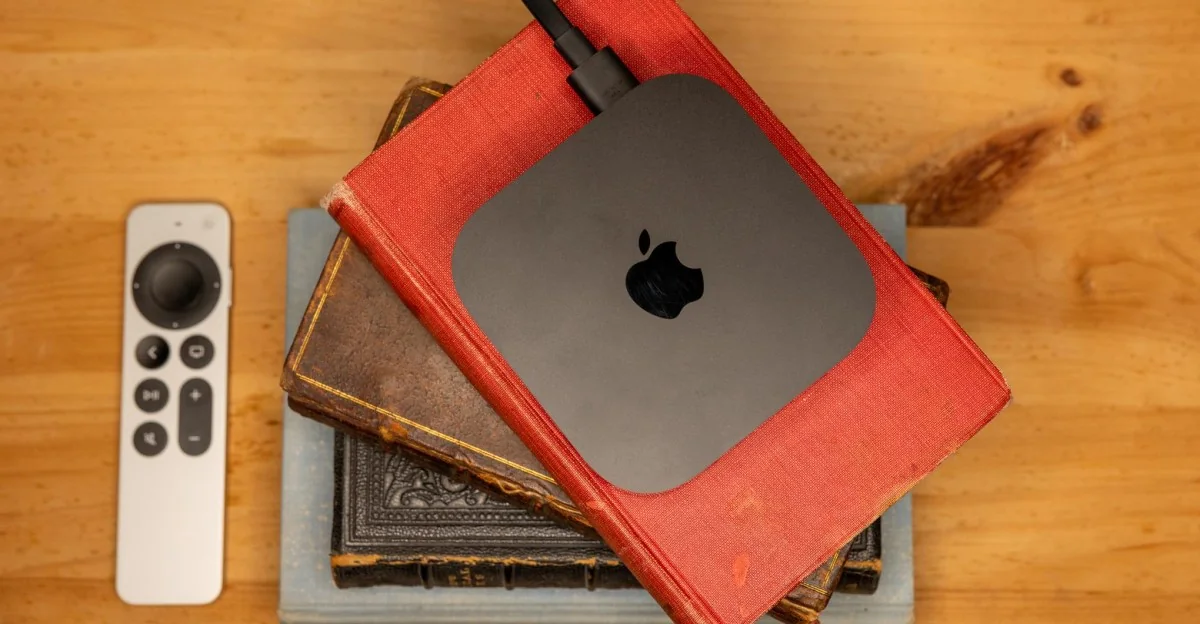
Externally, distinguishing the fourth-generation Apple TV 4K from previous iterations proves challenging. It retains the identical chassis size, finish, port layout, interface, and HDR compatibility of the 2022 model. Hardware improvements reside internally, highlighted by the powerful A19 chip adapted from the iPhone 17 and a standard 128GB storage allocation. Unfortunately, the removal of the lower-cost 64GB option means buyers lose out on a more affordable entry point.
The bundled aluminum remote remains visually identical, charging via USB-C with a touch-sensitive clickpad and side voice button. A welcome addition is the integration of the Find My feature, allowing users to pinpoint the remote via companion apps or audible pings when misplaced in furniture cushions.
Siri AI and Voice Features
Siri AI arrives on the platform to assist with personalized queries, leveraging contextual data from connected network devices like iPhones and iPads to retrieve specific show recommendations from message threads.
Despite these capabilities, Siri occasionally struggles with consistency, sometimes surfacing incorrect historical recommendations or failing to retrieve recent context when queried repeatedly.
Voice recognition can intermittently drop personal context awareness even when connected devices remain active on the local Wi-Fi network, leading to frustration during multi-topic search sessions.
Complex media requests can also be frequently misunderstood, occasionally triggering music tracks instead of live sports broadcasts, requiring manual remote navigation.
When functional, Siri AI streamlines media discovery effectively, but current performance feels akin to a beta project requiring further refinement.
Far-field microphones built directly into the streaming box allow hands-free voice activation without requiring users to hold the physical remote.
Home Theater Surround Sound Performance
Expanding beyond traditional stereo pairs, the streaming hub now supports a four-speaker HomePod configuration to deliver a much more immersive audio environment.
System calibration utilizes automated audio testing and visual screen ripples to map speaker positioning correctly within minutes.
Initial setup can present minor hurdles if primary Apple Home administrative accounts do not align smoothly with the configuring user's profile.
Operating as a cohesive unit, the multi-speaker setup delivers deep, impactful bass responses during action sequences, though it stops short of replacing a dedicated physical subwoofer.
The front-facing HomePods establish a convincing phantom center channel that anchors dialogue firmly to the visual display.
Spatial audio placement across dynamic movie scenes remains exceptional, rendering directional movement cleanly across the listening plane.
Dolby Atmos performance is less convincing regarding verticality, failing to produce a fully enveloping overhead canopy during atmospheric sound sequences.
Music mixed in Dolby Atmos benefits from supportive backup vocals in surround channels, though overhead positional elements occasionally collapse forward.
Value and Recommendations
While enhanced audio performance and privacy-focused software make the hardware compelling, the $300 price point lacks critical hardware additions like audio passthrough and 120Hz support that enthusiasts expect at this tier.
The device remains an exceptional media streamer, but the substantial cost increase complicates broad recommendations.
Building a complete four-speaker audio setup alongside the new box pushes total system costs significantly higher, positioning dedicated soundbar alternatives as viable competitors.
Apple preserves its reputation for fast performance and clean user experiences, supplemented by useful additions like Find My remote tracking and far-field microphones.
Ultimately, the premium-priced streaming box struggles to differentiate itself sufficiently from its predecessor while competing against fractionally priced alternatives.
Score breakdown
Scored out of 10Price & Release Date
Apple TV 4K (4th gen)